Securing Production Capacity for 800,000 Electric Vehicles by Year-End with Trillion-Won Sales Target
Changzhou, China · Hungary Factory
Full-scale Production Possible Starting This Year
Production Capacity Doubled
Battery Sales of 690.3 Billion KRW Last Year
Forecasted 1.8 Trillion KRW, Three Times More This Year
[Asia Economy Reporter Park So-yeon] SK Innovation, which recorded its worst performance ever in its core refining business, has taken the battery business expansion card as a strategy to overcome the crisis. It plans to secure battery production capacity capable of supplying 800,000 electric vehicles by the end of this year and achieve trillion-won level sales.
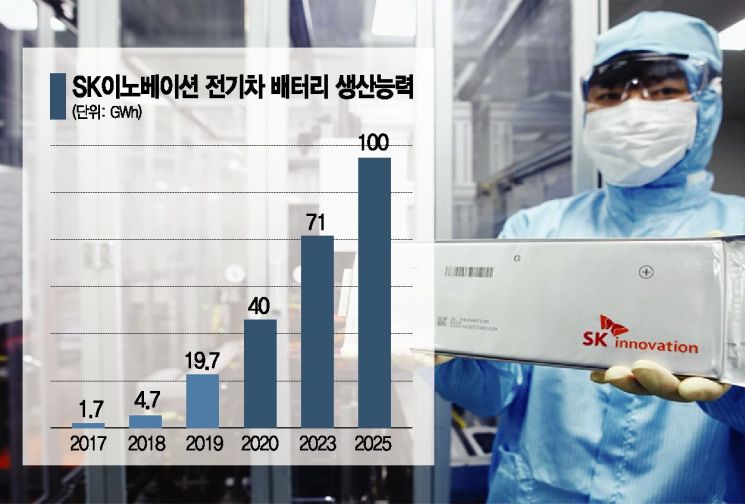
According to related industries on the 11th, SK Innovation plans to expand its current production capacity of 19.7 GWh (enough for 400,000 electric vehicles) to 40 GWh by the end of the year. This target considers the full-scale commercial production starting this year at the Changzhou factory in China and the Kom?rom factory in Hungary, both completed at the end of last year. Until 2017, SK Innovation's annual production capacity was only 1.7 GWh, so the company has expanded its production scale about 20 times in just three years.
If production capacity expands as planned, SK Innovation's battery business sales this year are expected to increase to about 1.8 trillion KRW, roughly three times last year's 690.3 billion KRW. The market estimates that SK achieved about 300 billion KRW in sales from the battery sector alone in the first quarter of this year. SK plans to strongly drive sales expansion starting from the second quarter.
SK Innovation is accelerating its battery business because it has been relatively less affected by the COVID-19 pandemic compared to the refining business. In fact, in the first quarter, SK Innovation posted a loss of 1.636 trillion KRW in its core petroleum business, turning to a deficit. However, the battery business reduced its operating loss by about 7.5 billion KRW compared to the previous quarter, narrowing the deficit.
With consecutive battery supply contracts from global automakers, the strategy to expand global production bases is also gaining momentum. SK Innovation recently decided to invest in building a second battery factory in Georgia, USA. When the Georgia 2 factory is completed in 2023, the total production capacity will reach 71 GWh (enough for 1.4 million electric vehicles), and it plans to expand to 100 GWh by 2025.
Along with securing production capacity, SK Innovation is also broadening its market base to secure customers. Recently, batteries produced at SK Innovation's Chinese battery factory 'BEST' were installed in the next-generation electric vehicle Arkfox by Beijing Automotive Group. Notably, these batteries received subsidies from the Chinese government. This is the first time since the 2016 THAAD incident that batteries made by a Korean company have been installed in a major Chinese automaker's electric vehicle and received subsidies.
Market share is also increasing. According to market research firm SNE Research, SK Innovation recorded 0.9 GWh of global electric vehicle battery usage in the first quarter of this year, ranking 7th with a 4.5% market share. After entering the top 10 for the first time last year, the company has continued to rise. Especially with the commercial production of the Changzhou factory in China and the Kom?rom factory in Hungary completed last year, SK Innovation is now close to entering the global top 5. The combined annual production capacity of the two factories is 15 GWh. Samsung SDI, ranked 4th, recorded 1.1 GWh of battery usage in the first quarter, only 0.2 GWh more than SK Innovation.
An SK Innovation official said, "If the battery business continues to grow at this pace, it is expected to quickly establish itself as a triangular alliance along with the existing core businesses of refining, chemicals, and materials," adding, "Considering the characteristics of manufacturing where profits are generated only after reaching a certain scale, profit generation from securing battery production capacity is not far off."
© The Asia Business Daily(www.asiae.co.kr). All rights reserved.

















