A Complete Collection of Calligraphy by 1,136 Notable Figures from Late Goryeo to Modern Era on the Korean Peninsula
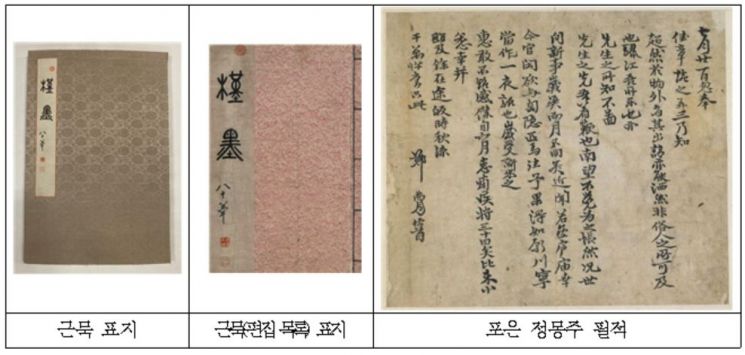
[Asia Economy Reporter Jo In-kyung] On the 11th, the Seoul Metropolitan Government announced that it will apply for the designation of 'Geunmuk (槿墨)', the largest collection of calligraphy by 1,136 famous figures in Korean history, as a national cultural heritage.
Geunmuk is held by the Sungkyunkwan University Museum and consists of a total of 34 albums of calligraphy and one catalog book. The silk cover bears the seal script characters '槿墨' and '八十葦 (Palsipwi)', along with the seal of Wichang Oh Se-chang (吳世昌), also known as Wichang Hanmuk (葦蒼翰墨), indicating that the album was compiled in 1943 when he was 80 years old.
From Po-eun Jeong Mong-ju to the modern calligrapher Lee Do-young (李道榮), excluding Admiral Yi Sun-sin, the collection includes semi-cursive, cursive, regular, seal, and clerical scripts of famous figures from the late Goryeo period to the modern era of the Korean Peninsula, preserved in letters and poems without omission.
Through this, we can glimpse the social conditions and lifestyles of various classes during the Joseon Dynasty, including kings, aristocrats, middle-class officials, slaves, and monks, as well as the patriotic loyalty of figures who showed exceptional integrity during the Japanese colonial period. This book also serves as a biographical dictionary of figures spanning over 600 years on the Korean Peninsula, providing important information to researchers in various fields.
Oh Se-chang was one of the 33 national representatives of the March 1st Movement during the Japanese colonial period, an enlightenment activist, and a lover of literature and arts. Alongside Kansong Jeon Hyeong-pil (全鎣弼), he was a leading figure who protected Korean cultural heritage during the colonial era. This book, which fully embodies Oh Se-chang’s beliefs, spirit, and discerning eye, is also a precious volume in the history of Korean calligraphy.
Not only Geunmuk but also many cultural assets collected and produced by Oh Se-chang and his family have emerged one by one whenever Oh Se-chang faced financial difficulties during the three years of imprisonment following the March 1st Movement, yet none have been designated or registered as cultural heritage to date.
The Seoul Cultural Heritage Committee reportedly engaged in long discussions and reviews regarding the value and application direction of Geunmuk as a national cultural heritage, especially since some works lack comparable originals making authenticity judgments difficult, and considering the compilation year of 1943. Nevertheless, they concluded that Geunmuk, which encompasses the largest number of calligraphies by famous figures in Korea, holds sufficient value as a national cultural heritage and should be continuously preserved and managed for future generations.
A Seoul city official stated, "Starting with Geunmuk, we hope that many cultural assets embodying the noble will and upright spirit of Wichang Oh Se-chang will be designated as national or local cultural heritage, so that their value can be widely recognized."
© The Asia Business Daily(www.asiae.co.kr). All rights reserved.

















