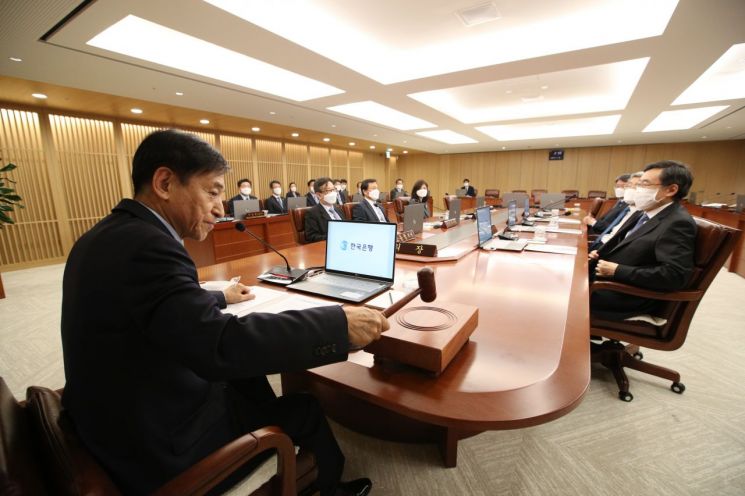
[Asia Economy Reporter Eunbyeol Kim] The Bank of Korea's Monetary Policy Committee is scheduled to hold a monetary policy meeting on the 28th, drawing attention to whether it will further lower the base interest rate, currently at 0.75% per annum. The Bank of Korea significantly cut the base rate to a record low level last March.
In the financial market, there is speculation that the Bank of Korea may lower the rate by an additional 0.25 percentage points to 0.5% per annum at this meeting, but the consensus leans toward it being difficult to cut rates this month. Since the rate has already been adjusted to the lowest level, some expect the Bank to conserve ammunition and only cut rates after the third quarter.
Global investment bank JP Morgan forecasted that the Bank of Korea will lower the base rate twice by a total of 0.5 percentage points by the first quarter of next year.
JP Morgan estimated, "The Bank of Korea is expected to cut the base rate by 0.25 percentage points in the third quarter of this year to mitigate the impact of COVID-19, and then cut it again by 0.25 percentage points in the first quarter of next year."
They added, "The Bank's policy focus is likely to tilt toward addressing deflation concerns rather than maintaining the base rate above the effective lower bound with a buffer."
However, JP Morgan noted that some Monetary Policy Committee members mentioned at the last meeting that policy leeway should be used cautiously, and considering that new members appear to be more hawkish (favoring monetary tightening) than their predecessors, the timing of a rate cut could be somewhat uncertain.
Since this is the first Monetary Policy Committee meeting deciding the base rate after the replacement of members, there are also opinions that it would be burdensome to lower the rate immediately.
Nevertheless, the securities industry still holds expectations that the Bank of Korea may cut the base rate this month. Most countries have lowered their rates to the lowest levels, so there is little burden in cutting the base rate. The ongoing real economy recession crisis in the US and Europe is also a rationale for experts expecting a rate cut.
Seungwon Kang, a researcher at NH Investment & Securities, said, "The real economy recession crisis in the US is ongoing, and there is additional funding capacity of $2 trillion, so it is expected that additional policies related to employment will be reinforced in May," adding, "The Bank of Korea is also likely to take a more proactive stance."
He continued, "Currently, Korea's interest-bearing debt is at around 3,600 trillion won, and the scale of interest-bearing debt is expected to expand due to additional issuance of government bonds and fund bonds," adding, "The effect of a rate cut is further amplified, so an additional rate cut at the May Monetary Policy Committee meeting is expected."
Furthermore, Kang said, "The government's supplementary budget and large-scale issuance of fund bonds in April confirmed a rise in rates due to supply-demand burdens," adding, "This is a condition for the active government bond purchases mentioned by the Bank of Korea governor at the April Monetary Policy Committee, so an active government bond purchase signal is expected at the May meeting."
© The Asia Business Daily(www.asiae.co.kr). All rights reserved.

















