European Economic Policy Research Center and National Bureau of Economic Research, Introduction to Related Studies
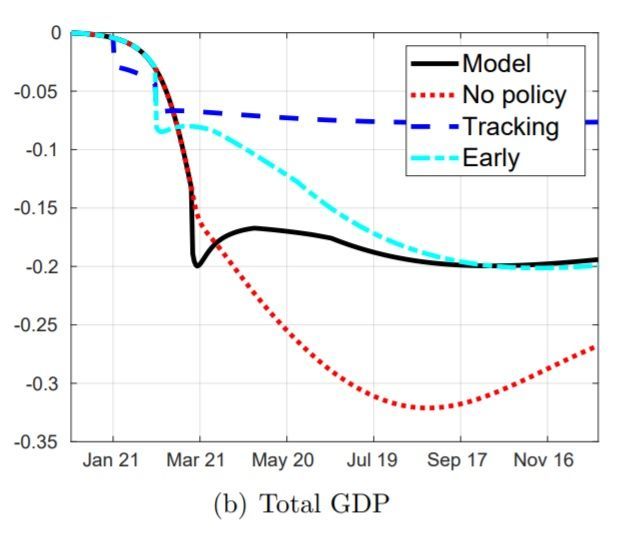 ▲When the Korean-style quarantine is implemented (blue dotted line), the economic shock in the UK is reduced to one-third of the level during the lockdown measures (black solid line). (Source: NBER Working Paper 27100, authored by Professors Eom Sang-min, Lee Sang-yoon, and Shin Yong-seok)
[Asia Economy Reporter Kim Eunbyeol] An analysis has emerged suggesting that if the United Kingdom, struggling with the novel coronavirus infection (COVID-19), had adopted South Korea's quarantine model, the decline in economic growth rate could have been reduced to about one-third. Despite the UK's abrupt lockdown measures, the number of COVID-19 deaths exceeded 30,000, surpassing Italy's death toll. This year, the gross domestic product (GDP) is also expected to shrink by around 20%.
On the 7th (local time), the Centre for Economic Policy Research (CEPR) published a study titled "Inequality of Fear and Voluntary Quarantine: Are GDP and Public Health in a Trade-off Relationship?" co-authored by Professor Eom Sangmin of Myongji University's Department of Economics, in its "Economics of COVID-19" issue report. Since last month, CEPR has been introducing noteworthy research related to COVID-19. The US National Bureau of Economic Research (NBER) also featured the same study on its website on the 4th.
The report stated, "After modeling the current situation in the UK and applying South Korea's quarantine measures, the GDP, which was expected to decline by 20%, was found to be mitigated to about -7%." It explained that South Korea's COVID-19 measures, based on testing and tracing rather than full lockdown, can alleviate economic shocks more effectively. The report added, "Some argue that the UK's economic shock was large due to delayed lockdown decisions, but even if the lockdown had been imposed earlier, the number of confirmed cases and growth rate (about -20%) around September would not have changed."
What if South Korea had implemented a full lockdown like the UK? The short-term GDP shock was expected to be about 2 percentage points larger. Although growth might briefly rebound after lifting lockdown measures, long-term economic recovery was estimated to be slower.
Professor Eom explained in a phone interview with Asia Economy, "Government-led lockdowns only prevent going to schools or workplaces but cannot stop general activities like shopping at supermarkets or taking walks, which poses a risk of increasing asymptomatic infections." He added, "This shows that tracking confirmed cases' movements and increasing COVID-19 testing, as done in South Korea, benefits not only quarantine efforts but also the economy in the long run."
Meanwhile, Professor Eom noted that the study also revealed that self-employed and low-skilled workers suffer greater economic damage during infectious disease outbreaks, as many cannot work from home compared to professionals. He said, "Government economic policies should actively support low-skilled industry workers, and increasing antibody testing for them also helps alleviate inequality." The study was jointly conducted by Professor Eom, Professor Shin Yongseok of Washington University in St. Louis, and Professor Lee Sangyun of Queen Mary University of London.
© The Asia Business Daily(www.asiae.co.kr). All rights reserved.

















