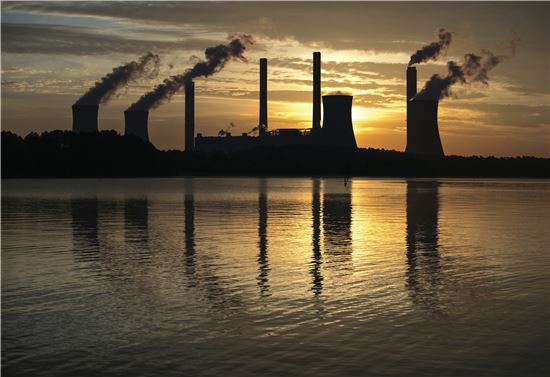
 (Photo by AP Yonhap News)
[Asia Economy Reporters Kim Bo-kyung and Moon Chae-seok] The government's advisory body on power supply and demand announced a plan to retire 30 out of the current 60 coal-fired power plants by 2034, effectively halving the number. Along with a bold reduction in coal power, this is expected to accelerate the transition to eco-friendly power generation such as liquefied natural gas (LNG) and renewable energy.
The General Subcommittee, an advisory body for establishing the Basic Plan for Power Supply and Demand, held a briefing on the main discussion results of the 9th Basic Plan for Power Supply and Demand expert working group on the 8th at COEX in Samseong-dong, Seoul, and announced this plan. The Basic Plan for Power Supply and Demand is a mid- to long-term government energy policy direction established and implemented every two years to ensure stable power supply.
The 9th Basic Plan for Power Supply and Demand includes forecasts of power supply and demand, power demand management, and power generation facility plans over 15 years from 2020 to 2034. The content announced on this day is a draft of the 9th plan, publicly disclosed for the first time ahead of the Ministry of Environment's Strategic Environmental Impact Assessment procedure, and is not the government's final decision.
The core of the 9th plan is a bold coal phase-out policy. Yoo Seung-hoon, chairman of the General Subcommittee, stated, "Based on stable power supply, we reviewed accelerating the transition to eco-friendly power generation, including a more aggressive reduction of coal power." The plan is to retire all aging coal-fired power plants over 30 years old among the current 60 coal power plants. As a result, by 2034, 30 out of the current 60 coal power plants (15.3GW) will be retired. Among the retired plants, 24 units (12.7GW) are planned to be converted to LNG power generation.
Thus, coal facility capacity will decrease from 34.7GW this year to 29.0GW in 2034, while LNG facility capacity will increase from 41.3GW to 60.6GW during the same period.
The gradual reduction of nuclear power and the expansion of renewable energy will be maintained. Nuclear power will peak at 26 units (27.3GW) in 2024 and then gradually decrease to 17 units (19.4GW) by 2034. Renewable energy plans to expand new facilities by 62.3GW by 2034. Accordingly, nuclear power facility capacity is expected to decrease from 24.7GW in 2020 to 19.4GW in 2034, while renewable energy facility capacity is expected to increase from 19.3GW to 78.1GW.
If this plan is implemented, the share of nuclear and coal facilities will be nearly halved from 46.3% to 24.8% of the total, while renewable energy will significantly expand from 15.1% to 40.0%. The total facility capacity in 2034 is projected to be 122.4GW. To maintain a standard reserve margin of 22% for emergencies and other situations, a total of 127.1GW of facilities will ultimately be required. The shortfall of 4.7GW will be supplemented through new power generation facilities such as LNG and pumped-storage power plants.
© The Asia Business Daily(www.asiae.co.kr). All rights reserved.
















