KIEP Hosts Seminar on "Three Years of Moon Jae-in Government's Foreign Economic Policy Achievements and Challenges"
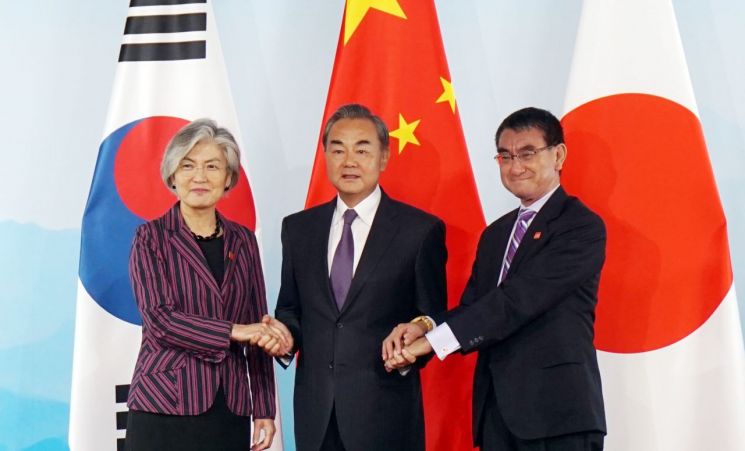 The photo shows Foreign Minister Kang Kyung-wha, Chinese State Councilor and Foreign Minister Wang Yi, and Japanese Foreign Minister Taro Kono posing for a commemorative photo at the 9th Korea-China-Japan Foreign Ministers' Meeting on August 21 last year. (Photo by Beijing Correspondent Joint Coverage Team) [Image source=Yonhap News]
[Asia Economy Reporter Moon Chaeseok] "As the spread of the novel coronavirus infection (COVID-19) continues alongside concerns over the ongoing US-China trade dispute, it is necessary to manage the Korea-China-Japan regional supply chain stably."
At the seminar titled "Three Years of Moon Jae-in Government's Foreign Economic Policy Achievements and Challenges," held on the 7th at the Korea Chamber of Commerce and Industry's Members' Meeting Room in Seoul by the Korea Institute for International Economic Policy (KIEP), there was a call to meticulously devise a global value chain (GVC) restructuring strategy given the overlapping situations of COVID-19 and the US-China trade dispute.
In the keynote speech titled "Korea's Trade Policy and the Trade Environment after COVID-19," Ahn Deok-geun, President of the International Trade Association, said, "We need to increase adaptability to new trade norms such as the spread of the United States-Mexico-Canada Agreement (USMCA) regulations, which will take effect from July 1, and attempts to reorganize multilateral trade norms," adding, "Since there is concern that the US-China trade dispute will continue, it is necessary to manage the Korea-China-Japan regional supply chain stably."
There was also a forecast that COVID-19 will have a long-term impact on major key industries. Jang Yoon-jong, President of POSCO Research Institute, diagnosed, "COVID-19 will have a negative impact on exports of automobiles, shipbuilding, general machinery, steel, petrochemicals, refining, textiles, and displays in the long term."
President Jang also presented "Five Major Directions of Industrial Structure Change in the Post-COVID-19 Era." The five directions are ▲ full-scale growth of online service industries ▲ expansion of servitization in manufacturing ▲ strengthening of B2B (business-to-business) manufacturing ▲ digital transformation of all industries ▲ development of new industries leading the Fourth Industrial Revolution.
He explained that establishing an "innovative industrial ecosystem" to lead structural changes is crucial for success, and that large corporations should hold the key and lead small and venture companies.
There was also an expert who predicted that the global economic growth rate will remain in the 2% range for the next two to three years.
Kim Young-min, President of LG Economic Research Institute, foresaw that structural changes seen after the 2008 global financial crisis will proceed at a much faster pace due to mid-term factors such as strengthened government roles, retreat of globalization, and rapid progress of non-face-to-face interactions. He expected acceleration in shifts from 'market to government,' 'globalization to regionalization,' 'face-to-face to non-face-to-face,' and '(Fourth Industrial Revolution, etc.) demonstration and pilot to full-scale diffusion.'
President Kim said, "The focus of economic policy should be on helping households, self-employed businesses, and companies that have suffered economic damage from the COVID-19 shock to endure until the situation stabilizes, so that important economic hardware is not damaged," and urged, "Since the paradigm shift in consumption markets, industrial structures, and trade will accelerate globally after the crisis, active regulatory reform and support for new businesses are necessary."
This year, there was also a diagnosis that many factors are weighing down "Export Korea," such as COVID-19, the US presidential election, Brexit trade negotiations, and intensified US-China strategic competition.
Jung Cheol, Acting President of KIEP, emphasized in his opening remarks, "In the post-COVID era, due to developments in digital technology, the spread of unilateralism, restrictions on human and material movement, and changes in global value chains, the global industrial structure and trade environment are likely to be reorganized in a form very different from before COVID-19," adding, "Proactive responses using new trade policies and New Southern and New Northern policies are important."
Kwon Gu-hoon, Chairman of the Northern Economic Cooperation Committee, said in his welcoming remarks, "The COVID-19 crisis will act as a catalyst for multipolarization of the world economy, which has been dominated by the US and China," and suggested, "Korea should seek new growth engines through cooperation with New Northern and New Southern countries and attempt to leap forward as a regional economic hub."
Chairman Kwon added, "Especially if the vision for the joint railway network, the Korea-China international cooperation pilot zone project, and the launch of the Korea-Russia investment fund bear fruit, it will be possible to respond to GVC restructuring in the post-COVID era and establish a foundation for cooperation in the Northeast Asia region."
Lee Jae-min, Vice Chairman of the National Economic Advisory Council, predicted in his congratulatory remarks that the COVID-19 crisis will bring about the spread of nationalism, changes in GVCs, and industrial structural changes.
Vice Chairman Lee called for ▲ restoration of the free trade order through active international cooperation ▲ diversification of economic cooperation through acceleration of New Southern and New Northern policies ▲ enhancement of Korea's international status as an opportunity to overcome the COVID crisis ▲ securing new competitiveness by utilizing IT capabilities and advanced health systems.
© The Asia Business Daily(www.asiae.co.kr). All rights reserved.
![From Bar Hostess to Organ Seller to High Society... The Grotesque Con of a "Human Counterfeit" [Slate]](https://cwcontent.asiae.co.kr/asiaresize/183/2026021902243444107_1771435474.jpg)
















