"Safer than Lithium-Ion Secondary Batteries... Cost is About Half"
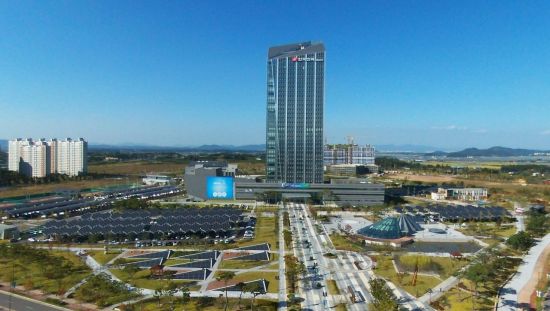
[Asia Economy Reporter Moon Chaeseok] Korea Electric Power Corporation (KEPCO) announced on the 7th that it has developed the nation's first next-generation secondary battery that is safer than lithium-ion batteries and costs about half the price. KEPCO expects that thanks to this next-generation secondary battery, the construction cost of energy storage systems (ESS) can be reduced.
According to KEPCO, the electrolyte used in conventional lithium-ion batteries (mainly a liquid substance that serves as the lithium-ion transport medium between the cathode and anode of the secondary battery) is a flammable organic material prone to catching fire, raising concerns about accidents such as fires. Lithium is found only in certain regions of South America, such as Bolivia and Chile, leading to unstable raw material supply and price increase risks. This has resulted in higher initial installation costs for energy storage systems (ESS).
KEPCO began research in 2017 and this month succeeded in developing the nation's first 20Ah-class next-generation secondary battery using manganese (Mn) instead of lithium. 20Ah means it can supply 20A current for one hour. First, the cathode material of the lithium-ion battery was replaced from lithium to manganese to reduce costs. Manganese is the 12th most abundant element on Earth. Additionally, a non-flammable aqueous electrolyte was used to enhance safety.
KEPCO expects the price of the next-generation secondary battery to be only half that of existing lithium-ion batteries while offering higher safety, which will reduce the burden on domestic companies in the future. It is estimated that replacing the lithium-ion batteries currently used for ESS in Korea with the next-generation secondary battery will save a total of 250 billion KRW.
A KEPCO Power Research Institute official said, "Large-capacity ESS construction is essential for the expansion of renewable energy sources such as solar and wind power, which are affected by weather," adding, "KEPCO's next-generation secondary battery can reduce ESS construction costs to about half, which will greatly help expand renewable energy through the activation of ESS in Korea."
© The Asia Business Daily(www.asiae.co.kr). All rights reserved.
![Clutching a Stolen Dior Bag, Saying "I Hate Being Poor but Real"... The Grotesque Con of a "Human Knockoff" [Slate]](https://cwcontent.asiae.co.kr/asiaresize/183/2026021902243444107_1771435474.jpg)










