Kim Doo-kwan "Revision of the Min-sik Law Needed... Turning School Zones into Life Zones"
Late Kim Min-sik's Parents "The Law is for the National Assembly... Please Stop the Criticism"
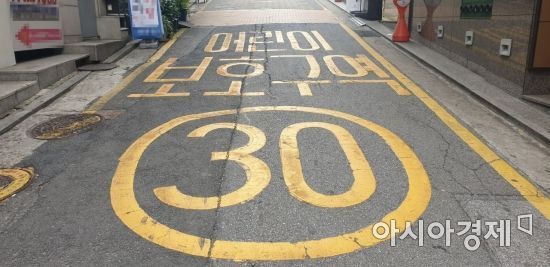 A child protection zone in front of an elementary school in Jung-gu, Seoul. / Photo by Heo Midam damdam@asiae.co.kr
[Asia Economy Reporter Heo Midam] As controversy over excessive punishment under the Minsik Law continues, voices calling for legislative revision are emerging in the political sphere. Originally, the Minsik Law was enacted to prevent child traffic accidents. However, there have been ongoing criticisms that the law has many issues because it is difficult for drivers to respond when children suddenly run out onto the road, and they can face aggravated punishment under the Minsik Law.
On the 5th, Kim Doo-kwan, a member of the Democratic Party of Korea, demanded a revision of the Minsik Law, proposing a Green New Deal to transform school zones into life zones (Children’s Life Zones).
In a post on his Facebook on the same day, Representative Kim emphasized, "I hope the Minsik Law will be revised not to ease punishment for offenders but to completely transform all child protection zones nationwide into Children’s Life Zones that protect not only traffic safety but also children’s health."
He continued, "Traffic safety is important. But it should become a culture, not just enforcement," and proposed, "We should also equip advanced traffic systems that immediately alert drivers to children approaching from unseen areas."
The Minsik Law mandates the installation of safety devices such as traffic lights and surveillance cameras within school zones and includes provisions for aggravated punishment of drivers who cause injury or death to children. The bill was proposed following a traffic accident at a crosswalk in front of an elementary school in Asan City, Chungnam Province, last September, in which the late Kim Minsik lost his life.
Concerns about excessive punishment were also raised when the Minsik Law was passed on December 10 last year. Kang Hyo-sang, a member of the United Future Party who was the only one to vote against the bill, argued that the statutory penalties were excessive.
He emphasized on his Facebook, "The negligence causing death by traffic accident should not have penalties similar to or higher than those for serious crimes such as drunk driving causing death or robbery, which are akin to murder."
He added, "While the duty of care in school zones cannot be overemphasized, distinguishing between intentional and negligent offenders is a principle of modern criminal law." Kang supported the amendment to the Road Traffic Act within the Minsik Law but opposed the amendment to the Act on Aggravated Punishment of Specific Crimes.
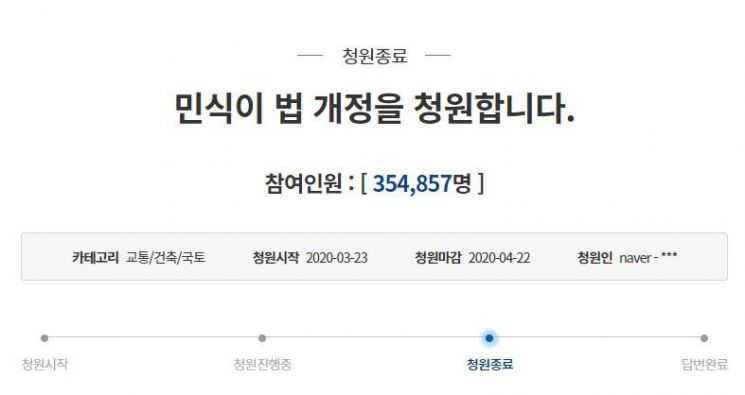
Meanwhile, as the Minsik Law was enacted, calls for its revision have grown louder among drivers. While agreeing with the legislative intent, they argue that the level of punishment is excessively harsh compared to other penalty provisions.
A Blue House petition requesting revision of the Minsik Law has garnered 354,857 signatures. The petitioner stated, "It is unfair to place all responsibility on drivers even when they could not avoid accidents involving children in child protection zones," and lamented, "Drivers are being held liable for negligence because 'children naturally exhibit many sudden behaviors.' As a result, comments like 'Just block cars from entering child protection zones,' and 'Is there no navigation system that avoids child protection zones?' are emerging."
They pointed out, "This effectively makes all drivers potential offenders of the crime and causes extreme tension and stress for drivers passing through child protection zones, making it one of the worst laws."
As criticism surrounding the Minsik Law grows, the parents of Kim Minsik also stated that if there are issues with the law, it needs to be supplemented. In an interview with CBS No Cut News on the 28th of last month, they said, "We do not view it negatively if parts of the Minsik Law are revised or supplemented to become a perfect law."
They added, "The purpose was to raise drivers’ awareness, and we did not decide on the details," emphasizing, "It was discussed and passed by the National Assembly, so we have little to say about that part."
They said, "The Minsik Law is not a law for retaliation," and expressed understanding of drivers’ concerns and confusion. "If there is room for misunderstanding, we hope the government will clarify it, and we ask those who have moved beyond misunderstandings not to attack us anymore."
They lamented, "The law was proposed and amended by the National Assembly. It would be unfair to say that we made the law," and added, "We are being targeted with criticism. The law was made to protect children, but sometimes we wonder if we should have stepped forward at all."
© The Asia Business Daily(www.asiae.co.kr). All rights reserved.


















