Maintaining Real Estate Policy Direction with Victory in General Election
Gangnam Turmoil Amid Land Public Concept Constitutional Amendment Debate
Decline Accelerates Due to COVID-19 and Government Regulations...
[Asia Economy Reporter Moon Jiwon] "If they are even talking about the public concept of land, doesn't that mean the government is putting everything on the line for housing prices?" (An official from a real estate agency in Seocho-dong, Seoul) "It seems the market won't be able to beat the government anytime soon." (Chairman of a construction organization)
The 'Gangnam invincibility myth' in the real estate market is shaking. The strong real estate regulation policies of the Moon Jae-in administration combined with the economic downturn caused by the spread of the novel coronavirus disease (COVID-19) are accelerating the decline in housing prices in Gangnam. Especially, following the ruling party's landslide victory in the recent general election, there is a growing atmosphere discussing the possibility of introducing the 'public concept of land' through constitutional amendment. The market is anticipating that the Gangnam real estate market may face unprecedented government policies.
According to the real estate industry on the 4th, recent trends in the real estate market show warning signs of a housing market downturn in various places. Urgent sale properties priced several hundred million won lower than the peak price are appearing in Gangnam redevelopment complexes that led last year's price surge. The Eonma Apartment in Daechi-dong, considered the flagship redevelopment complex in Gangnam, with an exclusive area of 84.43㎡, was traded at 1.95 billion won on the 6th of last month, falling into the 1.9 billion won range for the first time since October last year. Considering that the price of this property exceeded 2.3 billion won in December last year, it dropped about 100 million won per month.
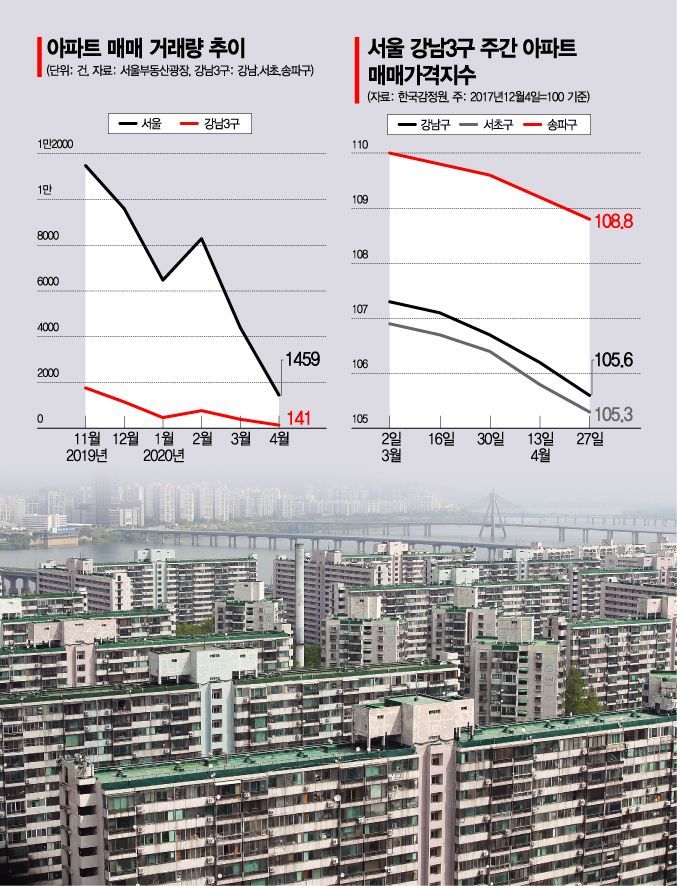
The situation is similar in other Gangnam redevelopment complexes such as Jamsil Jugong 5 Complex in Songpa-gu and Gaepo Jugong 1 Complex in Gangnam-gu. According to Real Estate 114, apartment prices in the three Gangnam districts (Gangnam, Seocho, Songpa) fell by 0.63% last month, marking the largest monthly decline in eight years since November 2012. According to the Korea Appraisal Board, a government-certified price survey institution, apartment prices in Gangnam-gu turned negative starting February.
More worrisome is the contraction in transaction volume. According to provisional data from the Seoul Real Estate Information Plaza, apartment sales transactions in Gangnam-gu dropped sharply from 377 in December last year to 60 last month. Seocho-gu decreased from 309 to 33, and Songpa-gu from 468 to 48 during the same period.
The freezing of the Gangnam housing market is directly caused by the significant tightening of loan regulations on high-priced homes under the December 16 real estate measures last year, combined with the economic contraction due to COVID-19. This is a completely different situation from past infectious disease outbreaks such as SARS (Severe Acute Respiratory Syndrome) or MERS (Middle East Respiratory Syndrome), during which Seoul apartment prices rose. Most market experts are already unanimously predicting a 'major downward trend' in housing prices.
Notably, there is a growing trend among Gangnam asset owners to divest from real estate. Field insiders say that asset owners are showing signs of selling their properties due to the historically strong market suppression measures surpassing even those of the Roh Moo-hyun administration. Over the past three years since the Moon Jae-in administration took office, the government has not only revived regulations targeting Gangnam such as the price ceiling system, the redevelopment excess profit recovery system, increased official property prices, strengthened holding taxes, and loan restrictions, but also, following the 21st general election, ruling party figures have been actively raising the need for constitutional amendments to introduce the public concept of land.
The public concept of land means "in cases necessary for the public nature of land, special restrictions or obligations can be imposed." If realized, the economic perspective on real estate would inevitably change 180 degrees. In fact, on the 2nd, Lee In-young, floor leader of the Democratic Party of Korea, ignited discussions on the public concept of land in an interview with this publication, stating, "We need to approach real estate not as a means of wealth accumulation but from the perspective of housing and welfare." Subsequently, ruling party figures such as Song Young-gil and newly elected lawmaker Lee Yong-seon, a former Blue House secretary, have also raised the need to discuss constitutional amendments to introduce the public concept of land.
Ahn Myung-sook, head of the Real Estate Investment Support Center at Woori Bank, analyzed, "If the public concept of land is established and the redevelopment excess profit recovery system is enforced more strongly, demand from wealthy people to buy homes in Gangnam will inevitably decrease." She added, "Although specific discussions on the public concept of land have not yet taken place, just mentioning it can psychologically shrink the Gangnam housing market."
However, there are also opinions that housing prices in Seoul, including Gangnam, will inevitably rebound in the long term. Shim Kyo-eon, professor of real estate at Konkuk University, said, "If the public concept of land is realized, there will be tremendous regulations such as development profit recovery, which will severely impact the real estate market," but added, "Since demand for Gangnam real estate in Seoul is very high, I believe prices will rise in the long term."
© The Asia Business Daily(www.asiae.co.kr). All rights reserved.
![User Who Sold Erroneously Deposited Bitcoins to Repay Debt and Fund Entertainment... What Did the Supreme Court Decide in 2021? [Legal Issue Check]](https://cwcontent.asiae.co.kr/asiaresize/183/2026020910431234020_1770601391.png)















