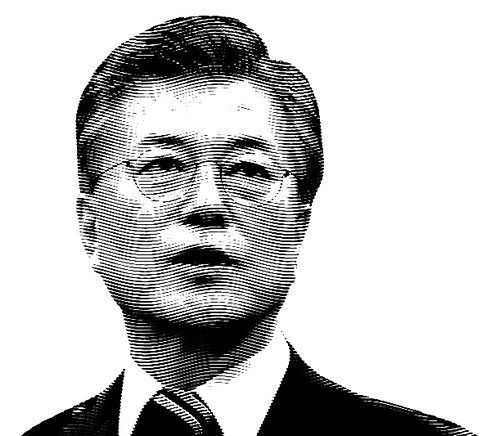
[Asia Economy, Reporter Ryu Jungmin, Reporter Son Sunhee] As the Moon Jaein administration approaches its third anniversary, it is adjusting the blueprint for its national agenda, setting "overcoming the economic crisis" as its top priority to prepare for the "post-coronavirus" era.
President Moon Jaein will mark the third anniversary of his inauguration on May 10. The Blue House plans to conduct an interim review of the "100 Major National Tasks" that were presented at the time of his inauguration on May 10, 2017. Taking into account the social changes brought about by the COVID-19 pandemic, the administration is reviewing its overall national agenda.
The reason President Moon is emphasizing the "post-coronavirus" era in his fourth year in office is because the impact on the economy as a whole is beyond imagination. The global economy is facing such significant variables that some say the basic order of the world economy will be divided into pre- and post-COVID-19 eras. When President Moon stated at the Cabinet meeting on April 28, "From now on, we are entering a full-fledged economic crisis," it was not an exaggeration. In reality, COVID-19 is emerging as a negative factor across various areas, including economic indicators, the real economy, and the real estate market. In particular, the shockwaves are expected to intensify from the second quarter, as the COVID-19 crisis has spread to countries around the world.
A Blue House official explained, "The situation before and after the COVID-19 crisis is completely different," and added, "There is a need to redefine those national tasks that are not urgent under the current circumstances, compared to when the administration was launched."
It is noteworthy that the COVID-19 crisis could also serve as a turning point. Based on the international community's trust in Korea as a "model case for COVID-19 response," Korea could become a beneficiary in the post-coronavirus era. President Moon has also emphasized, "Since our country did not have to close any businesses due to lockdowns or movement restrictions thanks to successful quarantine measures, Korea is becoming the safest production base. This is an opportunity for us."
In this regard, the government is promoting the expansion of the "untact" (non-face-to-face) industry based on Fourth Industrial Revolution technologies. This includes telemedicine and remote education, and legislative reforms for regulatory innovation in these areas are expected to gain momentum. In addition, with initiatives such as the "Korean New Deal" and large-scale national projects emphasized by President Moon, the government is expected to make every effort to protect jobs.
The Moon Jaein administration has faced difficulties in pushing forward its national agenda due to the political landscape of the 20th National Assembly, where the ruling party was outnumbered by the opposition. Key issues such as prosecutorial reform and eradicating deep-rooted corruption, which were central themes at the start of the administration, remain unfinished. As President Moon begins his fourth year in office on May 10, he will focus on addressing these pending national tasks, but the core keyword in the post-coronavirus era, regardless of what anyone says, will be the economy. Tasks such as eradicating deep-rooted corruption, anti-corruption reforms, and resolving historical issues, which were presented as the top national tasks at the start of the administration, are likely to be pushed down the list of priorities. While the eradication of deep-rooted corruption will not be halted, the focus of state affairs may shift to reflect President Moon's perception of the current situation as an "economic wartime situation." However, it is worth noting that political events symbolizing the eradication of deep-rooted corruption, such as the appointment of the first head of the Corruption Investigation Office for High-ranking Officials (CIO), still remain.
A key Blue House official stated, "Just as the Korean-style K-quarantine system has attracted global attention, we must also turn the crisis into an opportunity in the economic sector," and added, "'Eradicating deep-rooted corruption,' which was a national task at the time of the administration's launch, was not aimed at specific individuals but rather at institutional problems, and it cannot be said to be a top priority in the current situation of overcoming the COVID-19 economic crisis."
© The Asia Business Daily(www.asiae.co.kr). All rights reserved.
![Clutching a Stolen Dior Bag, Saying "I Hate Being Poor but Real"... The Grotesque Con of a "Human Knockoff" [Slate]](https://cwcontent.asiae.co.kr/asiaresize/183/2026021902243444107_1771435474.jpg)
















