Proposal to Temporarily Increase Refund Rate from 10% to 20% in First Half of Year
Include Clothing Care Devices, Dryers, Cordless Vacuum Cleaners, and Dishwashers as Refundable Items
Government: "Refund Program Contributes to Revitalizing Domestic Consumption Affected by COVID-19"
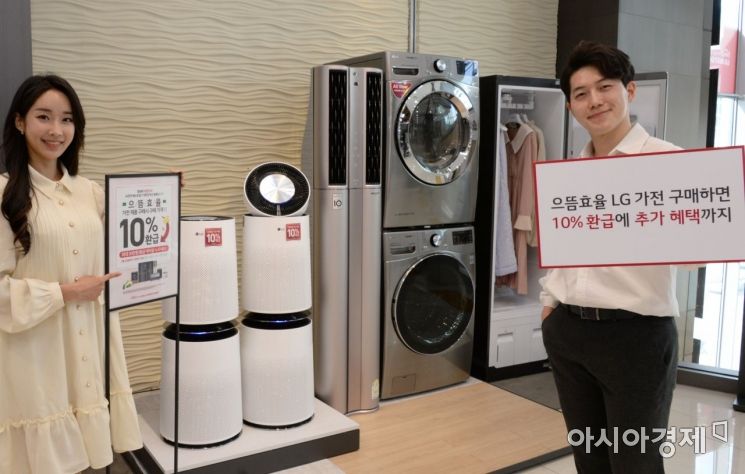
[Asia Economy Reporter Moon Chaeseok] The energy efficiency grade 1 home appliance rebate program has attracted applications worth 19.7 billion KRW within one month of its launch. Considering that the program’s goal is to stimulate domestic demand weakened by the novel coronavirus disease (COVID-19), there are suggestions to boldly raise the rebate rate, expand the rebate eligibility (energy efficiency) and product categories to accelerate the pace.
The Ministry of Trade, Industry and Energy announced on the 26th that it had used up 13% of the total budget, amounting to 19.7 billion KRW, during the first month of the "2020 Top Efficiency Home Appliance Purchase Cost Rebate Program." From the program’s launch on the 23rd of last month until the 22nd of this month, 176,258 rebate applications were received.
Although the pace is similar to last year’s early termination of the program after exhausting a 24 billion KRW budget in 37 days during November-December, the actual performance is somewhat sluggish compared to the initial target budget of 300 billion KRW. The rebate program is a policy where the government refunds 10% of the purchase price up to 300,000 KRW per individual when buying home appliances with high energy efficiency.
Since the program’s launch, there have been clear increases in sales for home appliance companies and energy-saving effects. According to a survey by the Korea Energy Agency under the Ministry of Trade, Industry and Energy on the performance of manufacturers such as Samsung Electronics, LG Electronics, Winia Dimchae, Winia Daewoo, Cuckoo Electronics, Cuchen, and Otek Carrier, sales of rebate-eligible home appliances increased by 122% (177.1 billion KRW → 392.9 billion KRW) compared to the same period last year. The Energy Agency expects that the high-efficiency home appliances distributed over the past month will save about 6,900 MWh of energy annually, which is equivalent to the annual electricity consumption of approximately 1,850 households (based on four persons per household).
Some in the industry point out that the rebate program alone is insufficient to reverse the demand cliff faced by the electronics sector. The industry is experiencing a severe management crisis, with some mid-sized electronics companies implementing unpaid leave. According to the Korea Electronics and Telecommunications Industry Promotion Association, sales of home appliance items in the first quarter decreased by up to 50% compared to the previous year, and some mid-sized companies are implementing unpaid leave for employees until June.
The industry suggests ▲temporarily raising the rebate rate to 20% in the first half of the year, ▲increasing the individual rebate limit, and ▲concentrating benefits in the first half to align with the government’s domestic demand revitalization policies. The government’s planned domestic demand stimulation policies for the first half include a 70% reduction in individual consumption tax on passenger cars, doubling the income deduction rate for credit card use, a 50% discount on admission fees to national cultural and artistic facilities, and the Korea Together Sale (scheduled).
There are also opinions that products with one or two grades just below the highest efficiency should be included in the rebate eligibility. Currently, refrigerators that received grade 1 certification after April 1, 2018, and are eligible for rebates number 497 models, which is only 16% of the total 3,057 models.
There are calls to include product categories with increasing recent consumption such as clothing care devices, dryers, cordless vacuum cleaners, and dishwashers in the rebate program. To do this, these products must be included in the energy consumption efficiency evaluation categories and assigned energy grades. However, this requires amendments to the regulations on the operation of efficiency management equipment under the Rational Use of Energy Act.
An official from the Ministry of Trade, Industry and Energy emphasized, "We hope this program will contribute to revitalizing domestic consumption, which has been depressed due to COVID-19, and become an opportunity to quickly overcome the difficulties facing our economy."
© The Asia Business Daily(www.asiae.co.kr). All rights reserved.

















