[Asia Economy Reporter Junho Hwang] Domestic researchers have developed an encryption algorithm based on a mathematical problem. This algorithm is expected to be used as a next-generation encryption algorithm because it cannot be cracked even by quantum computers. On the 27th, the Cryptography Technology Research Team at the National Institute for Mathematical Sciences announced that they had developed an "encryption algorithm based on the multivariate quadratic polynomial problem."
Unbreakable even by quantum computers... Encryption based on mathematical problems
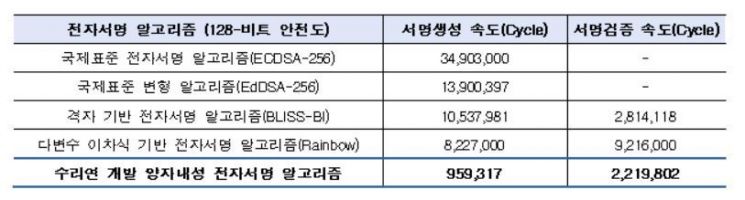 Comparison of Public-Key Cryptography Developed on 8-bit CPU Lightweight Device (ATxmega) and International Standard Public-Key Cryptography
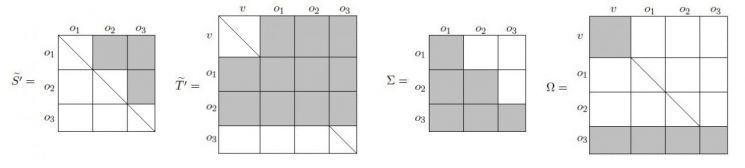
The research team expects that the newly developed encryption could become a next-generation encryption algorithm to respond to the quantum computer era. This encryption is based on the hard problem of finding solutions to multivariate quadratic polynomial systems. It is designed to be secure against attacks using quantum computers.
In the future, once quantum computers are developed, the currently used encryption can be decrypted in real time. The security of international standard public-key encryptions such as RSA and ECDSA is based on the problems of integer factorization and discrete logarithms, but quantum computers apply the "Shor's algorithm," which can decrypt these problems in real time. This means that electronic commerce and encrypted communications such as internet shopping and banking will no longer be safe.
Applicable from IoT to autonomous driving

In particular, it can be implemented at high speed even on lightweight devices such as IoT. The research team confirmed that the newly developed encryption operates more than 30 times faster than the current international standard encryption on 8-bit CPU devices.
The research team expects that it can be utilized for device authentication in various environments such as autonomous vehicles, unmanned aerial vehicles, wearable smart devices, and smart manufacturing. They also anticipate the possibility of designing quantum-resistant blockchains to replace the internationally standardized electronic signature ECDSA currently used in blockchain.
Sim Kyung-ah, head of the Cryptography Technology Research Team at the National Institute for Mathematical Sciences, stated, "Through this research, we plan to promote the domestic standardization of the developed encryption algorithm to reduce dependence on foreign encryption and further continue follow-up research to achieve the globalization of domestic encryption in preparation for the quantum computer era."
The research results were published in the April issue of the IEEE Internet of Things Journal.
© The Asia Business Daily(www.asiae.co.kr). All rights reserved.
![User Who Sold Erroneously Deposited Bitcoins to Repay Debt and Fund Entertainment... What Did the Supreme Court Decide in 2021? [Legal Issue Check]](https://cwcontent.asiae.co.kr/asiaresize/183/2026020910431234020_1770601391.png)