Total Road Length 111,314 km... Equivalent to 2.7 Times Around the Earth
Highest Traffic Volume on Seoul Ring Expressway
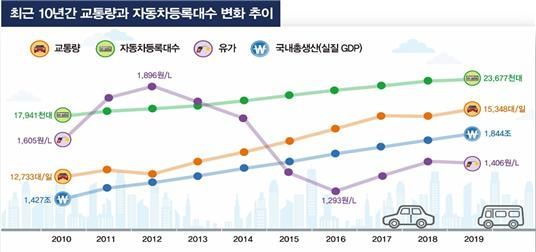
[Asia Economy Reporter Moon Jiwon] The total length of roads in South Korea is approximately 111,300 km, which corresponds to about 2.7 times the circumference of the Earth. This represents an increase of 600 km compared to the previous year. The average daily traffic volume was 15,348 vehicles, marking a 2.6% increase over one year.
The Ministry of Land, Infrastructure and Transport announced the nationwide road status and traffic volume statistics containing this information on the 27th. The statistics are based on data as of December last year.
The length of roads and traffic volume have been steadily increasing. Compared to 2010, the length increased by about 6,000 km (5.4%), and the daily traffic volume increased by about 3,000 vehicles (20.5%).
First, the total length of domestic roads is 111,314 km. This is equivalent to 2.7 times around the Earth, or one-third of the distance from the Earth to the Moon.
The total road area was surveyed to be approximately 1,712 km², which means about 1.7% of South Korea’s land area (103,780 km²) is used for roads. By region, Gyeonggi-do had the largest road area (272.6 km²), while Sejong City had the smallest (7.6 km²).
Highways and national roads managed by the government accounted for 15% (16,653 km) of the total roads, while roads managed by local governments such as provincial roads and special/metropolitan city roads accounted for 85% (94,661 km).
Paved roads made up 93.5% (96,456 km) of the total, representing the majority. Unpaved roads accounted for only 6.5% (6,736 km).
The nationwide average daily traffic volume was 15,348 vehicles, a 20.5% increase since 2010. As the Gross Domestic Product (GDP) and the number of registered vehicles increased, the average traffic volume has generally maintained an upward trend since 2010.
However, the statistics announced this time were surveyed based on data before the spread of COVID-19, as of last year, and do not reflect traffic volumes after January of this year.
Traffic volume in Gangwon-do (40.8%) and Jeju-do (42.4%) increased significantly last year. This is believed to be due to improved accessibility from road expansions such as the opening of the 2nd Yeongdong Expressway and the Seoul-Yangyang Expressway, as well as an increase in domestic and foreign tourists.
The average daily traffic volume was highest on expressways at 49,281 vehicles, followed by national roads at 13,185 vehicles, and provincial roads at 5,411 vehicles.
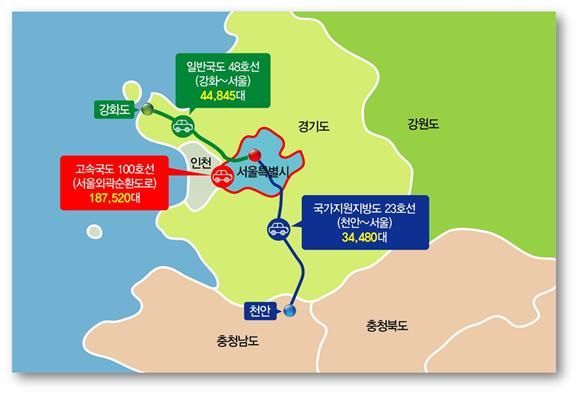
The locations with the highest traffic volumes were the Seoul Outer Ring Expressway (187,520 vehicles), National Road No. 48 from Ganghwa to Seoul (44,845 vehicles), and Provincial Road No. 23 from Cheonan to Seoul (34,480 vehicles).
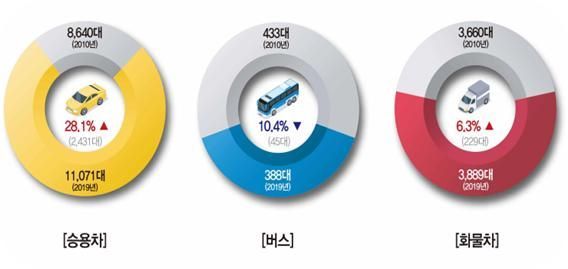
By vehicle type, passenger cars accounted for 72.2%, freight trucks 25.3%, and buses 2.5%. Compared to 10 years ago, traffic volumes for passenger cars and freight trucks increased, while bus traffic volume decreased. The decrease in bus traffic volume is believed to be due to the diversification of transportation options such as the expansion of high-speed rail and urban rail systems.
The road status statistics and road traffic volume statistical yearbooks will be distributed to government agencies, research institutes, and universities to be used as policy and research materials in various fields such as roads, transportation, land, and urban development.
© The Asia Business Daily(www.asiae.co.kr). All rights reserved.
![User Who Sold Erroneously Deposited Bitcoins to Repay Debt and Fund Entertainment... What Did the Supreme Court Decide in 2021? [Legal Issue Check]](https://cwcontent.asiae.co.kr/asiaresize/183/2026020910431234020_1770601391.png)

















