[Asia Economy Reporter Junho Hwang] Domestic researchers have achieved the world's first implementation of a vertically standing two-dimensional structure. This structure is expected to enable the development of adsorbents capable of storing gaseous fuels such as hydrogen or methane, or removing hazardous gases.
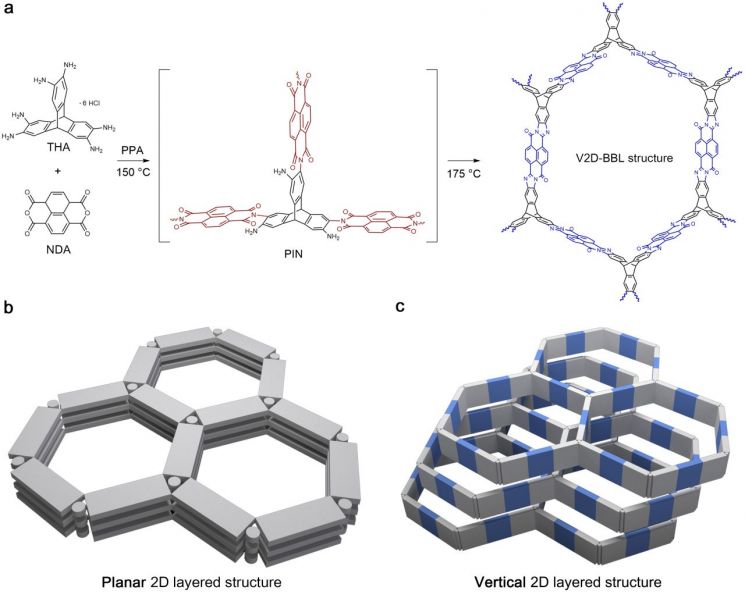
The research team led by Professor Jongbeom Baek from the Department of Energy and Chemical Engineering at Ulsan National Institute of Science and Technology (UNIST) developed a material with excellent gas storage capacity and hazardous substance adsorption performance by realizing a 'vertically standing 2D stacked structure.' The vertical 2D stacked structure is formed by standing atomically thin layered materials vertically and stacking them.
Professor Jongbeom Baek said, "Since the discovery of graphene, a carbon-based 2D material, attempts to utilize two-dimensional materials have steadily increased. By introducing a new concept, we overcame the inherent limitations of 2D structures and realized the world's first vertically standing 2D structure."
The research team also developed a new material constituting this structure. It is a synthesized material combining triptycene hexamine and naphthalene tetracarboxylic dianhydride. Due to the vertical stacking structure, this material has a large surface area in contact with gases, demonstrating excellent performance in gas storage. In particular, the adsorption rate of iodine (I2), known as a radioactive substance that is difficult to adsorb, was found to be the fastest among currently developed organic porous materials.
This material is highly stable and can withstand high temperatures up to 600℃. First author Hyukjun Noh, a researcher in the Department of Energy Engineering at UNIST, explained, "By making every part of the structure ring-shaped, we enhanced the chemical and thermal stability compared to existing 2D organic porous frameworks. It is expected to be usable in various high-temperature processes."
This research was published in the international academic journal Nature Communications on the 24th.
© The Asia Business Daily(www.asiae.co.kr). All rights reserved.
![User Who Sold Erroneously Deposited Bitcoins to Repay Debt and Fund Entertainment... What Did the Supreme Court Decide in 2021? [Legal Issue Check]](https://cwcontent.asiae.co.kr/asiaresize/183/2026020910431234020_1770601391.png)















