Yongsan-gu Reexamines Site of Former Kyungsung Allied Prisoner of War Camp on Current Shinkwang Girls' Middle and High School Grounds... Part of District Newsletter's Planned Series 'Exploring Modern and Contemporary Historical Sites'
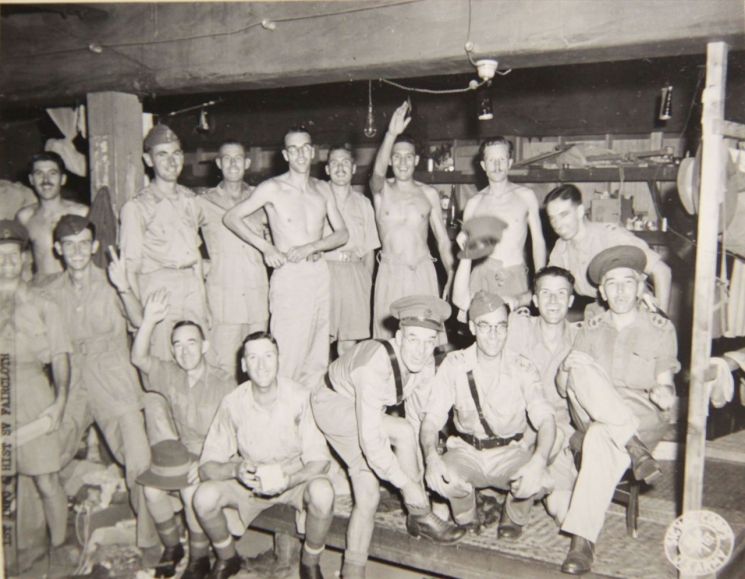
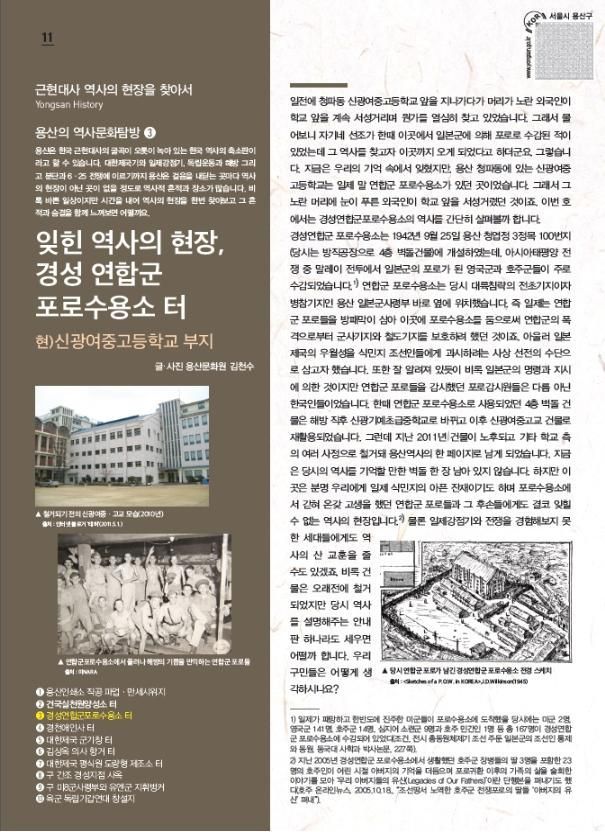
[Asia Economy Reporter Jong-il Park] Yongsan District (Mayor Seongjanghyun) reexamined the site of the “Keij? Allied Prisoner of War Camp (Cheongpa-dong 3-ga 100, currently the site of Shinkwang Girls' Middle and High School)” during the Japanese colonial period through the May issue of the district newsletter (Yongsan District News).
The Keij? Allied Prisoner of War Camp (hereafter the camp) was a facility established by the Japanese during the Asia-Pacific War (1941?1945) to detain Allied forces captured in the Malaya (Singapore) battle.
The camp was established on September 25, 1942, located at 100, Cheongpa-dong 3-chome, Yongsan (formerly Cheongyeopjeong 靑葉町). A four-story brick building that had been used as a textile factory (Iwamura Textile Factory) was repurposed.
The Japanese likely built the white prisoner camp right next to the Yongsan Japanese Military Headquarters to protect their military and railway bases from Allied bombings. They essentially used the prisoners as a “human shield.”
There was also a propaganda effect. The Japanese established camps in three locations within Korea?Keij?, Incheon, and Heungnam?to demonstrate their superiority to the colonial Korean population.
Until liberation in 1945, hundreds of British and Australian prisoners were held at the Keij? camp for about three years, performing forced labor during the day mainly at nearby Japanese Army warehouses (currently Camp Kim site), Keij? Station (now Seoul Station), and Han River bridges.
After the prisoners were released, the Keij? camp was repurposed as a school. In 1946, Shinkwang Technical Elementary and Middle School was established there, which is now Shinkwang Girls' Middle and High School. The remaining camp buildings were demolished in 2011, disappearing into history.
The articles and photos published in the newsletter were provided by Kim Cheonsu, head of the History and Culture Research Office at Yongsan Cultural Center.
Mr. Kim said, “Once, in front of Shinkwang Girls' Middle and High School, I met a foreigner with yellow hair who came looking for traces of our ancestors,” adding, “Although not a single brick remains now, this is an unforgettable historical site.”
Besides the Allied POW camp site, the district will continue a planned series titled “Exploring Modern and Contemporary Historical Sites (Yongsan History and Culture Exploration)” through the district newsletter until the end of the year.
▲ Site of Gyeongcheon Aeinsa ▲ Site of the Korean Empire Military Arsenal ▲ Site of Kim Sang-ok’s Resistance ▲ Site of the Korean Empire Pyeongsikwon Weights and Measures Factory ▲ Former Ganj? Keij? Branch Office Building ▲ Former US 8th Army Headquarters and UN Command Bunker ▲ Site of the Army Independent Armored Regiment establishment, among others, will be introduced continuously.
The district publishes 64,500 copies of the newsletter monthly and distributes them to residents through community leaders. Residents who wish to receive it by mail can request it from the district’s Public Relations Officer (☎2199-6702). It is also available as an e-book on the district website.
Seongjanghyun, Mayor of Yongsan District, said, “Yongsan is a treasure trove of Korea’s modern and contemporary history,” and encouraged, “Although daily life is busy, please take some time to visit these historical sites.”
© The Asia Business Daily(www.asiae.co.kr). All rights reserved.


















