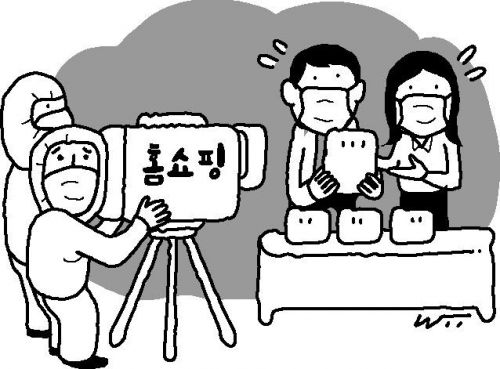
[Asia Economy Reporter Oh Hyung-gil] Since the outbreak of the novel coronavirus disease (COVID-19), non-face-to-face sales have emerged as an alternative in the insurance industry, but home shopping channels have struggled to gain traction.
Although social distancing has led to increased TV viewing time and boosted home shopping sales, this has not translated into insurance sales. Critics point out that the system only allows the sale of products with low premiums and simple contract structures.
According to the insurance industry on the 23rd, Hyundai Home Shopping has scheduled a sales broadcast for Heungkuk Fire & Marine Insurance's 'Power Life Comprehensive Insurance' on the 24th, and on the 27th, it will air AIA Life's 'Seamless Cancer Insurance' and Shinhan Life's 'Sincere Repeated Living Expense Cancer Insurance' twice, in the morning and afternoon.
GS Home Shopping has also been airing insurance sales broadcasts consecutively, except on weekends, featuring AIA, LINA, and Shinhan Life. Lotte Home Shopping will broadcast Samsung Fire & Marine Insurance's health insurance and Shinhan Life's cancer insurance in the afternoon on the 27th.
Although insurance sales broadcasts through TV are increasing, the number of actual contracts is declining. A representative from a life insurance company said, "Since the spread of COVID-19 in February and March, we have been focusing on non-face-to-face sales company-wide, but the contribution of home shopping sales has not significantly increased," adding, "In fact, some channels have seen a decrease in contracts compared to last year."
For example, A Insurance recorded home shopping sales of 273 million KRW in January, but this decreased to 233 million KRW in February. In March, it slightly rebounded to 259 million KRW. Last year, sales for January, February, and March were approximately 288 million KRW, 313 million KRW, and 470 million KRW, respectively. It appears there has been almost no windfall benefit from the COVID-19 outbreak.
Every year, the insurance premiums collected through contracts made via home shopping are steadily decreasing. Property and casualty insurers received 847.9 billion KRW in gross written premiums from home shopping last year, down 12.5% from 969.7 billion KRW the previous year. Although they received over 1 trillion KRW in 2017, the trend has been gradually shrinking. Life insurers are experiencing a similar situation.
Life insurers are in a similar situation. The initial premiums from home shopping sales shrank by more than 20%, from 8.997 billion KRW in 2018 to 7.151 billion KRW last year.
Home shopping insurance sales operate on an inbound sales model, where consumers who watch recruitment advertisements call directly. When viewers call during the insurance sales broadcast on home shopping channels, they are connected to the insurance company. Even if viewership or consultation calls increase, it may not lead to contracts.
An insurance industry official explained, "Because insurance products must be explained within a short broadcast time of about an hour, product understanding is low and cancellation rates are high," adding, "Due to the nature of insurance products, the substitution effect of non-face-to-face sales like home shopping is not as significant as expected."
© The Asia Business Daily(www.asiae.co.kr). All rights reserved.
![User Who Sold Erroneously Deposited Bitcoins to Repay Debt and Fund Entertainment... What Did the Supreme Court Decide in 2021? [Legal Issue Check]](https://cwcontent.asiae.co.kr/asiaresize/183/2026020910431234020_1770601391.png)















