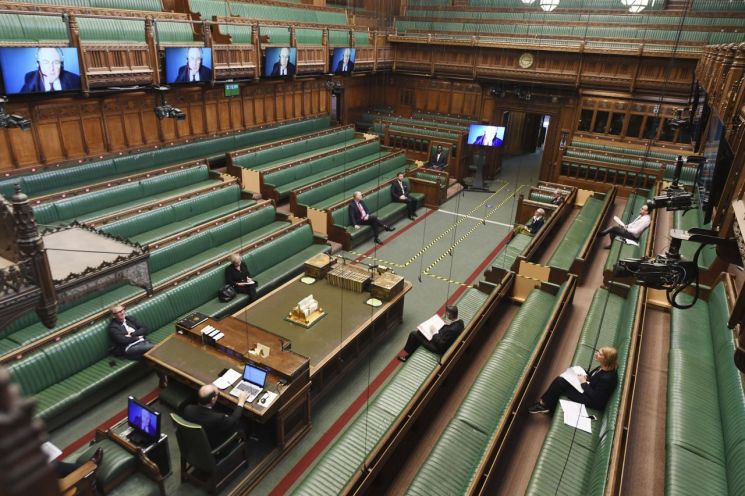
[Asia Economy Reporter Jeong Hyunjin] In response to the COVID-19 pandemic, the UK Parliament has implemented social distancing measures for the first time in its 700-year history and decided to adopt video conferencing and 'remote voting' methods to carry out its parliamentary functions.
According to BBC and other sources on the 21st (local time), the House of Commons, on the first sitting day after Easter, described the situation as "exceptional and unprecedented" and made this decision. Speaker Lindsay Hoyle announced that from the 22nd, the House would operate as a 'hybrid' parliament, with only some members attending in person while the rest connect via video.
Following this decision by the House members, only up to 50 of the total 650 members will be allowed inside the parliament at one time, and they must sit apart according to social distancing guidelines. Using the video conferencing program Zoom, up to 120 members can participate in meetings. This measure is initially set to last until the 12th of next month and may be extended depending on the COVID-19 situation.
Jacob Rees-Mogg, the Conservative Party leader in the House of Commons, evaluated the new 'safety measures' as essential, although not perfect or permanent. Referring to the suspension of Parliament during the Black Death in 1349, he expressed his pleasure that, thanks to modern technology, the fundamental constitutional role can be fulfilled during this COVID-19 crisis. He also expressed gratitude for the bipartisan agreement among members to adopt this groundbreaking 'virtual parliament' approach.
The UK government stated that until concerns about flaws or hacking in the voting process are dispelled, only bills that can pass with overwhelming support will be subjected to remote voting. The Guardian predicted that in this virtual parliament, members seated in the backbenches would not be able to boo or stand up and sit down to gain the floor, as was possible in traditional sessions.
Meanwhile, parliaments around the world are implementing new measures in response to the COVID-19 pandemic. In the US Congress, remote voting through a 'proxy voting' system is expected. The New York Times (NYT) reported that the Democratic leadership plans to amend congressional rules to allow remote voting for the first time in the 231-year history of the US Congress.
Steny Hoyer, the House Majority Leader for the Democrats, announced that a vote on new rules allowing members who cannot attend Congress in person to temporarily designate another member to vote on their behalf will take place on the 23rd. The Republican House leadership opposes this.
The German and Irish lower houses, as well as legislative bodies in Poland, Italy, and France, are continuing face-to-face meetings while maintaining social distancing guidelines. The Canadian Parliament is conducting a mix of one in-person meeting and two video meetings each week.
© The Asia Business Daily(www.asiae.co.kr). All rights reserved.

















