Temporary Panic Buying in Domestic Market Only in February... Essential Goods Stockout Rate Drops to 0% Afterwards
Strong Logistics Network and Online Infrastructure Strengths... Consumers Say "No Need for Panic Buying"
Panic Buying in the US, Hong Kong, Italy, Spain, Japan... Toilet Paper and Bottled Water Stockouts
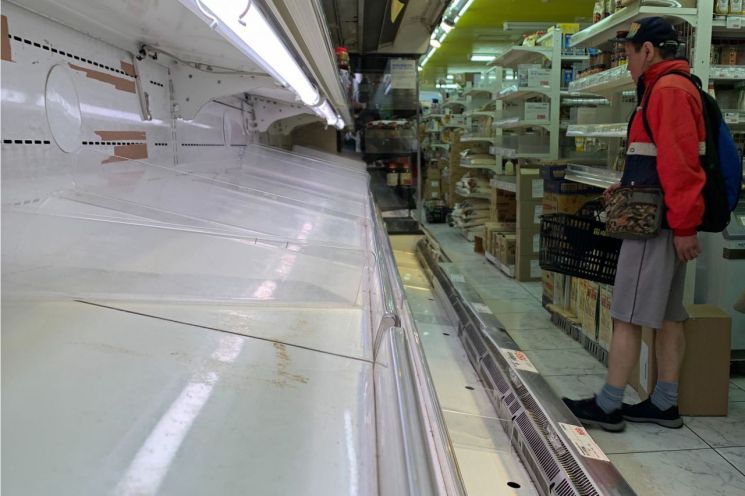
[Asia Economy Reporter Lee Seon-ae] While many countries around the world are experiencing shortages of daily necessities such as bottled water, toilet paper, hand sanitizers, and wet wipes due to the COVID-19 pandemic, South Korea is an exception. Although there was a temporary surge in hoarding of certain items in February when COVID-19 cases rapidly increased, the balance between supply and demand was quickly restored, maintaining a near 0% out-of-stock rate. In contrast, countries such as the United States, Japan, China, Spain, Italy, and Hong Kong are showing high out-of-stock rates.
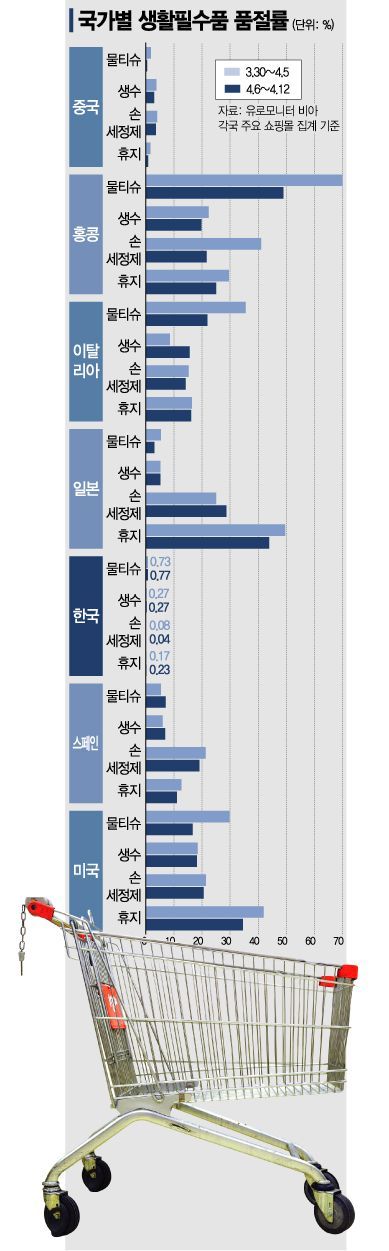
According to Euromonitor VIA on the 24th, the out-of-stock rate for wet wipes sold at major domestic shopping malls was 0.73% in the first week of April and 0.77% in the second week. The out-of-stock rate for bottled water was 0.27% in both the first and second weeks of April. The out-of-stock rates for hand sanitizers and toilet paper were even lower, recorded at 0.08% and 0.04% for hand sanitizers, and 0.17% and 0.23% for toilet paper, respectively.
On the other hand, hoarding of daily necessities overseas has led to high out-of-stock rates. In the United States, the out-of-stock rate for toilet paper reached 41.97% in early April and was 34.52% in the second week. Wet wipes, bottled water, and hand sanitizers also showed out-of-stock rates of 16.67%, 18.16%, and 20.59%, respectively, in the second week.
Japan also exhibits high out-of-stock rates. The out-of-stock rate for hand sanitizers increased from 25.05% in the first week of April to 28.72% in the second week, while toilet paper decreased from 49.56% to 43.86%. In Hong Kong, the out-of-stock rates for daily necessities are generally high, with wet wipes, bottled water, hand sanitizers, and toilet paper recorded at 48.98%, 19.77%, 21.62%, and 25%, respectively, in the second week. Italy, where COVID-19 cases continue to rise, showed out-of-stock rates of 21.88%, 15.63%, 14.20%, and 16.10% for wet wipes, bottled water, hand sanitizers, and toilet paper, respectively, in the second week.
China has seen some easing in out-of-stock rates as the COVID-19 situation stabilizes. Wet wipes and toilet paper entered the 0% range in the second week. However, bottled water and hand sanitizers were recorded at 2.94% and 3.57%, respectively.
Spain is also experiencing hoarding. Thanks to a culture that does not frequently use wet wipes, the out-of-stock rate for wet wipes was 7.02% in the second week, but toilet paper reached 11.08%. Bottled water and hand sanitizers were recorded at 6.88% and 19.10%, respectively.
Experts attribute the low out-of-stock rates for daily necessities in South Korea to a robust logistics network and a mature online market system. As of 2019, e-commerce accounted for 28% of South Korea's distribution market size, the same rate as China, the world's leading e-commerce country. The spread of COVID-19 has clearly demonstrated how solid Korea's e-commerce infrastructure is.
In fact, in the domestic market, shortages of wet wipes, hand sanitizers, toilet paper, and rice occurred when COVID-19 cases increased in February, but normalization began from the end of February, resulting in out-of-stock rates in the 0% range. The high dependence on e-commerce platforms such as 11st and Gmarket is analyzed to have enabled a quick recovery.
Lee O-ryun, Senior Researcher at Euromonitor International Korea, explained, "The anxiety about COVID-19 and temporary supply instability combined to cause many categories of daily necessities to record high out-of-stock rates online in various countries. However, South Korea is one of the countries with the most well-developed online shopping industries and also has a stable logistics network, enabling stable product supply from the early stages of the COVID-19 spread." He added, "From the consumer's perspective, there is no need to hoard, which is why the out-of-stock rates remain low. The variety of online shopping channels available to consumers and the shop-in-shop structure of large malls like Gmarket and 11st, where many mini-shop individual businesses sell products, contribute to a diverse supply channel and help maintain stable supply."
© The Asia Business Daily(www.asiae.co.kr). All rights reserved.
![User Who Sold Erroneously Deposited Bitcoins to Repay Debt and Fund Entertainment... What Did the Supreme Court Decide in 2021? [Legal Issue Check]](https://cwcontent.asiae.co.kr/asiaresize/183/2026020910431234020_1770601391.png)
















