19 Sellers Decide to Participate by Today
Expectations for Preventing Illegal Fund Outflows and Ensuring Operational Transparency
But Analysis Points to Low Effectiveness in Investment Recovery
[Asia Economy Reporter Park Ji-hwan] As Lime Asset Management fund distributors, who caused a 1.7 trillion KRW scale fund redemption suspension incident, have decided to establish a 'bad bank' to recover non-performing funds, attention is focused on whether the speed of investors' fund recovery will accelerate.
According to the financial investment industry on the 22nd, Lime fund distributors will notify the Financial Supervisory Service by today whether they will participate in the establishment of the bad bank management company. On the 20th, 19 Lime fund distributors decided to discuss the bad bank establishment plan and the scale of investment at the Financial Supervisory Service Training Institute in Jongno-gu, Seoul, and decide on participation.
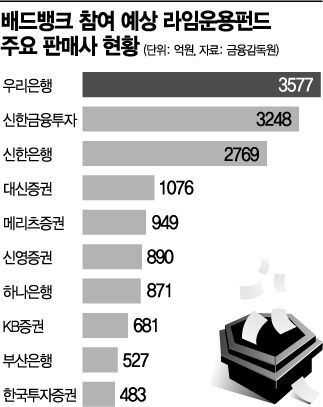
The scale of investment is expected to be determined according to the scale of fund sales. Based on sales amount, the order is Woori Bank (357.7 billion KRW), Shinhan Financial Investment (324.8 billion KRW), Shinhan Bank (276.9 billion KRW), Daishin Securities (107.6 billion KRW), Meritz Securities (94.9 billion KRW), and Shinyoung Securities (89 billion KRW). The scope of included funds is known to likely encompass all fund assets, including those with suspended redemptions. A bad bank refers to a financial institution temporarily operated to handle non-performing assets of financial companies. The bad bank recovers funds by issuing securities backed by various collaterals held by the insolvent financial company or by selling the collateral.
However, even if the bad bank is launched, the general consensus is that the effectiveness of recovering investment funds will not be significant due to the severe deterioration of Lime Asset Management's current assets. A financial investment industry official said, "Currently, Lime fund assets are not general stocks or bonds but items difficult to liquidate, so the recovery rate will not immediately increase nor will the recovery schedule speed up," adding, "The asset liquidation plan recently announced by Lime Asset Management, which is set to extend until 2025, reflects this reason."
Nonetheless, transparency in fund management, such as preventing illegal outflows of fund money, is expected to improve. A representative of a bad bank participating company pointed out, "Rather than an immediate increase in recovery rates, this strongly signals that investors no longer trust Lime's redemption plans amid ongoing asset leakage from Lime Asset Management." In January, Lime Asset Management diverted 19.5 billion KRW from Pluto FI D-1 fund, whose redemption was suspended, into convertible bonds (CB) of Star Mobility, a KOSDAQ-listed company. Star Mobility is the real ownership company of Kim Bong-hyun, who was involved in illegal fund management along with former Lime Asset Management Vice President Lee Jong-pil.
There is also growing voice that securities firms need to forgo some of their total return swap (TRS) profits to increase investors' recovery rates. This is because some of Lime's sub-funds are expected to incur total losses, raising concerns about investor damage. According to the recoverable amount disclosed by Lime on the 13th based on the audit by Samil Accounting Corporation, the loss rate of Lime Tetis No. 9 and Titan No. 7 funds sold by Daishin Securities is expected to be 100%. KB Securities' AI Star No. 1 to 3 funds and Shinhan Financial Investment's Saturn No. 1 fund are also expected to incur total losses.
Considering that the average recovery rate of Lime sub-funds is around 40-50%, a 100% loss is an exceptional case. All of these funds leveraged through TRS, which amplified the losses. Funds using TRS are structured so that securities firms receive repayment in priority; thus, if losses occur, investor losses increase further. It is reported that these funds did not use TRS funds, and when calculating recovery rates, it is assumed that not all will incur total losses.
A victim of Lime Asset Management said, "Investors suffered huge losses, but distributors are trying not to incur any losses," and argued, "Along with distributors' efforts to recover investment funds, such as waiving TRS priority repayment rights, the bad bank should be used for compensation to investors for pre-damage by distributors and subsequent settlement."
© The Asia Business Daily(www.asiae.co.kr). All rights reserved.

















