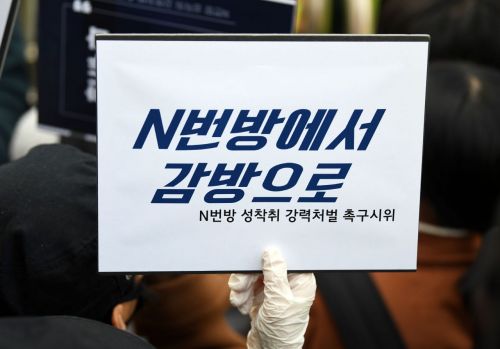
 On the 25th of last month, as the vehicle carrying Jo Joo-bin, the operator of the "Doctor's Room" who is accused of producing and distributing sexual exploitation materials of women including minors on the internet messenger Telegram, left the Jongno Police Station in Seoul and headed to the prosecution detention center, citizens held a picket protest demanding severe punishment for Jo Joo-bin. [Image source=Yonhap News]
[Asia Economy Reporter Yoon Shin-won] Amid the uproar in South Korea over the so-called 'Nth Room case,' in which sexually exploitative videos were produced and distributed via Telegram, public opinion is growing in favor of allowing 'sting operations' in digital sex crimes. However, the legality of sting operations remains controversial.
As crimes occurring in cyberspace, such as the Nth Room case, become increasingly sophisticated, voices calling for the allowance of sting operations to enable swift responses and prevent further harm are growing louder. A sting operation is a method where investigative agencies conceal their identity and induce a crime to apprehend offenders. It is a more proactive investigative method than the legally permitted 'undercover investigation.' In South Korea, sting operations are illegal.
For example, if a police officer disguised as a drug dealer voluntarily purchases drugs, it is considered an 'undercover investigation.' However, if the disguised officer offers drugs to an ordinary citizen who then purchases them, it could be classified as a 'sting operation.' This conflicts with current law, which punishes only crimes committed with voluntary intent, as sting operations artificially induce crimes. There is debate over whether acts without 'voluntariness' should be considered criminal offenses. Additionally, concerns exist that sting operations may violate the integrity and principles of investigations.
Nonetheless, the rationale for sting operations arises because undercover investigations have limitations in cases of child sex crimes. Professor Lee Soo-jung, a criminal psychology expert at Kyonggi University, appeared on CBS Radio's 'Kim Hyun-jung's News Show' and said, "Sting operations are illegal in that they induce criminal intent in people who have no intention of committing a crime." However, she added, "Sting operations are not only about inducing intent but also about targeting those who already have intent, such as those handling child pornography in secret rooms like the Nth Room, who can be seen as having the willingness to commit sexual violence."
She continued, "If (investigative agencies) prepare guidelines for the procedure of participating in the Nth Room while posing as a child, and if they observe situations where sexual violence is being committed in secret rooms targeting children, and one of the viewers is an undercover police officer, then all such conversations and videos should be admissible as evidence." Under current law, evidence collected through illegal sting operations is not admissible.
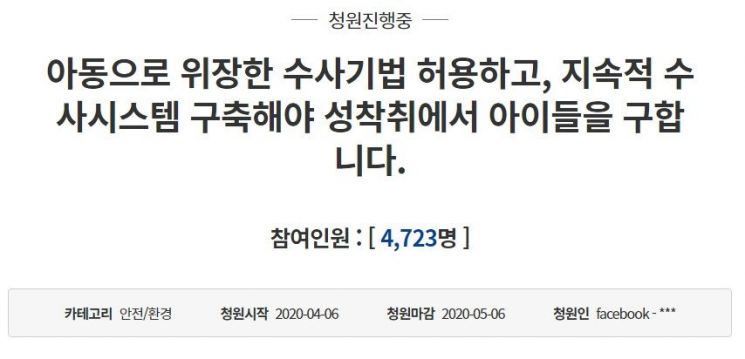
Following the Nth Room case, public opinion has also grown in favor of apprehending digital child sex offenders through more proactive investigative methods. On the 6th, a petition titled "Allow investigative techniques disguised as children and establish a continuous investigation system to save children from sexual exploitation" was posted on the Blue House's public petition board. As of 10 a.m. on the 22nd, it has garnered over 4,720 supporters.
The petitioner stated, "Warnings about (online sexual exploitation) have been ongoing for 20 years, but it was dismissed as a rite of passage for an IT powerhouse, and sex crime sites have flourished," opening their remarks. "Countless children, driven by curiosity or desperate situations, have been lured and threatened into victimization."
They continued, "Even while watching children being dragged to their deaths through sexual exploitation sites, we repeatedly heard excuses like 'privacy invasion,' 'lack of manpower,' 'overseas servers,' and 'sting operations are not allowed.' If the police pose as victims to catch perpetrators, it is illegal, but is the Korean-style sting operation, where they pose as sex buyers to catch victims, legal?" they questioned.
The petitioner urged, "What about other Nth Rooms that continue to evolve rapidly, mocking public authority? Will investigation teams be reassembled when the next victims emerge? Please remove the shackles on investigators and allow sting operations in online child sex crime investigations."
© The Asia Business Daily(www.asiae.co.kr). All rights reserved.


















