[Asia Economy Reporter Junho Hwang] Domestic researchers have discovered that a protein adhesive substance present in the brain regulates the ability to recognize new stimuli. This is expected to contribute to a better understanding of the neural circuits and synapse formation processes involved in recognizing "newness."
The research team led by Eunjoon Kim of the Synapse Brain Disease Research Group at the Institute for Basic Science (IBS) discovered the synaptic mechanisms and neural circuits involved in recognizing "newness."
The team found that a synaptic adhesion protein called PTPσ regulates the location and stabilization of NMDA receptors, which are known to mediate memory. In particular, the team confirmed through in vivo animal experiments that PTPσ is related to the maturation of synaptic function. Previously, in vitro studies had shown that the synaptic adhesion protein PTPσ is involved in synapse formation.
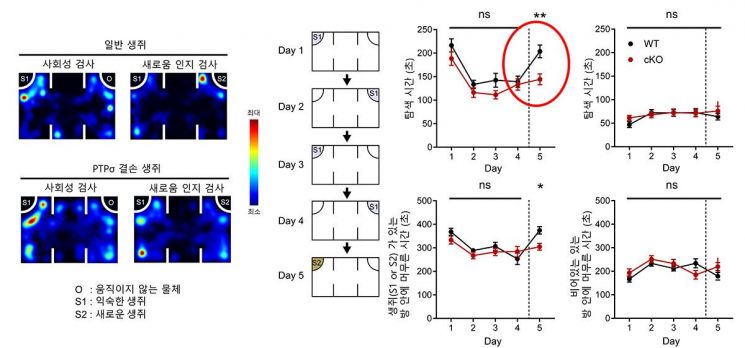
Through experiments on mice, the research team found that mice lacking PTPσ showed no significant problems in synapse formation itself but failed to recognize newness. By comparing the responses of normal mice and PTPσ-deficient mice after exposure to various experimental environments such as new objects, new mice, new situations, or changes in rules, they confirmed that the PTPσ-deficient mice could not recognize new targets.
Director Eunjoon Kim said, "We revealed that PTPσ, one of the synaptic adhesion proteins, is not simply an 'adhesive' connecting pre-synapse and post-synapse, but a substance that regulates the ability to recognize new stimuli and activates related neural circuits." He added, "We expect this research to help understand the pathogenesis of related brain diseases and aid in the development of future brain cognitive function therapeutics."
The research results were published in eLife on the 6th of last month.
© The Asia Business Daily(www.asiae.co.kr). All rights reserved.

















