At the end of 2018, a shortage of 4,700 personnel in digital healthcare, smart and eco-friendly ships, aerial drones, and intelligent robots... Average shortage rate of 4.3%
"Expansion of master's and doctoral level personnel, adjustment of university quotas in new industry sectors, and expansion of job transition training for current employees needed to resolve mismatch"
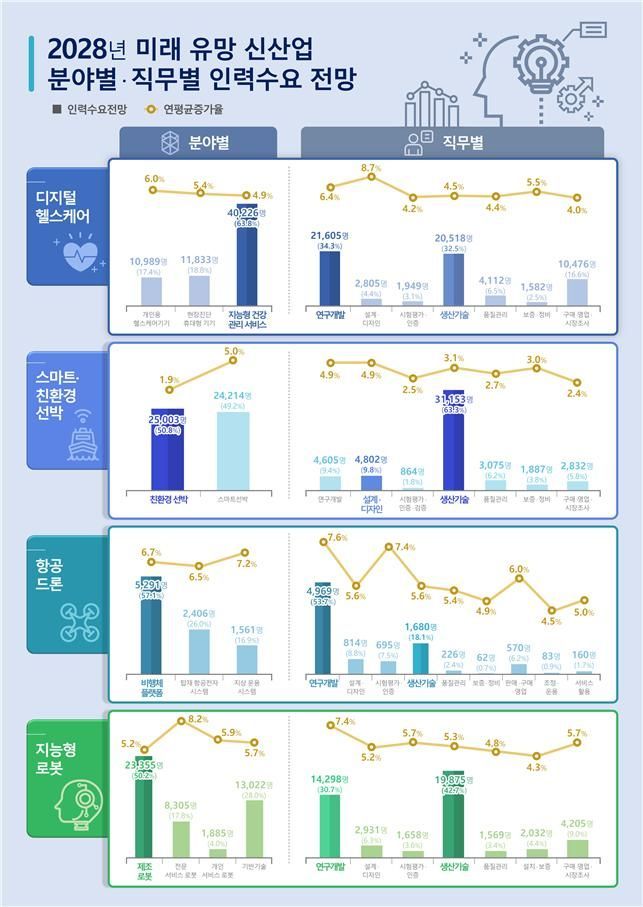
[Asia Economy Reporter Moon Chaeseok] The government forecasted that by 2028, 168,000 personnel will be needed in four promising new industries: digital healthcare, smart and eco-friendly ships, aerial drones, and intelligent robots.
On the 19th, the Ministry of Trade, Industry and Energy announced the results of an industrial technology workforce survey conducted on companies participating in the four promising new industries as of the end of 2018.
The industrial technology workforce was about 105,000 people, with a shortage of 4,755 personnel. The average shortage rate was 4.3%, which is double the 2.2% average shortage rate of the 12 major key industries.
Industrial technology personnel refer to those with a high school diploma or higher who work in companies as researchers, technical staff, production or information communication-related managers, or corporate executives.
The Ministry of Trade, Industry and Energy reported that among about 3,500 companies in the four new industry sectors, 81.7% are small and medium-sized enterprises with fewer than 100 employees. Companies have mainly filled necessary personnel through new hires and job transitions of existing employees.
Because of this, the shortage rate of university undergraduate and master's/doctoral level personnel in the four new industry sectors was higher than in the 12 major key industries. In particular, the personnel shortage rate in the digital healthcare sector was as high as 7.1%.
By education level, the shortage rates in the four new industries are 1.6% for high school graduates, 3.4% for junior college graduates, 4.9% for university graduates, and 9.1% for graduate school graduates. For the 12 major key industries, the rates are 2.2%, 1.8%, 2.3%, and 2.4%, respectively.
The Ministry plans to expand related personnel training this year as the shortage rate of master's and doctoral level personnel was found to be the highest across the four new industries.
In the smart and eco-friendly ships, aerial drones, and intelligent robots sectors, 7.4 billion KRW was invested last year to train 300 people, and this year, 8 billion KRW will be spent to train 350 people. Next year, a new training program for specialized personnel in the bio-health sector will be launched.
Additionally, the ministry plans to resolve the mismatch between supply and demand of personnel and strengthen cooperation with related ministries to communicate industry workforce demands.
Through the Sector Council (SC) for human resource development in new industries under the Ministry of Education, industry demands related to university quota adjustments and specialized high school curriculum reforms will be conveyed.
In continuous consultation with the Ministry of Employment and Labor, the vocational training system will be restructured to facilitate organic job transitions for current employees into new technology fields. Efforts will be made to relax standards for applying the National Competency Standards (NCS) and training cost criteria in new industry sectors.
Meanwhile, as of the end of 2018, 38,050 people were employed in the digital healthcare sector. The shortage rate was 7.1%, with a shortage of 2,900 personnel. By 2028, 63,048 personnel will be needed, with an average annual growth rate of 5.2%.
This sector requires convergent personnel equipped with both biotechnology expertise and data analysis skills, making workforce supply and demand challenging. Companies are addressing shortages through new hires followed by in-house training (35%), hiring experienced personnel (31%), and recruiting majors through industry-academia cooperation (18%).
In the smart and eco-friendly ships sector, 35,549 people are employed, with a shortage rate of 2.6% and a shortage of 932 personnel. By 2028, 49,217 personnel will be needed, with an average annual growth rate of 3.3%.
Although this sector faces difficulties such as industrial restructuring, workforce demand is expected to continue due to domestic and international environmental regulations and the development of autonomous ships.
In the aerial drones sector, 4,823 people are employed. The shortage rate is 4.3%, with a shortage of 215 personnel. By 2028, 9,258 personnel will be needed, with an average annual growth rate of 6.7%.
The drone market is expanding from low-cost, small-sized to high-cost, medium-sized drones, increasing the need for technological development. As the industry is still in its early growth stage, companies have high demand for research and development (R&D) personnel.
In the intelligent robots sector, as of the end of 2018, 26,338 people were employed. The shortage rate was 2.6%, with a shortage of 708 personnel. By 2028, 46,567 personnel will be needed, with an average annual growth rate of 5.9%.
The workforce has increased about 1.6 times compared to the end of 2016. The increase factors were expansion of industry scope due to industrial convergence (5,200 personnel), increase in newly participating companies (3,100 personnel), and workforce growth due to company growth (1,700 personnel).
© The Asia Business Daily(www.asiae.co.kr). All rights reserved.
![User Who Sold Erroneously Deposited Bitcoins to Repay Debt and Fund Entertainment... What Did the Supreme Court Decide in 2021? [Legal Issue Check]](https://cwcontent.asiae.co.kr/asiaresize/183/2026020910431234020_1770601391.png)
















