Supply Challenges Including Price Risk Due to Oil Price Fluctuations and Solar Power Intermittency
Controversy Over Fine Dust Management Due to Peak Power Generation
Increased Economic Burden from Higher Share of Expensive LNG
Blackout Risk Due to Climate Variability from Global Warming
[Asia Economy Reporter Moon Chaeseok] As the government is expected to announce the 9th Basic Plan for Electricity Supply and Demand in the second half of the year, attention is focused on the energy industry's views on the share of power generation by energy source. The government is considering a plan to reduce dependence on coal power and expand the share of liquefied natural gas (LNG) power generation to address issues such as greenhouse gases and fine dust. Experts urge the government to carefully establish adjustments and measures for the share of energy sources in the 9th plan to solve problems related to supply stability, environmental impact, economic feasibility, and climate uncertainty.
According to related ministries on the 19th, the Ministry of Trade, Industry and Energy (MOTIE) is expected to soon deliver a draft of the 9th plan to the Ministry of Environment. The basic plan is a mid- to long-term electricity supply stabilization measure established by the government every two years, and the 9th plan will include the share of power generation by energy source until 2033. It is highly likely to be finalized and announced in the second half of the year. Unlike the previous eight plans, this time it must go through the Ministry of Environment's strategic environmental impact assessment and public hearings for the first time.
There is keen interest in whether MOTIE will adjust the shares of coal and LNG to the 20% range of total power generation by 2033 in the 9th plan. Previously, in December 2017, MOTIE announced through the 8th plan that the shares of coal and LNG, which were 45.4% and 16.9% respectively in 2017, would be changed to 36.1% and 18.8% by 2030. During the same period, renewable energy was to be adjusted from 16.9% to 18.8%, and nuclear power from 30.3% to 23.9%.
There is little disagreement with the expectation that the LNG share will expand to the 20% range in the 9th plan. Since the government's nuclear phase-out (energy transition) policy requires reducing coal power to meet greenhouse gas emission targets, the shortfall in power generation must be compensated. In 2018, the government revised the 'National Greenhouse Gas Reduction Roadmap' to reduce 7% of the 11.3% overseas greenhouse gas reduction domestically. Since the possibility of increasing the shares of coal and nuclear power is low, it is widely expected that the LNG share will inevitably expand. MOTIE Minister Sung Yun-mo also stated in January, "When establishing the 9th plan, we will prepare bold measures to reduce coal power for greenhouse gas and fine dust reduction."
Attention is focused on whether only the coal share will be drastically reduced or if the nuclear share will also be cut. If the 9th plan adjusts the shares of coal and nuclear power to the 20% and 10% ranges respectively, it would require reducing 6.2% and 4% compared to the 8th plan. Experts say that reducing coal is less damaging to supply stability than reducing nuclear power. The reasons cited include: ▲nuclear plant closures depend on design life and are therefore more difficult than closing coal plants, ▲nuclear power is cheaper and more supply-secure than coal, and ▲a sharp reduction in nuclear power generation would increase Korea Electric Power Corporation's financial burden.
Professor Jung Yong-hoon of KAIST's Department of Nuclear and Quantum Engineering explained, "Reducing coal is less problematic than reducing nuclear power because coal is more expensive than nuclear power. If coal is drastically reduced and nuclear and LNG are slightly increased, supply stability might be maintained assuming cost burdens are accepted, but if nuclear power is also reduced, supply stability will decrease."
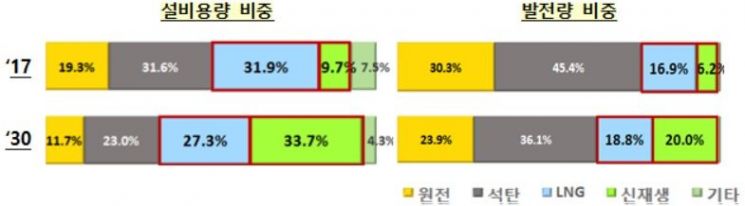 Proportion of installed capacity and power generation by energy source presented in the "8th Basic Plan for Electricity Supply and Demand (2017-2031)" announced by the Ministry of Trade, Industry and Energy on December 29, 2017. (Source: Ministry of Trade, Industry and Energy)
Experts say that if the government plans to increase the shares of LNG and renewable energy while reducing coal and nuclear power, it must present clear solutions to four issues: ▲supply stability ▲environmental impact ▲economic feasibility ▲climate uncertainty.
First, questions arise about how to control price and supply volatility if LNG is prioritized. It is also uncertain how to solve the intermittency problem (variation in power generation due to weather and seasons) of solar energy, one of the renewable energies that already surged to 20% in the 8th plan. Since the decline in oil prices, which fluctuate due to political decisions by oil-producing countries, may continue unpredictably, the possibility of increased supply instability due to LNG price volatility cannot be excluded. This is why some voices argue that a certain amount of coal should still be included even if reduced.
Professor Song Jong-soon of Chosun University's Department of Nuclear Engineering said, "The reason past governments based energy sources on coal and nuclear power was not only economic feasibility but also supply stability. When establishing the Basic Plan for Electricity Supply and Demand, more careful consideration should be given to how stable the supply can be rather than short-term variables like reduced electricity demand due to the COVID-19 pandemic."
There is also controversy over whether LNG can reduce the harmful effects of fine particulate matter compared to coal. According to a recent analysis by the Ministry of Environment, MOTIE, and the Energy Transition Forum of pollutant emissions from 61 domestic coal power plants and 59 LNG power plants (based on 2018 data), coal power emitted an average of 98.4 kg of fine particulate matter per 1 GWh (=1 million kWh) of electricity generated, while LNG power emitted only 10.9 kg. Professor Jung countered this by stating that ▲applying the European Union's nitrogen oxide conversion factor could double the fine particulate emissions from coal power and increase LNG emissions eightfold, and ▲LNG power plants are mainly located in large cities, which could amplify their impact.
Economic feasibility is the biggest weakness of LNG power. According to the Korea Power Exchange's Electricity Statistics Information System (EPSIS), as of January, the settlement cost per 1 kWh is 65.2 won for nuclear power, 96.1 won for bituminous coal, and 120.5 won for LNG. Not only is LNG's current cost higher, but about half of the nuclear power cost reflects initial nuclear plant construction costs, which could decrease in the future.
Climate uncertainty due to global warming cannot be ignored. When the government established the 8th plan in December 2017, it made excessively drastic adjustments to the shares of energy sources compared to the previous 1st to 7th plans, and in February the following year, it requested demand reduction (emergency dispatch) from companies due to a cold wave. Because of this, the government faced strong criticism for failing to predict electricity demand when establishing the 8th plan.
Professor Lee Deok-hwan, emeritus professor of chemistry and science communication at Sogang University, emphasized, "The core of the Basic Plan for Electricity Supply and Demand is to ensure sufficient electricity supply anytime and anywhere. The government was criticized for failing to predict demand during the emergency dispatch in winter 2018. Since the unpredictability of climate is the biggest feature of warming, and since summers have been less hot and winters warmer after 2018, it is not a time to be complacent. The government must include blackout countermeasures for extreme weather variables in the basic plan."
© The Asia Business Daily(www.asiae.co.kr). All rights reserved.


















