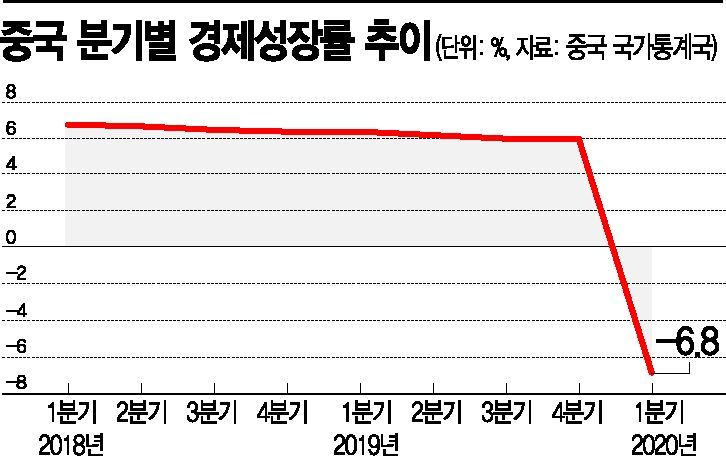
[Asia Economy Beijing=Special Correspondent Park Sun-mi] Due to the impact of the novel coronavirus disease (COVID-19), the Chinese economy contracted for the first time in 44 years since 1976.
On the 17th, the National Bureau of Statistics of China announced that the first quarter gross domestic product (GDP) was 20.6504 trillion yuan, recording an economic growth rate of -6.8%. The year 1976 was when the Cultural Revolution led by Mao Zedong ended, and at that time, China’s economic growth rate was -1.6%. It is also the first official negative growth rate since the government began releasing quarterly economic growth rates separately in 1992.
By industry, the primary industry was 1.0186 trillion yuan, down 3.2% compared to the same period last year; the secondary industry was 7.3638 trillion yuan, down 9.6%; and the tertiary industry was 12.268 trillion yuan, down 5.25% year-on-year.
The negative growth in the first quarter was anticipated after the COVID-19 infection began to spread in Wuhan, Hubei Province in January. As the virus spread nationwide, population movement was restricted and cities were locked down in China. Factory operations were also suspended, adversely affecting the economy. To prevent the spread of COVID-19, China extended the Spring Festival (Chinese New Year) holiday, originally from January 24 to 30, until February 2. Even after that, as the spread of COVID-19 did not subside, all efforts were focused on COVID-19 prevention, enduring the suspension of economic activities.
The first quarter growth rate is not significantly different from forecasts by private and foreign media. Caixin, a Chinese private economic media outlet, projected the first quarter growth rate to be between 0% and -11.5%, while The New York Times cited a Reuters survey of 57 analysts estimating an average first quarter growth rate of -6.5%.
However, considering that China has sustained high growth for over 40 years since adopting the reform and opening-up policy in 1978, the impact of this negative growth rate is expected to be significant. China recorded a growth rate of 15.2% in 1984 and has shown stable and sustainable growth with single-digit growth rates since 2010, reflecting an expansion in economic scale.
The economic indicators released on the same day also showed that the Chinese economy has not yet escaped the shock of COVID-19.
Industrial production in March decreased by 1.1% year-on-year, improving from the January-February period (-13.5%) but still continuing the decline. Retail sales also fell by 15.8%, and fixed asset investment dropped by 16.1%. Earlier released March export data showed a 6.6% decrease year-on-year, indicating that the three pillars driving the Chinese economy?exports, consumption, and investment?have all been impacted by COVID-19. The urban unemployment rate in March surged to 5.9%.
However, Mao Xingyong, spokesperson for the National Bureau of Statistics of China, emphasized the possibility of economic recovery during the economic operation briefing on the day.
Spokesperson Mao said, "Looking at the economic operation situation, the improvement in March is clearer than in January and February," adding, "We expect this improvement trend to continue. Especially as factory resumption accelerates and stronger (stimulus) policies are being introduced, the economy in the second quarter will be clearly better than in the first quarter." He added, "If COVID-19 is well controlled worldwide, the economy in the second half of the year will also be better than in the first half."
He also said that the economic shock caused by COVID-19 will not affect China’s long-term growth trajectory. He stated, "The fundamentals of the Chinese economy remain unchanged," adding, "Despite the COVID-19 shock, the national economy has generally remained stable. The effect of managing COVID-19 control and economic and social development simultaneously has been remarkable. However, due to the global spread of COVID-19, downward pressure on the economy is significant and uncertainty factors have increased."
© The Asia Business Daily(www.asiae.co.kr). All rights reserved.

















