The basis for dispersing political responsibility to the opposition disappears... Need to discover a new political model in a minority government dominated by the ruling party
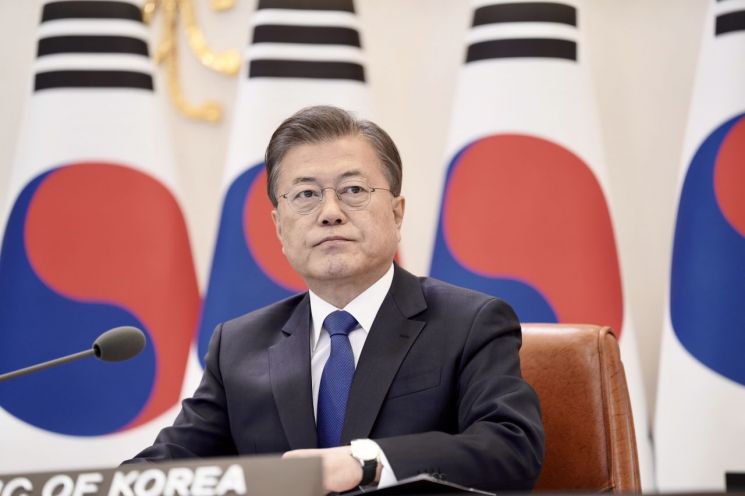
[Asia Economy Reporter Ryu Jeong-min] President Moon Jae-in has taken on the responsibility of riding the "tiger's back" and is now facing the remaining two years of his term.
The people granted the ruling party overwhelming power through the 21st general election. Not only the Blue House and the executive branch but also the National Assembly and local councils are all dominated by forces friendly to President Moon. It is now difficult to use the excuse that governing is hard due to opposition party non-cooperation. The protective shield that dispersed political responsibility has disappeared.
If there is no substantial improvement in the lives of the people going forward, the political structure will inevitably hold the ruling party fully accountable. With the inauguration of the 21st National Assembly on May 30, there is also a possibility that the latent desire for reform across society will erupt all at once. This is why President Moon expressed his thoughts regarding the recent general election, saying, "Before joy over the great choice of the people, I feel the heavy responsibility with my whole body."
In fact, the Blue House and the Democratic Party of Korea have been keeping a low profile immediately after the election. Rather than popping the champagne of victory, their expressions show clear tension. Democratic Party leader Lee Hae-chan said, "Now, the 21st National Assembly is completely different from before; it is a working National Assembly, a National Assembly worthy of its name, and a National Assembly that unites the people. The full responsibility to create this lies with the Democratic Party."
According to the National Election Commission, in the 21st general election, the Democratic Party secured 163 constituency seats and 17 proportional representation seats (through the Together Citizens' Party), totaling 180 seats. This is not only a majority of seats (151 seats) essential for passing plenary sessions in the National Assembly but also a scale that can maintain a stable majority in the composition of all standing committees.
The problem lies in the gap between political ideals and reality. Theoretically, it is an environment where all state affairs and various reform bills can be passed, but there is a possibility of hitting the wall of reality.
During the election, the Democratic Party announced a plan to provide emergency disaster relief funds for the novel coronavirus disease (COVID-19) to all citizens. Although the United Future Party also showed a positive response to expanding cash support during the election, it is questionable whether the ruling party's intentions will prevail during National Assembly discussions. The political vacuum period until the new National Assembly convenes is also noteworthy. COVID-19 requires urgent response, but the United Future Party is experiencing a leadership vacuum due to the election aftermath.
Discussions on the distribution of standing committee chairmanships in the 21st National Assembly are also a variable. If the United Future Party insists on demanding key standing committee chairmanships, including the Legislation and Judiciary Committee chairmanship, which has traditionally been recognized as the opposition party's share, the actual start of the 21st National Assembly's activities may be delayed beyond expectations. The ruling party's dilemma is that they cannot wait indefinitely for opposition cooperation, nor can they recklessly push a hardline approach based solely on their numerical strength.
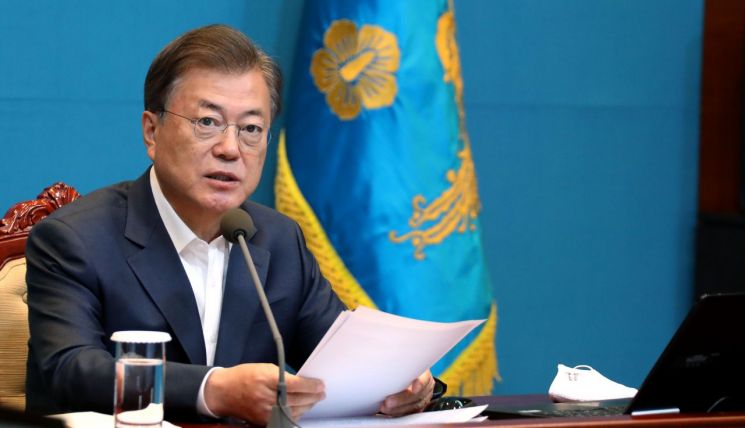
This is why there are calls for developing a "cooperation model" suited to the changed reality of a ruling party majority and opposition minority National Assembly to realize President Moon's reform agenda. It means that a system must be established to rationally coordinate the diverse interests of society and reflect the opposition party's views in state governance to accelerate the implementation of state affairs.
On the 17th, Lee Nak-yeon, head of the Democratic Party's COVID-19 National Crisis Overcoming Committee, said, "To fulfill the responsibility given by the people, we must gather the people's will and also gain the opposition party's cooperation." The lesson that the ruling Uri Party, which became the majority party thanks to the backlash against the impeachment attempt of the late President Roh Moo-hyun, should not repeat the experience of internal division due to intensified factional strife will also support this.
In this regard, the Blue House is paying close attention to preparing a cooperation model suitable for the changed National Assembly environment by broadly meeting with political science professors, public opinion experts, and others. A key Blue House official said regarding the future direction of state governance, "It is expected that the president will make a direct statement." This suggests there will be a direct mention separate from the message from President Moon conveyed by Blue House spokesperson Kang Min-seok the previous day.
© The Asia Business Daily(www.asiae.co.kr). All rights reserved.
![A Woman Who Jumps Holding a Stolen Dior Bag... The Mind-Shaking, Bizarre Con of a "Human Knockoff" [Slate]](https://cwcontent.asiae.co.kr/asiaresize/183/2026021902243444107_1771435474.jpg)

















