Government to Cut Civil Servants' Salaries to Secure Disaster Relief Funds
Plan to Fully Cut Annual Leave Compensation (395.3 Billion Won)
Civil Servants' Union Urges "Immediate Withdrawal of Shameless Wage Cut Policy"
Civil Servants Complain "Too Busy to Use Leave... Cutting Compensation Is Too Much"
Ministry of Economy and Finance States "Sharing the Pain of the COVID-19 Crisis"
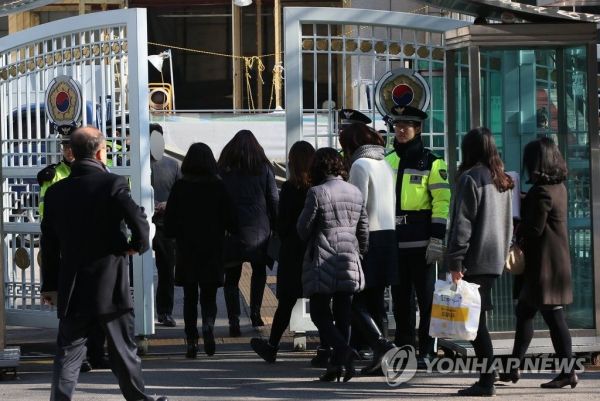 Government officials who have finished their lunch are entering their offices at the Government Seoul Office in Sejongno, Seoul. Photo by Yonhap News
[Asia Economy Reporter Kim Suwan] "Are public officials slaves?"
Mr. A, a public official who requested anonymity, recently said this in response to the government's announcement to cut public officials' annual leave compensation to secure funds for emergency disaster relief payments. Mr. A lamented, "I work for a meager salary, and I don't understand why there are so many demands," adding, "With the recent COVID-19 pandemic and the general election overlapping, I worked overtime even on weekends. I can't even rest, yet they say they will cut annual leave compensation." He continued, "Many public officials are already volunteering beyond the monthly 57-hour overtime limit," and "I'm too busy to even take annual leave anyway."
Recently, the government announced plans to cut public officials' annual leave compensation to secure funds for emergency disaster relief payments. On the 16th, Hong Nam-ki, Deputy Prime Minister and Minister of Economy and Finance, stated at a briefing on the second supplementary budget bill (supplementary budget) focused on providing emergency disaster relief payments to citizens affected by COVID-19 at the Government Complex Sejong, "As part of the government's initiative and sharing of pain, we have reduced about 800 billion won mainly in personnel expenses and building construction costs," adding, "We have fully cut annual leave compensation as well as personnel expenses savings from delayed recruitment in the first half of the year, and partially reduced building construction costs considering project schedules."
Accordingly, the plan is to secure a total of 695.2 billion won by cutting the entire annual leave compensation for public officials (395.3 billion won) due to leave consumption and combining it with personnel cost savings (299.9 billion won) from delayed public official recruitment.
Annual leave is a system that allows public officials to take mental and physical rest to maintain productivity and provides convenience to care for their private lives; it is a right of public officials. Annual leave compensation is a method of compensating public officials in cash for unused leave days.
The number of annual leave days for public officials is fixed according to their length of service, and annual leave compensation cannot exceed 20 days within the budget scope.
In particular, since annual leave is paid leave and a right of public officials, it should be granted when the official desires. However, if many officials take leave simultaneously, it may disrupt work performance, so some control is exercised.
In response to the government's policy, the Korean Government Employees' Union Federation and the National Government Employees' Union issued a joint statement on the 16th, urging, "The government must immediately withdraw the cut to public officials' annual leave compensation."
These organizations criticized, "Countless public employee workers nationwide are suffering from around-the-clock emergency work due to COVID-19 and are handling murderous workloads such as disaster relief payments, wildfire prevention, and election duties for the April 15 general election." They also stated, "They have already shared pain sufficiently through forced wage returns and fundraising."
They added, "The government is pushing shameless wage cut policies through secretive administration without any consultation with public officials' unions," emphasizing, "When reports about cutting public officials' annual leave compensation to prepare disaster relief funds surfaced recently, the Ministry of Economy and Finance denied it by saying 'nothing has been decided yet,' but this is false and deceptive."
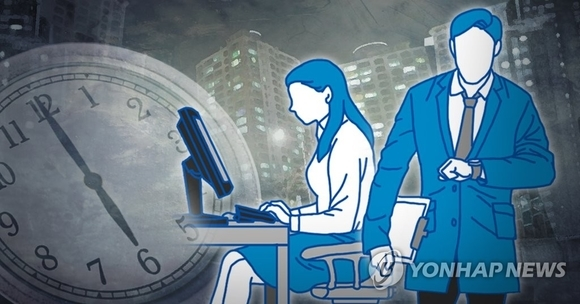 It is reported that public officials are entering an emergency work system, including overtime and weekend work.
 Photo by Yonhap News
As a result, criticism is pouring in among public officials as well, with comments like "I might understand if the work was less," and "Aren't public officials citizens too?" This is because related work has increased in local governments to prevent the spread of infectious diseases and secure public safety amid the COVID-19 aftermath. Public officials are reportedly entering emergency work systems including overtime and weekend work.
Mr. B (27), a public official, said, "I'm often working night shifts and weekends; how can I use annual leave here?" He lamented, "Saying they won't pay compensation means we should use all the leave, but that's practically impossible."
Another public official, Mr. C (31), said, "Even without the COVID-19 situation, some local governments tell us to use annual leave early because they don't have money," adding, "When work is heavy, it's common to feel pressured and take leave but still go to work."
He continued, "The public thinks public officials are idling on taxpayers' money, but that's not true at all," raising his voice, "Everyone is struggling now; isn't it too much to expect sacrifices? Public officials are citizens too."
Some argue that alternatives to cutting public officials' wages should be sought. One public official recently posted on an online community, "It's unreasonable to forcibly cut public officials' annual leave compensation while imposing sanctions on companies and employers for not paying workers' leave compensation. This is a double standard by the government," and "Instead of taking away junior public officials' annual leave compensation, the government should reduce lawmakers' salaries or find other solutions."
An anonymous public official said, "The officials themselves learned about this through press releases. The government decided this arbitrarily without consultation," adding, "Public officials have been sacrificing by working overtime and weekends to stabilize people's lives since the COVID-19 outbreak. This government policy is very unfair."
Meanwhile, the government maintains that the full cut of annual leave compensation is unavoidable. Deputy Prime Minister Hong emphasized at the second supplementary budget briefing, "As part of sharing the pain caused by the COVID-19 crisis, active participation by public officials and the public sector is inevitable," adding, "Reducing annual leave compensation is one of the most effective and swift ways for public officials to share the public's pain. We believe this will be well understood."
© The Asia Business Daily(www.asiae.co.kr). All rights reserved.
!["The Woman Who Threw Herself into the Water Clutching a Stolen Dior Bag"...A Grotesque Success Story That Shakes the Korean Psyche [Slate]](https://cwcontent.asiae.co.kr/asiaresize/183/2026021902243444107_1771435474.jpg)

















