Government Announces Detailed Criteria for Selecting Subsidy Recipients
[Asia Economy Reporters Kim Hyun-jung (Sejong), Jang Se-hee, Jo In-kyung] The government has decided to exclude high-net-worth individuals who own apartments valued at 2 to 2.2 billion KRW or deposits worth around 1.25 billion KRW from the emergency disaster relief fund payment targets amid the COVID-19 crisis. Self-employed individuals whose income has sharply declined due to the COVID-19 impact can receive support based on submitted proof documents. However, this government policy must go through National Assembly review and approval, as well as local government assessments, so the actual payment timing cannot be specified at this time. Whether the National Assembly, after the general election, will push for 'universal payment' is also a variable.
On the 16th, the government submitted the second supplementary budget bill for emergency disaster relief fund payments to the National Assembly and announced the 'detailed criteria for selecting support recipients' reflecting this content.
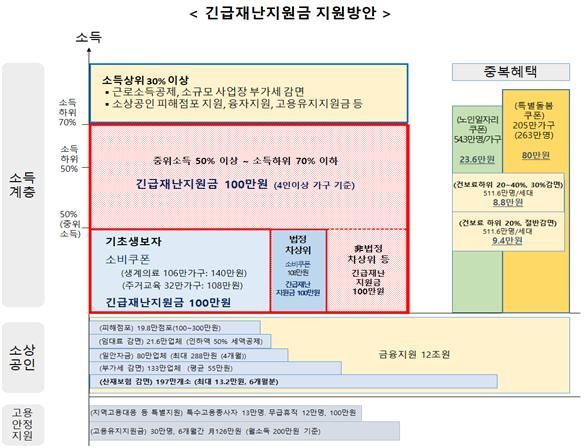
◆ Submission of proof documents required if income has sharply declined = The support fund will be paid up to 1 million KRW (for households of four or more) to households whose combined health insurance premiums imposed in March this year fall within the bottom 70%. For a household of four, the premiums are 237,652 KRW for workplace subscribers, 254,909 KRW for regional subscribers, and 242,715 KRW for mixed subscribers. The emergency disaster relief fund can be received in conjunction with previously announced low-income consumption coupons worth 1.4 million KRW, senior job coupons (236,000 KRW), and special care coupons (400,000 KRW per person). Accordingly, a household of four receiving basic livelihood security benefits can receive cash-type support amounting to up to 3.84 million KRW.
The cut-off criteria for high-net-worth individuals will use taxable income data, setting the threshold at 900 million KRW (exceeding), which is the deduction standard for a single homeowner under the comprehensive real estate tax. This corresponds to households owning homes with a publicly announced value of about 1.5 billion KRW, or market prices around 2 to 2.2 billion KRW. The financial income criterion is set at 20 million KRW, which is the threshold distinguishing comprehensive taxation and separate taxation on interest and dividend income. This corresponds to income generated from deposits of approximately 1.25 billion KRW (assuming a 3-year fixed deposit from 2018 with an annual interest rate of 1.6%).
To assist self-employed individuals whose income reductions are not yet reflected in current health insurance premiums, the government plans to add insurance premiums based on proof documents and include them as support recipients if they meet the selection criteria. Self-employed individuals can submit bankbook copies showing sales deposits from card companies for February and March this year, or sales confirmed through sales management systems (POS). Freelancers or special-type workers such as private tutors can submit service contracts, appointment documents, or certificates confirming non-provision of labor. However, even in these cases, high-net-worth individuals will be excluded from support.
The government projects approximately 14.78 million households will benefit from the support announced this time, but this includes about 125,000 households estimated to be cut off. Adding requests for self-employed relief makes the exact scale of beneficiaries variable.
◆ Actual payment timing uncertain = The government is preparing measures to enable payment of the support fund immediately after the supplementary budget bill, approved at the temporary Cabinet meeting on the 16th, is deliberated and approved by the National Assembly. However, even after passing the National Assembly, administrative procedures such as household applications and eligibility assessments must be completed, making it difficult to specify when the support funds will actually reach recipients' wallets.
In broad terms, this support fund will be paid only if the eligible households 'apply.' Each household will verify whether they fall within the bottom 70% through the Ministry of Health and Welfare website or other means, then apply to their local government. Local governments will refer to the health insurance premium database (DB) to determine payment eligibility. Therefore, even if the National Assembly approval process accelerates, actual full-scale payments are likely to begin from next month.
To address the 'speed' issue, the government is preparing both online and offline application procedures and is reviewing various payment methods such as local gift certificates, electronic money, and credit/debit card charging. Local governments are also preparing to organize one-point local supplementary budgets to enable support fund payments as soon as the government’s supplementary budget is finalized by the National Assembly.
◆ National Assembly decision is a variable... possibility of 100% payment push = The biggest variable is the National Assembly's decision. Especially with the Democratic Party's landslide victory in the general election, the party's push for '100% payment' has gained momentum. If the Democratic Party's proposal to pay up to 1 million KRW to all households is adopted, the expected support scale would reach 13 trillion KRW, requiring a new supplementary budget.
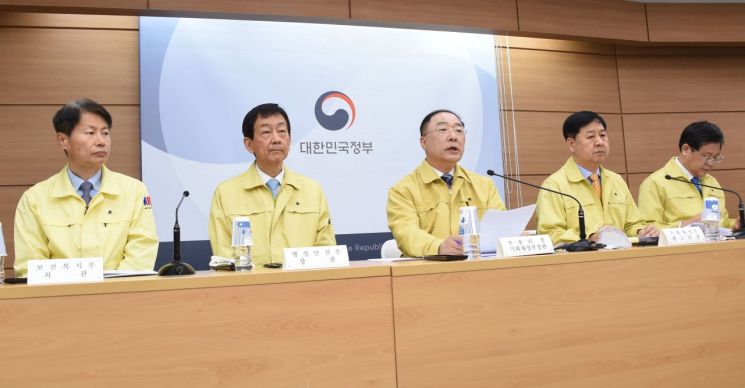
The government intends to persuade the National Assembly to maintain the original plan, which set the target scale considering urgency, efficiency, and fiscal capacity comprehensively. Hong Nam-ki, Deputy Prime Minister and Minister of Economy and Finance, said at a briefing that day, "We will maintain the original position so that the 70% standard set by the government can be upheld in the National Assembly."
Some voices are also emerging for a 'third and fourth supplementary budget' to minimize economic damage amid the prolonged COVID-19 crisis. Ahn Il-hwan, Director of the Budget Office at the Ministry of Economy and Finance, explained, "It is difficult to judge now whether a third supplementary budget is necessary or not. We are responding with various resources, and if necessary, the government can step in again to provide support through fiscal measures."
© The Asia Business Daily(www.asiae.co.kr). All rights reserved.
![Clutching a Stolen Dior Bag, Saying "I Hate Being Poor but Real"... The Grotesque Con of a "Human Knockoff" [Slate]](https://cwcontent.asiae.co.kr/asiaresize/183/2026021902243444107_1771435474.jpg)

















