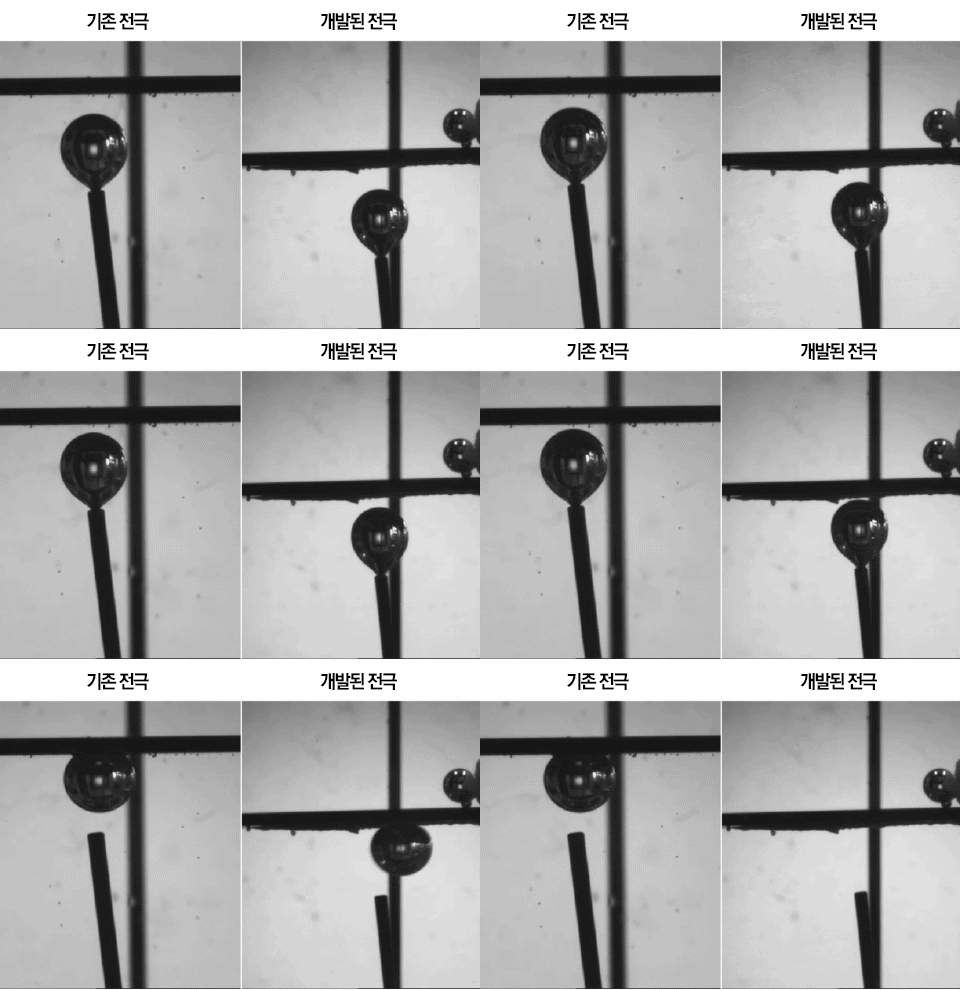
 Test Results of Air Bubble Detachment for Conventional Electrode and Ultra-Hydrophobic Film Electrode
[Asia Economy Reporter Junho Hwang] Domestic researchers have developed a technology that enhances the efficiency of water electrolysis (water splitting) by utilizing a polymer gel with numerous microscopic pores on its surface. This is expected to impact productivity improvements in the chemical industry and carbon dioxide resource utilization. Ulsan National Institute of Science and Technology (UNIST) announced on the 16th that the research results of Professor Jeongki Ryu and Professor Dongwook Lee's chemical engineering research team were published in the international academic journal Science Advances.
The research team developed a technology that can increase hydrogen production by up to five times simply by coating the electrode surface during water electrolysis without using new catalysts.
The team developed a porous hydrated gel that prevents gas bubbles from adhering to the electrode during water electrolysis. This gel is a polymer material capable of absorbing a large amount of water, and when coated on a solid surface, gas does not stick but falls off. The research team reported that hydrogen generation efficiency was increased fivefold using electrodes coated with this gel.
Professor Jeongki Ryu explained, "Polymer materials cannot act as catalysts to promote reactions and are electrically insulating, so they were expected to reduce water electrolysis efficiency. Because of these reasons, they had never been used on electrodes before, but by applying them as a coating on the electrode surface, we were able to overcome the drawbacks of the water electrolysis method."
In particular, this gel can be applied to any solid regardless of the material, and since it only requires coating, it can be considered inexpensive and simple.
Professor Dongwook Lee said, "This research is the first to implement 'superhydrophobicity (a property that repels gas)' on various solid surfaces using 'coating of porous polymer hydrated gel.' We expect this technology to be applicable not only to water electrolysis but also to various fields such as carbon dioxide resource utilization."
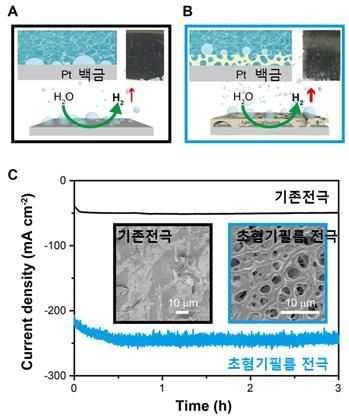 Comparison of Hydrogen Gas Generation Efficiency Between Conventional Electrodes and Ultra-Anaerobic Film Electrodes
© The Asia Business Daily(www.asiae.co.kr). All rights reserved.
!["The Woman Who Threw Herself into the Water Clutching a Stolen Dior Bag"...A Grotesque Success Story That Shakes the Korean Psyche [Slate]](https://cwcontent.asiae.co.kr/asiaresize/183/2026021902243444107_1771435474.jpg)

















