Democratic and United Parties Lead in Vote Share in Ho and Yeongnam Respectively
Civilians Say "This General Election Result Is a Product of Regional Sentiment"
Experts Advise "Political Sphere Must Move Beyond Regionalism-Based Factionalism"
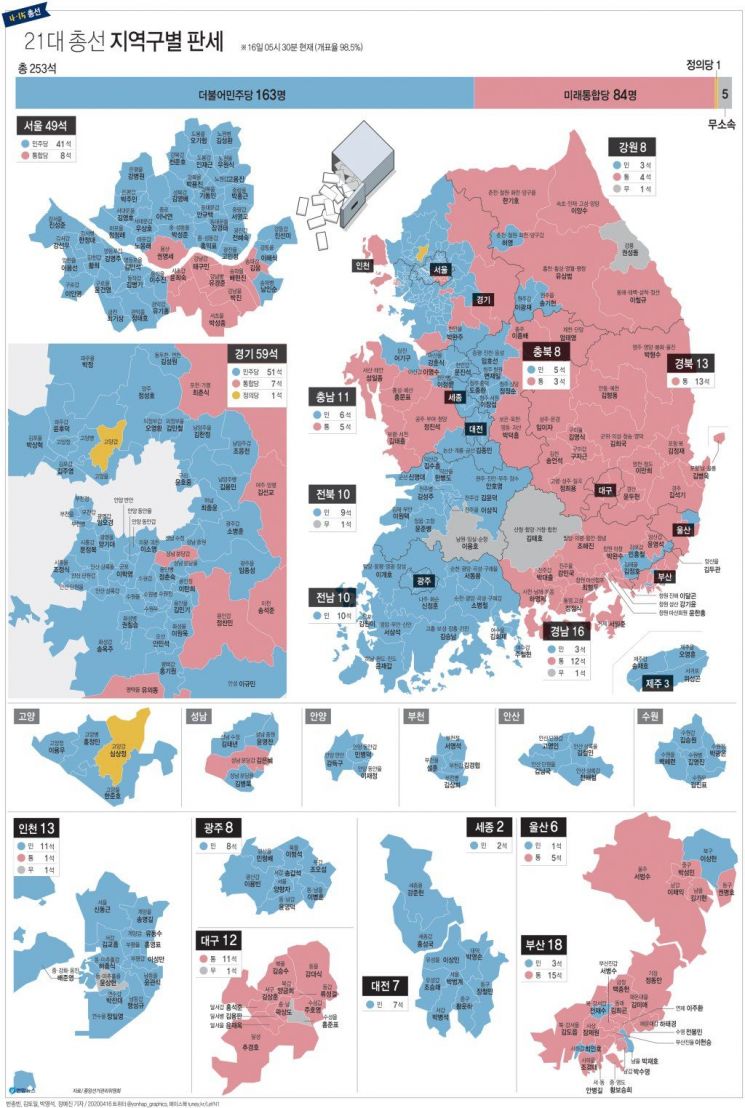 In the 21st general election held on the 15th, the Democratic Party secured a total of 27 seats in the Honam region constituencies (Gwangju 8, Jeonnam 10, Jeonbuk 10), while the United Party won 55 seats in the Yeongnam region constituencies (Daegu 11, Ulsan 6, Gyeongbuk 13, Busan 18, Gyeongnam 16), highlighting regional sentiments based on a two-party structure.
 Photo by Yonhap News
[Asia Economy reporters Seunggon Han and intern Seulgi Kim] There are concerns that regionalism may be intensifying following the results of the 21st general election. Looking at the election results, the Democratic Party of Korea secured a total of 27 seats in the Honam region constituencies (Gwangju 8, Jeonnam 10, Jeonbuk 10). The United Future Party won 55 seats in the Yeongnam region constituencies (Daegu 11, Ulsan 6, Gyeongbuk 13, Busan 18, Gyeongnam 16). Some have even made self-deprecating remarks suggesting that the country has been split into two. Additionally, there are criticisms that the two-party dominance has not been broken.
A (25), who revealed that they voted on the 15th, said, "Looking at the map showing the election results, it feels like Korea is divided strictly into east and west," adding, "During the campaign period, there were candidates who incited regionalism, which was exhausting, and seeing the results, I feel that regionalism has only deepened, not improved."
Such criticism has spread further on online communities. On one online bulletin board, several posts appeared with claims such as "I am disappointed in Daegu and Gyeongbuk. I will not even travel to the Daegu and Gyeongbuk regions in the future," and "People from Jeolla should be stripped of their voting rights. Let's not help the Jeolla region."
B, a user of a Democratic Party-leaning online community, said, "Daegu clearly forgot all the help from the government and the people during the COVID-19 crisis," and raised their voice, "I will not even eat franchise food that started in the Daegu and Gyeongbuk regions."
C, a user of a United Future Party-leaning online community, also strongly criticized, saying, "I will not even travel to the Jeolla region," and "I cannot understand Jeolla, which insists that conservatives are absolutely unacceptable. The voting rights of Jeolla people should be revoked. From now on, no matter what happens in the Jeolla region, we should never help them."
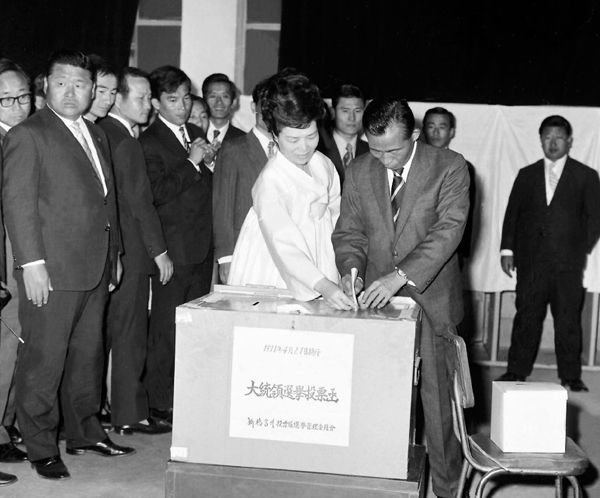 On April 27, 1971, former President Park Chung-hee and his wife exercised their voting rights at the Seonhee School polling station in Jongno-gu, Seoul, during the 7th presidential election. Photo by Government Archives Collection
Winning elections by exploiting regionalism is a shameful aspect of Korean political history. Instead of healthy competition based on pledges for the people, candidates often resort to 'get-elected-first' reckless pledges or reinforce regionalism, which ultimately hinders national development.
The regional conflict between Yeongnam and Honam, represented by Gyeongsang-do and Jeolla-do, began in earnest during the 1971 presidential election battle between Democratic Republican Party candidate Park Chung-hee and New Democratic Party candidate Kim Dae-jung.
In the 7th presidential election, Park Chung-hee received 53.2% of the nationwide vote, while Kim Dae-jung received 45.2%. Although the vote difference between the candidates was not large in Seoul and Gyeonggi, Park Chung-hee had a dominant vote share in Gyeongbuk and Gyeongnam regions, with 65.62% and 73.35% respectively, compared to Kim Dae-jung’s 23.32% and 25.56%.
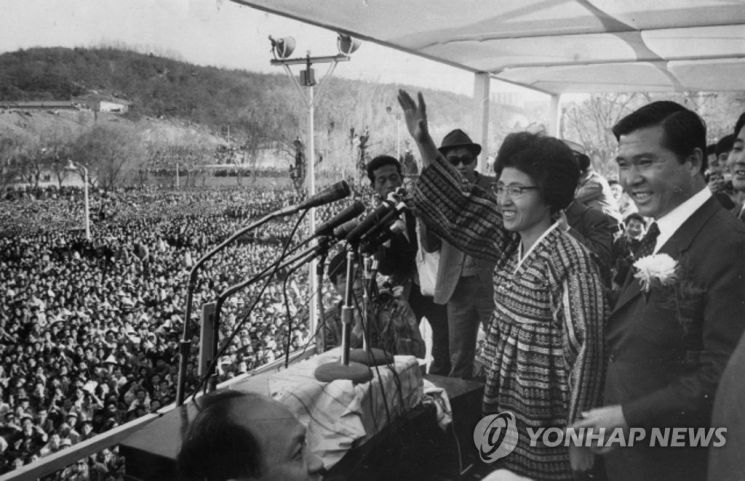 In 1971, at Jangchungdan Park, Mrs. Lee is greeting the audience during the election campaign of former President Kim, who was the opposition candidate in the 7th presidential election at the time. Photo by Yonhap News
Similarly, in Jeonbuk and Jeonnam, Kim Dae-jung’s vote shares were high at 61.52% and 62.80%, while Park Chung-hee’s vote shares were significantly lower at 35.48% and 34.43%.
In the 13th presidential election in 1987, conservative candidates dominated the Yeongnam region votes, while progressive candidates secured the Honam region votes by a significant margin.
As a result, current politicians are voicing calls to resolve the deep-rooted regional conflicts by urging the alleviation of regionalism. The aim is to end extreme politics of the past and elect workers who genuinely serve the people through practical pledges.
Lee Nak-yeon, elected as a member of the National Assembly from Jongno District, Seoul, appealed during a campaign rally in Pohang, Gyeongbuk on the 13th, "How about showing a relaxation of regionalism by the citizens of Pohang as well as the residents of Daegu and Gyeongbuk, thereby inspiring the entire nation?"
At the support rally for candidates Oh Jung-gi of Buk-gu and Heo Dae-man of Nam-gu and Ulleung, held in front of Pohang City Hall that day, Lee made this appeal, asking for "a demonstration of easing regionalism."
On the 7th, Won Yoo-chul, leader of the Future Korea Party, who visited Gwangju, a conservative-weak region, said, "We will remember the spirit of May 18 and strive harder for healing and regional integration," and "We will devote ourselves to sustainable development of Honam with a practical spirit and build trust."
He also apologized again for past wounds inflicted on Gwangju citizens, saying, "Despite the COVID-19 crisis, Gwangju citizens showed beautiful solidarity. They actively supported Daegu citizens with human resources such as medical staff and volunteers, and material resources such as masks, hand sanitizers, daily necessities, and food," expressing hope for easing regional conflicts.
Experts have suggested that the political sphere must move beyond regionalism-based factional logic.
Yang Seung-ham, former professor of Political Science and Diplomacy at Yonsei University, explained, "In the 21st general election, regionalism, which had been easing, seems to have returned to a considerable level. Since last year’s Cho Kuk incident, political mobilization based on factional logic has taken place, and this is reflected in the voting behavior this time."
Yang added, "Ideological factionalism and regionalism overlapped, strengthening regionalism. Those running parties within a political power structure based on regional sentiments, which is already solid, need to improve their behavior of moving solely based on factional logic for election victory rather than the country's future."
© The Asia Business Daily(www.asiae.co.kr). All rights reserved.



















