Birth of 'Dinosaur Ruling Party' Holding Three-Fifths of the National Assembly
Mirae Tonghap and Korean Party Secure Only 103 Seats
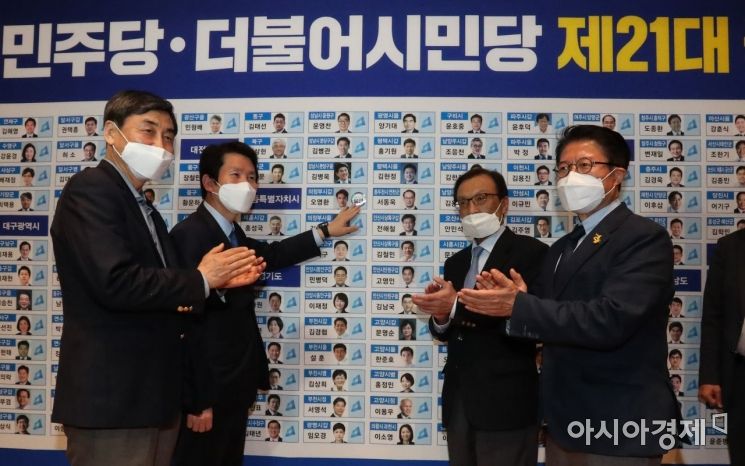 Lee Hae-chan, leader of the Democratic Party of Korea, Lee In-young, floor leader, and Woo Hee-jong, election committee chairman of the Democratic Citizen Party, are placing election winner stickers on the elected candidates at the comprehensive vote counting situation room set up in the National Assembly on the 15th. Photo by Yoon Dong-joo doso7@
In the 21st general election held on the 15th, the Democratic Party of Korea and the proportional representation party, the Together Citizens' Party, secured over 180 seats, resulting in the emergence of a 'giant ruling party.'
As of 6:22 a.m. on the 16th, with a nationwide vote count rate of 99.3%, the Democratic Party of Korea and the proportional party Together Citizens' Party were counted to have secured a total of 180 seats independently. The United Future Party and the Future Korea Party secured 103 seats, just 3 seats above the constitutional amendment blocking threshold of 100 seats.
Looking only at the constituency votes, the Democratic Party won 163 seats, the United Future Party 84 seats, the Justice Party 1 seat, and independents 5 seats.
In the proportional representation votes, with a counting rate of 92.66%, the Future Korea Party received 34.18%, the Citizens' Party 33.21%, the Justice Party 9.54%, the People's Party 6.71%, and the Open Democratic Party 5.32%.
Converted into seats, this is expected to be 19 seats for the Future Korea Party, 17 seats for the Citizens' Party, 5 seats for the Justice Party, 3 seats for the People's Party, and 3 seats for the Open Democratic Party.
If the ruling party secures three-fifths of the National Assembly seats, it can independently pass fast-track (rapid processing agenda) bills, effectively neutralizing the revised National Assembly Act known as the Advancement Act.
The emergence of a giant 'dinosaur party' surpassing three-fifths of the total seats as a single party is unprecedented since democratization in 1987, enabling the ruling party to exercise most legislative powers except for constitutional amendments.
If the government pushes further on major legislative tasks such as judicial reform, it could gain momentum for full-scale reform initiatives even beyond the mid-term of its administration.
On the other hand, the United Future Party, which suffered a devastating defeat in most regions except for parts of the Gangnam belt and its stronghold Yeongnam, faced aftershocks including the resignation of leader Hwang Kyo-ahn and the possibility of forming an emergency committee.
Although the Justice Party secured some seats in this election, the position of the third party has significantly diminished, and the 21st National Assembly with a 'ruling party majority and opposition minority' is expected to return to a largely two-party system, signaling an overall change in the legislative landscape.
© The Asia Business Daily(www.asiae.co.kr). All rights reserved.

















