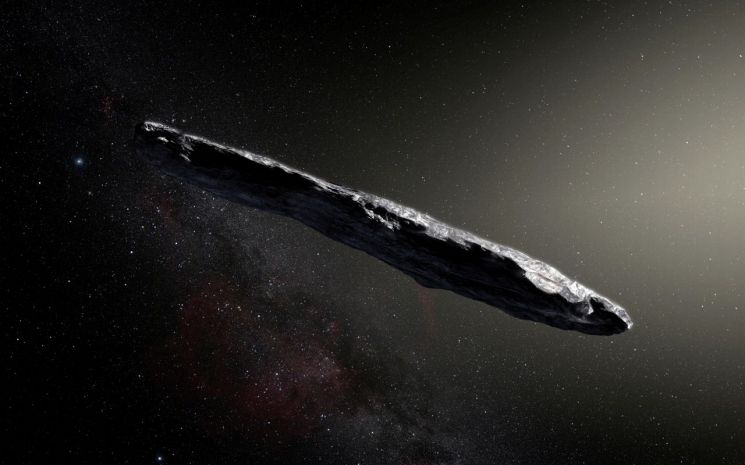
[Asia Economy Reporter Kwon Jae-hee] A new study suggests that 'Oumuamua,' the celestial object located among the first stars observed in the solar system, may be a fragment of a celestial body torn apart after approaching a star.
Various claims have been made about Oumuamua, ranging from a comet to an asteroid to an alien probe. This is because it exhibited many unusual characteristics, such as its elongated cigar shape, tumbling rotation along its major axis, and the absence of a typical long tail seen in comets, which sparked much debate.
An international research team led by Zhang Yun of the National Astronomical Observatories of China (NAOC) demonstrated through computer simulations that celestial bodies like Oumuamua can form due to stellar tidal forces. Their findings were published in the latest issue of the scientific journal Nature Astronomy.
According to the Chinese Academy of Sciences and the University of California, Santa Cruz, the team developed and tested computer simulations that can verify the outcomes when celestial bodies of various sizes?from comets to rocky planets?approach a star closely.
The results showed that when a celestial body approaches within 600,000 km of a star, the star’s gravity tears the body apart and ejects the fragments as interstellar objects. This distance is about 1/80th of the distance between the Sun and Mercury, the innermost planet of the solar system.
The fragments of these celestial bodies have elongated shapes and dry surfaces, and they accelerate as they pass near the star, matching the unusual phenomena observed in Oumuamua.
Additionally, the research team confirmed that the ratio of the major to minor axes of the fragments torn apart by stellar tidal forces can exceed 10 to 1.
Moreover, the surface of the fragments is molten when close to the star but hardens as they move away, allowing the elongated shape to remain stable. During this process, volatile materials evaporate, maintaining a dry surface. This provides a sufficient explanation for why Oumuamua did not exhibit a 'coma'?a gas and dust cloud typical of comets.
The team explained that although Oumuamua showed acceleration similar to a comet when orbiting the Sun without displaying a coma, all volatile materials on its surface had evaporated. However, ice buried deep underground did not sublimate and remained, evaporating during its solar orbit and causing the non-gravitational acceleration phenomenon.
The researchers analyzed that the original celestial body from which Oumuamua broke off could have been a small minor planet orbiting a low-mass star or a white dwarf, or it could have been a super-Earth-sized rocky planet.
The team stated, "This model not only explains the formation process of Oumuamua but also accounts for the countless interstellar objects like Oumuamua." They added, "Interstellar objects represent a very new field and can provide important clues about the formation and evolution of planetary systems."
Douglas Lin, an astronomer at UC Santa Cruz and co-author of the paper, said, "Oumuamua is just the tip of the iceberg. Once the Vera C. Rubin Observatory (Large Synoptic Survey Telescope) becomes operational, many more interstellar objects with similar characteristics will be discovered."
© The Asia Business Daily(www.asiae.co.kr). All rights reserved.
![User Who Sold Erroneously Deposited Bitcoins to Repay Debt and Fund Entertainment... What Did the Supreme Court Decide in 2021? [Legal Issue Check]](https://cwcontent.asiae.co.kr/asiaresize/183/2026020910431234020_1770601391.png)















