High Possibility of Democratic Party Victory in Polls
Four Years Ago, Saenuri Predicted to Win Big... But Democratic Party Won by 1 Seat
"Results Could Differ This Time Too"... Poll Limitations Pointed Out
"Accuracy Improved with Ansim Number" Rebuttal Also Raised
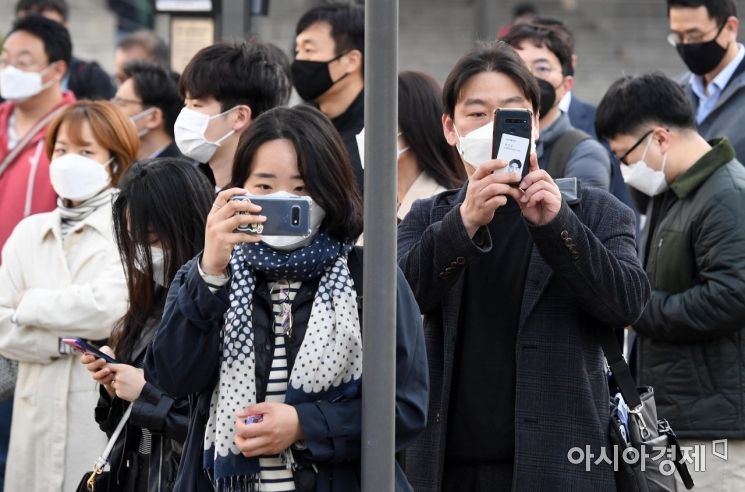 On the 14th, one day before the 21st National Assembly election, citizens near Gangbyeon Station in Seoul are watching a candidate's street campaign. Photo by Hyunmin Kim kimhyun81@
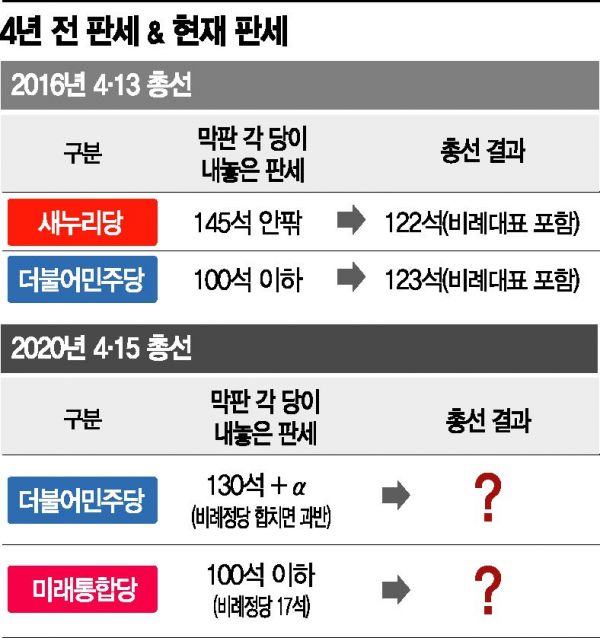
[Asia Economy Reporter Kim Hyemin] On the 14th, one day before the voting day, polling experts predicted a comfortable victory for the Democratic Party of Korea. Hong Youngsik, director of Hangil Research, said, "If you include the proportional representation parties, there is a sufficient possibility of a majority," and added, "It is true that the United Future Party is in a difficult situation." The forecasts of each party do not deviate from this. Out of 253 constituencies, the Democratic Party is expected to win '130 seats + α,' while the United Future Party is projected to have 'less than 100 seats.'
Compared to the situation one day before the 2016 general election, the political landscape between the ruling and opposition parties is completely reversed. At that time, most polling agencies predicted that the ruling Saenuri Party (now the United Future Party) would secure a majority. The Democratic Party worried in its own analysis that "even including proportional representation, 100 seats would be difficult." However, the actual result overturned everyone's predictions, with the Democratic Party winning 123 seats and the Saenuri Party 122 seats. This is the basis for the last hope among opposition parties that "you only know after opening the actual ballot box."
Current polls have clearly improved compared to the last general election. Above all, the biggest reason cited for failing to reflect public sentiment?the issue of landline phones?has been resolved. Moving away from the past method where only landline phone surveys were possible, virtual numbers were assigned to mobile phones, enabling mobile phone surveys. This made it easier for young people and office workers, whose opinions significantly influence election results, to participate in polls. Director Hong said, "If the past survey method overrepresented conservative parties, now the sample frame has changed to 10-40% landline phones and 60-90% mobile phones," adding, "This has improved accuracy."
However, there are still criticisms that polls cannot guarantee the overall public sentiment. A representative issue is that the polling results can fluctuate depending on the proportion of newly introduced mobile phone surveys. Just as a higher proportion of landline phones increased the response rate of conservative-leaning voters, a higher proportion of mobile phone surveys may increase the response rate of relatively progressive-leaning voters.
Even with polls conducted during similar periods, rankings have been completely reversed depending on the wired and wireless ratio. In the case of Dongjak-eul, Seoul, in the Embrain Public poll (surveyed on April 7) which set the landline phone ratio at 10%, Democratic Party candidate Lee Sujin (48%) was shown to lead United Future Party candidate Na Kyungwon by 13 percentage points. However, in the Jowon C&I poll (surveyed April 4-5), which increased the landline phone ratio to 31%, Na Kyungwon (44.1%) was shown to lead Lee (40.9%).
There are also voices pointing out the overrepresentation of ruling party supporters in polls. Professor Kim Minjeon of Kyung Hee University said, "Opposition party supporters tend not to respond well to polls. Especially shy conservatives tend to keep quiet," explaining, "This is why the ruling party has appeared higher in past polls." Professor Shin Yul of Myongji University said, "With Korea's polling method, where once a call is disconnected, they do not call again, it is impossible to properly capture the undecided voters," adding, "Those who answer immediately are definite supporters and will all go to the polls."
Additionally, even within the same constituency in general elections, support tendencies can vary greatly by neighborhood, so the polling results can differ depending on which neighborhood voters responded from. Also, it is fundamentally difficult to capture accurate public sentiment with a sample size of around 500 people. The fact that there are many competitive constituencies rather than an absolute dominance by one side is also cited as a reason why polling results and actual voting outcomes may differ. The Democratic Party considers 70 constituencies, and the United Future Party considers 50 constituencies as close races where the results can only be known after opening the ballot boxes.
However, considering the trend of polls so far and the controversy over the opposition party's reckless remarks during the blackout period of polls, there is also analysis that the election results will follow the polls. Director Hong said, "Four years ago, the Saenuri Party dropped by 1-2 percentage points daily due to controversies like the pro-Park Geun-hye marketing inspector, but looking at the current relationship between the Democratic Party and the United Future Party, the partisan battles have been evenly matched for almost a month without tilting to either side," adding, "The situation is completely different from four years ago." Professor Lee Junhan of Incheon National University also forecasted, "Compared to the last general election, the effects of Ahn Cheol-soo and Park Geun-hye have faded this time," and "If you combine the progressive forces, 170 seats are not impossible."
© The Asia Business Daily(www.asiae.co.kr). All rights reserved.


















