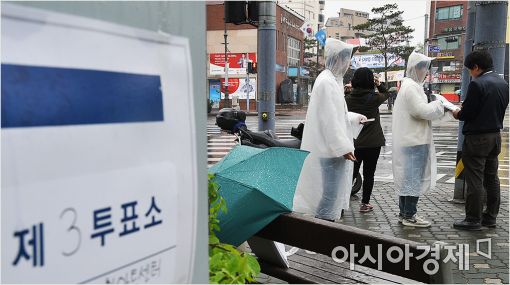
[Asia Economy Reporter Wondara] Interest is rising in the accuracy of broadcast station exit polls ahead of the counting of the 21st National Assembly election, due to the record-high early voting rate and the impact of the novel coronavirus disease (COVID-19). In particular, the significant increase in ultra-close battleground districts is expected to make accurate predictions by exit polls more difficult. Since the 19th general election in 2012, the three major broadcasters have conducted exit polls covering all constituencies.
According to the Broadcasting Association, which oversees the exit polls on the 14th, approximately 11.74 million early voters (26.69%) are excluded from this exit poll survey. This is because, under the Public Official Election Act, exit polls can only be conducted on the actual voting day. This means that the voting intentions of about one in four early voters are omitted from the exit poll results. In the 20th general election, when the early voting rate was less than half of this year's level (12.19%), exit poll predictions also missed the mark. At that time, the exit poll predicted that the Saenuri Party would be the first party and the Democratic Party the second. However, the final count showed the Democratic Party winning 123 seats to become the first party, while the Saenuri Party fell short by one seat with 122 seats.
The reduced number of survey areas and pollsters due to the COVID-19 impact is another variable. According to the Broadcasting Association conducting the 4.15 general election exit polls, about 12,000 pollsters are deployed at 2,321 polling stations for this exit poll. In the 20th general election, about 13,000 pollsters were deployed at 2,530 polling stations. Compared to the 20th general election, the number of survey areas decreased by about 200 and pollsters by about 1,000.
An association official explained, "After consulting with the Korea Disease Control and Prevention Agency and others, the exit poll environment was strengthened to the level of polling station operations, increasing expenses, but the total budget remains at the 20th general election level (7.2 billion KRW)," adding, "We inevitably reduced the number of survey areas and pollsters." The official also said, "In the 20th general election, predictions were wrong in 18 out of 253 areas. Especially in this election, with more than 100 ultra-close districts within 4% margin nationwide among 253 constituencies, overcoming the margin of error will not be easy."
The voting intentions of self-quarantined voters who will vote after the exit poll results are announced are also uncertain. Kim Kang-lip, the first chief coordinator of the Central Disaster and Safety Countermeasures Headquarters, said at a briefing the day before, regarding the impact of exit poll announcements, "We have not reviewed it, but it is certainly a concern." How voter abstention due to COVID-19 infection fears will unfold is also critical. The association explained, "Pollsters are required to wear masks and sanitary gloves, and supervisors frequently check pollsters' temperatures by visiting 5 to 6 locations."
Meanwhile, the broadcast stations' exit poll results will be announced at 6 p.m. on the 15th. The exit poll is conducted by giving a survey form to one out of every five voters leaving the polling station after voting, who then fill in the candidate or party they voted for and submit it. The three major broadcasters predict and announce the results based on this data, combined with prior opinion polls and expert analysis.
© The Asia Business Daily(www.asiae.co.kr). All rights reserved.
![User Who Sold Erroneously Deposited Bitcoins to Repay Debt and Fund Entertainment... What Did the Supreme Court Decide in 2021? [Legal Issue Check]](https://cwcontent.asiae.co.kr/asiaresize/183/2026020910431234020_1770601391.png)














