Labor Institute's Presentation on 'Exploring Employment Policies for COVID-19 Response'
"Strengthen Employment Retention Support for Indirectly Employed Workers"
"Consider Introducing 'Emergency Unemployment Benefits' Like the US and Canada"
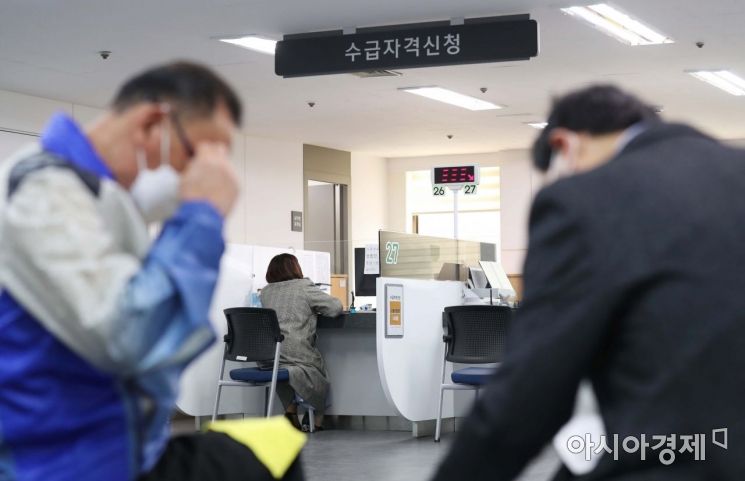 On the 10th, unemployment benefit applicants are receiving consultations at the Western Employment Welfare Plus Center in Mapo-gu, Seoul. Photo by Mun Ho-nam munonam@
[Asia Economy Reporter Kim Bo-kyung] Voices have emerged calling for bold incentives to be provided to companies that maintain employment in order to prevent a massive unemployment crisis caused by the aftermath of the novel coronavirus infection (COVID-19). There are also opinions suggesting that measures to provide unemployment benefits to those not enrolled in employment insurance and unpaid leave workers should be considered.
The Korea Labor Institute released a report titled "Exploring Employment Policies in Response to COVID-19" on the 14th, containing suggestions on job retention and income support for the unemployed, including cases from various countries for reference ahead of the government's employment policy announcement.
Senior Research Fellow Lee Byung-hee of the Labor Institute stated in the report, "The moral hazard issue surrounding subsidies conditional on employment retention during disaster situations is not significant," and added, "It would be acceptable to generously increase employment retention incentives." He believed that, in addition to the government raising the employment retention subsidy to 90% of the suspension allowance, it is necessary to support the costs required to maintain employment as much as possible. He cited the United States' Paycheck Protection Program (PPP), which loans wages, rent, and other expenses to employers and forgives the loans if employment is maintained. He also expressed the opinion that support for employment retention for indirectly employed workers such as dispatched, outsourced, and in-house subcontracted workers should be strengthened.
Furthermore, Senior Research Fellow Lee emphasized the need to strengthen social protection for special-type workers (teukgo), freelancers, and others who are in the blind spots of the employment safety net. As of August last year, only 49.4% of employed persons in South Korea were enrolled in employment insurance, meaning less than half of all employed workers are protected by employment insurance. Despite this, unemployment income support systems are limited to unemployment benefits alone. In contrast, the United States introduced "Disaster Unemployment Assistance," which supports all unemployed persons including self-employed, special-type workers, platform workers, and part-time workers, and Canada temporarily introduced "Emergency Unemployment Benefits" covering all unemployed persons.
Lee suggested that, like the United States and Canada, a temporary emergency unemployment benefit system targeting all unemployed persons should be introduced, and that providing unemployment benefits to workers with no income due to unpaid leave should be considered. He advised, "The more vulnerable groups in the labor market who are not protected by the employment safety net suffer greater income shocks," and added, "This should lead to policy efforts to establish a universal employment safety net for vulnerable groups."
© The Asia Business Daily(www.asiae.co.kr). All rights reserved.
![User Who Sold Erroneously Deposited Bitcoins to Repay Debt and Fund Entertainment... What Did the Supreme Court Decide in 2021? [Legal Issue Check]](https://cwcontent.asiae.co.kr/asiaresize/183/2026020910431234020_1770601391.png)















