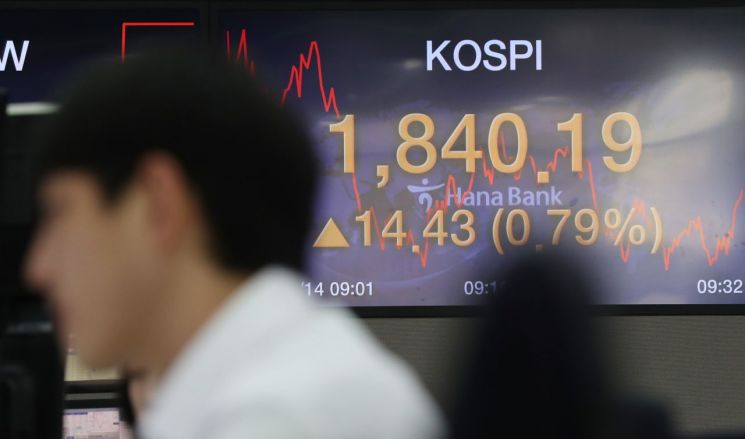
[Asia Economy Reporter Eunmo Koo] As various indices that had plummeted due to the impact of the novel coronavirus infection (COVID-19) have recently shown signs of recovery, the returns of domestic equity index funds are also responding accordingly.
According to fund rating company FnGuide on the 14th, the one-week return of 386 domestic equity index funds as of the previous day was recorded at 7.94%. The one-month return (1.46%) also turned positive. This outperformed the returns of domestic bond funds (0.22%) and equity active funds (6.86%) during the same period. The KOSPI, which had plunged to the 1400 level last month amid extreme uncertainty in the international financial markets due to COVID-19, has recovered to the 1800 level, leading index-linked funds to begin regaining returns.
Looking at individual funds, among those with assets under management exceeding 1 trillion won, exchange-traded funds (ETFs) showed notable returns. The largest ETF, KODEX 200, recorded a 6.91% increase, while KODEX Leverage (13.75%) and KODEX Samsung Group (9.18%) also posted returns above the average. Additionally, KODEX KOSDAQ 150 (7.72%), KBSTAR 200 (7.02%), and TIGER 200 (6.89%) also rose significantly. Among non-ETF funds, NH-Amundi Korea 2x Leverage Securities Investment Trust [Equity-Derivative Type] (13.70%) and Kyobo AXA Power Index Securities Investment Trust (6.97%) ranked high in returns.
As returns increased, the number of investors redeeming shares also rose, leading to a decrease in fund assets. Last month, as fear in the stock market peaked and the index was perceived as bottomed out, fund assets increased. However, as the index showed signs of recovery this month, demand for profit-taking also grew. The assets under management of domestic equity index funds stood at 35.3981 trillion won as of the previous day, down 1.0448 trillion won compared to a week earlier.
Jung Sung-in, head of the ETF Strategy Team at Korea Investment Management, explained, "As the index has recovered significantly, profit-taking from funds that entered at the bottom is occurring." However, he pointed out, "It is important to note that the market has risen not because of relief that it has recovered, but as a counterbalance to the parts that had fallen significantly, combined with government measures."
With individual investors actively entering the stock market recently, there is also advice that index funds can reduce volatility compared to individual stocks. Kim Jong-hyup, head of the Strategy Operation Team at Kiwoom Asset Management, explained, "Individual investors tend to be swayed by supply and demand because it is difficult for them to accurately assess a company's valuation (price level relative to performance). Investing in ETFs or index funds, which consist of multiple stocks, has the advantage of relatively lower volatility and allows individuals to easily calculate valuations."
© The Asia Business Daily(www.asiae.co.kr). All rights reserved.
![User Who Sold Erroneously Deposited Bitcoins to Repay Debt and Fund Entertainment... What Did the Supreme Court Decide in 2021? [Legal Issue Check]](https://cwcontent.asiae.co.kr/asiaresize/183/2026020910431234020_1770601391.png)
















