Authorized Nationwide Sending Rights to Cities, Counties, and Districts Since September Last Year
Increased Trust in Information Provided via Disaster Messages
Some Express "Fatigue Due to High Sending Frequency"
Ministry of the Interior and Safety Advises Local Governments to Refrain from Sending Behavioral Guidelines Like Handwashing
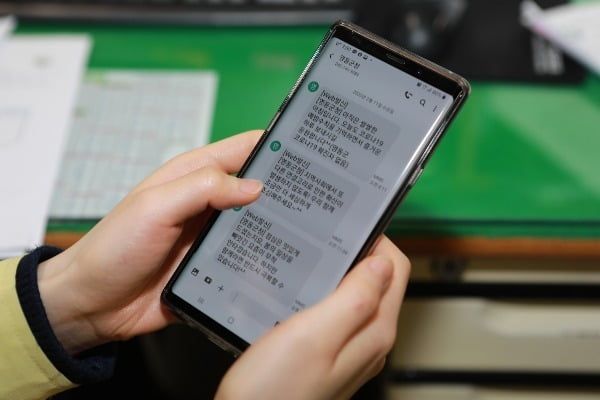 Since the first confirmed case of the novel coronavirus infection in South Korea on January 20, the government and local governments have been delivering related information such as infection prevention guidelines and confirmed case status to citizens through emergency disaster messages.
 Photo by Yonhap News
[Asia Economy Reporter Kim Suwan] "I definitely think it is necessary."
A in their 20s, an office worker, recently expressed a positive view on the emergency disaster safety texts related to the novel coronavirus infection (COVID-19). A said, "Some people complain about receiving disaster texts these days, but I think differently," adding, "The messages sent by local governments help prevent infections." They continued, "Isn't information like confirmed patients' movement paths and prevention guidelines necessary? It's more unsettling when the messages don't come."
Since the first confirmed COVID-19 case in Korea on January 20, the government and local governments have been delivering related information such as infection prevention guidelines and confirmed case status to citizens through emergency disaster texts. However, as the COVID-19 situation has prolonged, the frequency of disaster text messages has increased, leading to ongoing controversy. While some citizens agree on the necessity of the disaster text service, others express stress from the flood of messages.
According to the National Disaster Safety Portal on the 9th, a total of 4,404 disaster texts were sent nationwide last month, averaging 142 messages per day.
According to the Ministry of the Interior and Safety's "Disaster Text Broadcast Standards and Operation Regulations," domestic disaster texts are classified into three levels depending on the severity of the disaster: △Critical disaster (war situation) △Emergency disaster (natural disasters such as typhoons, earthquakes, tsunamis) △Safety guidance (infectious diseases, weather warnings).
Also, disaster texts are sent collectively through mobile carrier base stations based on the current location, not the residence.
The actual senders are local governments nationwide. Originally managed by the Ministry of the Interior and Safety, since 2017 metropolitan cities have been allowed to send disaster texts. In September last year, the authority was extended to basic local governments such as cities, counties, and districts nationwide. Because of this, messages sent at the city level and district level come together.
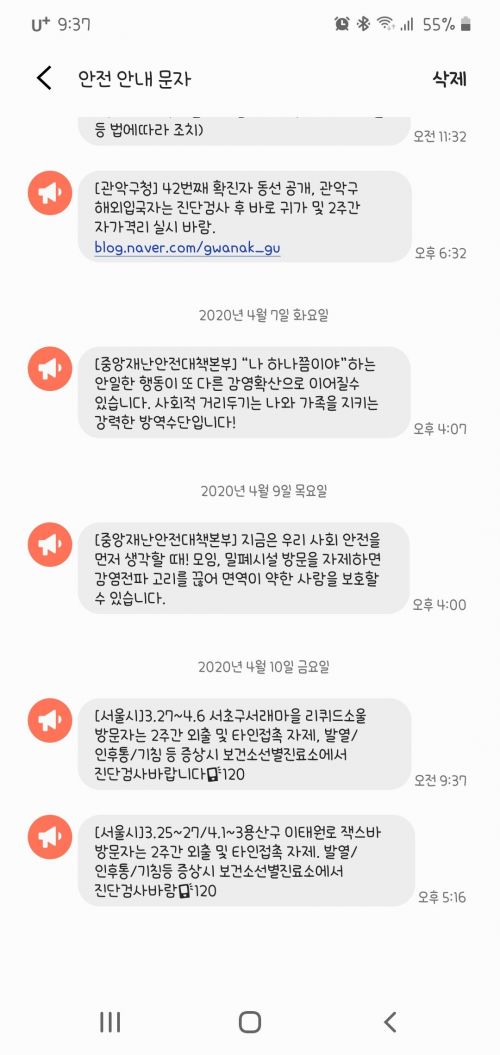 As the COVID-19 pandemic prolongs, the frequency of emergency disaster text messages has increased, leading to ongoing controversies surrounding them. The photo shows an emergency disaster safety message related to COVID-19. Photo by Suwan Kim suwan@asiae.co.kr
According to a survey, many citizens agree on the necessity of the disaster text service.
Market research firm Embrain Trend Monitor conducted a perception survey on "national disaster situations" and "disaster text services" on the 8th targeting 1,000 men and women aged 15 to 64 nationwide who use smartphones. The results showed that 92.2% of respondents said they "trust the information provided in disaster texts."
The reasons cited included △being able to quickly grasp disaster situations (50.1%, multiple responses allowed), △immediately confirming the scale of damage and number of infected people (44.1%), △knowing the situation of the current location and residential area (42.8%), and △being able to know disaster information without having to look it up themselves (35.9%).
The problem is that most messages are about checking confirmed patients' movement paths or urging adherence to "social distancing" guidelines. In particular, some local governments send basic guidance messages such as handwashing.
Because of this, some express fatigue toward disaster texts sent by local governments. B (35), an office worker, said, "I get startled every time by disaster text alerts ringing several times a day," adding, "But I hesitate to change the reception settings because sometimes important information comes."
C, a university student in their 20s, said about disaster texts, "I always checked them at the beginning of the COVID situation," but added, "(However) recently, as the number of new confirmed cases decreased and too much information I already knew came, I refused to receive them."
Meanwhile, the government is researching a disaster text sending system with the three major mobile carriers that can narrow the sending range to within hundreds of meters to improve these issues. They are also discussing ways to reduce excessive message sending, not only technical problems.
The Ministry of the Interior and Safety stated that it has conveyed a policy to local governments to refrain from sending behavioral guidelines such as handwashing and social distancing other than confirmed patients' movement paths.
Some local governments send non-urgent content via regular texts or KakaoTalk, and some accept text service applications through their websites.
© The Asia Business Daily(www.asiae.co.kr). All rights reserved.


















