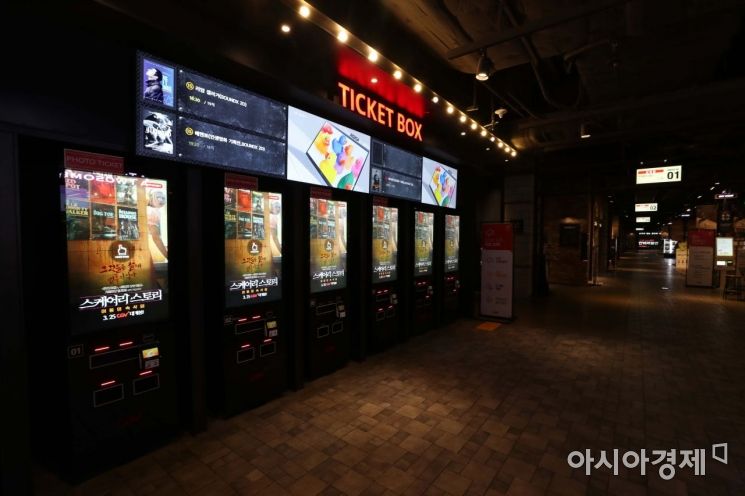
 Due to the government's strict 'social distancing' measures, a movie theater in Yeongdeungpo-gu, Seoul is quiet.
[Asia Economy Reporter Kwangho Lee] As the domestic economy froze due to the spread of the novel coronavirus infection (COVID-19), the government introduced consumption stimulation measures such as reducing the individual consumption tax on automobiles, promoting advance payment and pre-purchase, and expanding the income deduction rate, but it is uncertain whether these will have a proper effect. Although the spread of COVID-19 has somewhat subsided, it is not yet a stage to be relieved, and high-intensity social distancing measures are still in place. Above all, as the social atmosphere of refraining from going out continues, voices are being raised that the development of treatments and vaccines to hasten the end of COVID-19 is urgent.
According to the Ministry of Strategy and Finance on the 10th, the government is continuously presenting domestic demand recovery measures to revive consumption sentiment frozen by the COVID-19 crisis. On the 8th, through the 4th Emergency Economic Meeting presided over by the President, it was decided to urgently inject 17.7 trillion won. Measures to ease the tax burden totaling about 12 trillion won, including the extension of the comprehensive income tax payment deadline, were also introduced. Specifically, during the second quarter (April to June), the card income deduction rate was uniformly expanded up to 80%, and support measures for advance payment and pre-purchase of goods and services were prepared. Last month, measures such as reducing the individual consumption tax, refunding the purchase amount of home appliances, issuing consumption coupons, and reducing rental burdens were also introduced.
These government supports clearly reflect the urgency to revive the rapidly shrinking domestic industry. The number of tourists visiting Korea last month plummeted by 94.7% compared to the same period last year. In fact, domestic travel by foreigners has almost stopped. Due to the disappearance of demand, service industry production in February recorded a 3.5% decline compared to the previous month, marking the largest drop since statistics began in January 2000. Significant decreases continued in accommodation and food services (-18.1%), arts, sports, and leisure (-27.2%), and retail (-6.8%). The Consumer Sentiment Index (CSI), which indicates consumer sentiment, also plunged for two consecutive months to 78.4 last month, cooling to the worst level since the global financial crisis and darkening future prospects.
There is an analysis that it will not be easy for the government's various measures to produce proper effects. These measures are temporarily applied only in the second quarter to induce consumption planned for the second half of the year to be brought forward, but it is insufficient to open wallets firmly closed due to the atmosphere of refraining from going out. Professor Sangbong Kim of the Department of Economics at Hansung University advised, "Due to the COVID-19 situation, people are reluctant to go out. The prolonged situation raises concerns that the consumption cliff will worsen the management difficulties of self-employed and small business owners," adding, "More practical government support measures should come first."
© The Asia Business Daily(www.asiae.co.kr). All rights reserved.

















