"Real Estate Alone Struggles to Rise Amid Economic Recession"
Impact of Gangnam Redevelopment Complexes Also Affects Gangbuk Housing Prices
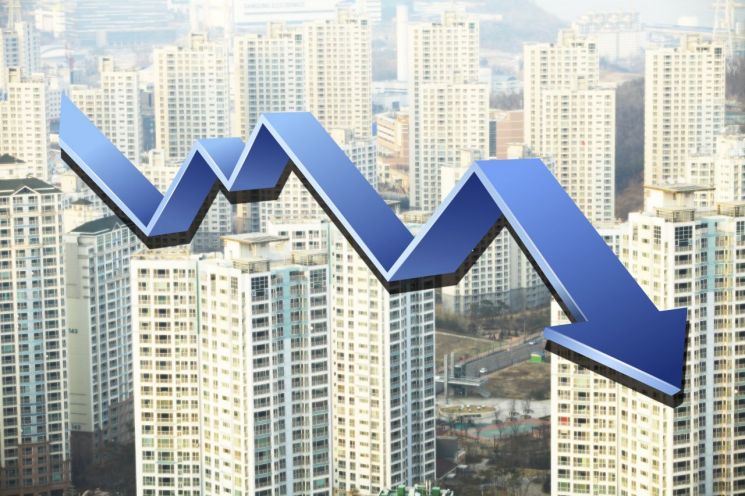
[Asia Economy Reporter Moon Jiwon] The downward trend in housing prices, which began in redevelopment complexes in the Gangnam area, is expanding throughout Seoul. Although the low- to mid-priced apartment clusters in Nowon, Dobong, and Gangbuk districts (collectively known as No-Do-Gang) and Geumcheon, Gwanak, and Guro districts (collectively known as Geum-Gwan-Gu) are still maintaining an upward trend, there are predictions that this rise will soon come to an end.
According to the Korea Real Estate Board on the 10th, as of the 6th, apartment prices in 14 out of the 25 autonomous districts in Seoul showed a decline compared to the previous week. Including districts such as Dongdaemun, Yangcheon, and Yeongdeungpo, which showed a stable trend, most housing price increases have stalled. Consequently, apartment prices in the 11 districts north of the Han River, which had been rising continuously since July last year, have returned to a stable trend.
Industry experts believe that if the downward trend continues in Mapo, Yongsan, and Seongdong districts (collectively known as Ma-Yong-Seong), which have led the rise in housing prices in the northern part of Seoul, it is highly likely that housing prices in the northern area will soon turn negative (-). Mapo district’s decline widened from -0.02% last week to -0.04% this week, and Yongsan district’s from -0.01% to -0.04% during the same period.
In Seoul, only No-Do-Gang and Geum-Gwan-Gu maintained a steady rise of 0.02% to 0.05%. For example, the actual transaction price of a 31.98㎡ unit in Jugong Complex 5 in Sanggye-dong, Nowon district, remained stable in the high 400 million won to low 500 million won range from January to March this year, showing little change even after the COVID-19 pandemic.
However, as the areas experiencing housing price declines are expanding, it is difficult for these regions to avoid downward pressure. Professor Kwon Daejung of Myongji University’s Department of Real Estate stated, "In an economic recession, it is hard for real estate prices alone to rise."
Incheon and Gyeonggi Province are also showing a slowdown in apartment price growth compared to the previous week. In particular, the upward trend in Suwon’s Gwonseon and Yeongtong districts, which surged earlier this year due to regulatory balloon effects, has stopped after 21 and 39 weeks, respectively.
Some analysts suggest that if there is no sharp increase in urgent sales by the end of May, when the capital gains tax surcharge on multiple homeowners is excluded, the decline in housing prices may not be as severe as expected. In fact, among multiple homeowners, despite the increased holding tax burden due to the recent sharp rise in official property prices, there is a sentiment to hold onto their properties for now rather than sell.
Kwon Il, head of the research team at Real Estate Info, said, "The downward trend is expected to continue for the time being," but added, "If a flood of properties comes onto the market in Gangnam or Ma-Yong-Seong by June, there will be a time when overall housing prices collapse, but if not, there is a possibility that the upward trend will resume after that."
© The Asia Business Daily(www.asiae.co.kr). All rights reserved.
![Clutching a Stolen Dior Bag, Saying "I Hate Being Poor but Real"... The Grotesque Con of a "Human Knockoff" [Slate]](https://cwcontent.asiae.co.kr/asiaresize/183/2026021902243444107_1771435474.jpg)
















