Final Agreement Delayed Due to Mexico's Opposition... US, Canada Likely to Increase Production Cut Demands
Additional Supply Stabilization Measures Discussed at G20
[Asia Economy Reporter Naju-seok] The 'oil price war' between Saudi Arabia and Russia has encountered another unexpected obstacle in Mexico. Mexico has opposed accepting a production cut of 400,000 barrels per day. However, even if the Organization of the Petroleum Exporting Countries (OPEC) and the OPEC+ alliance of non-OPEC oil-producing countries persuade Mexico, the prevailing view in the market is that unless a significant production cut is achieved, the impact on prices will be limited. This is because the tentative agreement to cut production by 10 million barrels per day is insufficient to resolve the oversupply amid a sharp decline in global oil demand due to the novel coronavirus disease (COVID-19).
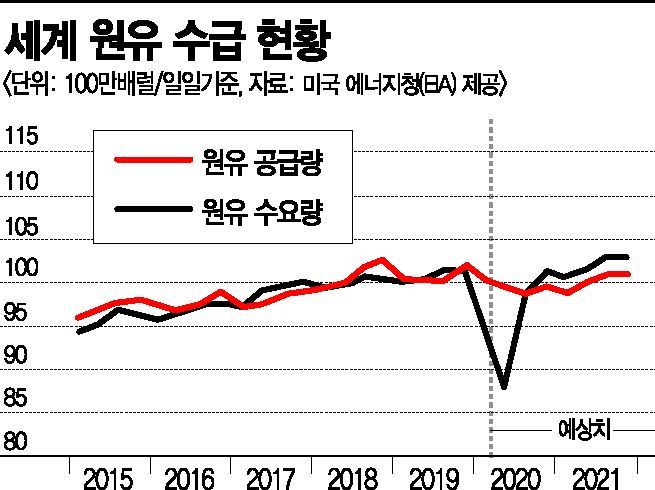
Experts estimate that lockdown measures to contain the spread of COVID-19 will reduce average daily oil consumption by 30 million barrels in the short term. OPEC Secretary-General Mohammed Barkindo pointed out, "The supply-demand situation is chilling," adding, "In the second quarter, the demand reduction is close to 12 million barrels per day on average and is gradually expanding." The pace of oil production cuts is struggling to keep up with the decline in supply and demand caused by the economic downturn.
With Mexico also resisting the production cut agreement, additional persuasion efforts are necessary.
Even if the OPEC+ agreement is finally reached, many hurdles remain.
OPEC+ has proposed a production cut plan of 10 million barrels per day and is also demanding that the United States, Canada, and Brazil reduce their daily oil production by 5 million barrels.
Experts expect a kind of breakthrough at the Group of Twenty (G20) energy ministers' meeting. It is anticipated that the United States, Canada, and Brazil will present concrete plans for market stabilization at this meeting. There are also forecasts that countries may expand strategic petroleum reserves to stabilize the market. For this reason, some believe that the true oil supply and demand measures will come from the G20 meeting results rather than the OPEC+ agreement.
Foreign media expect that at the G20 energy ministers' meeting, countries will discuss expanding strategic petroleum reserves and a global production cut of 15 million barrels per day to resolve supply-demand issues.
The key issue is whether non-OPEC member countries such as the United States will participate. The United States maintains an official stance of not engaging in government-level production cut negotiations related to global production cut discussions. It advocates market-based supply-demand balance adjustments, where U.S. oil producers reduce output due to low oil prices.
However, the fact that U.S. President Donald Trump discussed oil market stabilization measures during phone calls on the 9th (local time) with Saudi King Salman bin Abdulaziz Al Saud and Russian President Vladimir Putin is seen as a variable. After the calls, President Trump said, "We had a good conversation," and predicted, "Oil prices have hit bottom and will probably start to rise."
Although the United States advocates market-driven production cuts, there is also speculation that it may take actual production cut measures. In Texas, a major U.S. oil-producing state, a railroad commission meeting is scheduled for the 14th to discuss production cuts and related issues. The meeting was convened after some U.S. oil producers expressed the need for production cuts.
Helima Croft, Global Head of Commodity Strategy at RBC Capital Markets, expressed concern, saying, "A large-scale production cut agreement will be reached in some form, but specific details such as the duration of cuts, implementation plans, and enforcement measures may be omitted." She emphasized that detailed planning is needed at this point.
© The Asia Business Daily(www.asiae.co.kr). All rights reserved.

















