Eurozone 19 Countries' Finance Ministers Reach Agreement After Difficult Negotiations
[Asia Economy Reporter Jeong Hyunjin] The Eurogroup, a consultative body of finance ministers from the Eurozone (19 countries using the euro), has agreed to establish a new coronavirus disease 2019 (COVID-19) relief fund totaling 540 billion euros (approximately 715 trillion won). The so-called 'corona bonds,' Eurozone joint bonds desired by Southern European countries, were not included in the measures.
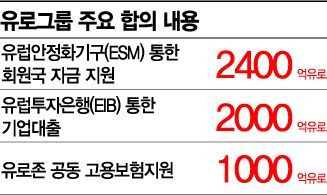
According to Bloomberg and others on the 9th (local time), finance ministers of European Union (EU) member states agreed during an emergency video conference on a financial plan to support countries, companies, and workers hit by COVID-19 through the Eurozone relief fund and other means. The agreement includes utilizing 240 billion euros from the European Stability Mechanism (ESM) to support member states and securing up to 200 billion euros in corporate loans through the European Investment Bank (EIB). Additionally, 100 billion euros will be used for joint Eurozone employment insurance support. This plan will be implemented after final approval by EU leaders next week.
The agreement was reached after intense discussions among member states. The Eurogroup had failed to reach a conclusion even after a 16-hour meeting on the 7th and reconvened on this day. The key issue discussed on the 7th was the conditions for ESM support. At that time, the Netherlands emphasized that there should be conditions such as a commitment to economic reforms for repayment when receiving ESM funds. However, Italy insisted that since the COVID-19 situation is a crisis, funds should be provided without any conditions.
Ultimately, the agreement set a limit up to about 2% of the member states' gross domestic product (GDP), with the condition that the funds be used only for areas directly or indirectly related to COVID-19. Italy will be able to receive 38 billion euros in emergency health funds.
During this process, German Chancellor Angela Merkel and French President Emmanuel Macron reportedly played a mediating role by communicating with Italian Prime Minister Giuseppe Conte and Dutch Prime Minister Mark Rutte. The meeting was scheduled to start at 5 p.m. but was repeatedly delayed due to prolonged pre-coordination among member states.
However, the corona bonds, which were one of the topics of discussion in this agreement, were not included. Corona bonds, similar in nature to the 'Eurobonds' proposed during the Eurozone financial crisis, are bonds jointly issued by member states instead of individual government bonds issued separately by each country to share fiscal risks among member states. Foreign media reported that even Chancellor Merkel clearly opposed corona bonds, preventing the agreement from moving forward. Mario Centeno, Eurogroup chairman, described the agreement as "bold and tremendous, unimaginable a few weeks ago," and evaluated, "Today, we agreed on three safety nets and a recovery plan to grow together and not fall apart in times of crisis."
Although EU finance ministers dramatically reached a consensus, conflicts remain. As conflicts between Northern and Southern Europe over the use of EU funds have surfaced, foreign media predict fierce disputes among member states over the burden of the costs incurred. In particular, Italy continues to insist on issuing corona bonds.
© The Asia Business Daily(www.asiae.co.kr). All rights reserved.


















