Industry: "Thankful for the ventilators, but securing cash flow is more urgent"
Academia: "Evaluation possible only after 6 months... If recession persists, tax waste criticism remains"
No disagreement that government and public corporation's decision is better than a decade of delayed responses and misjudgments
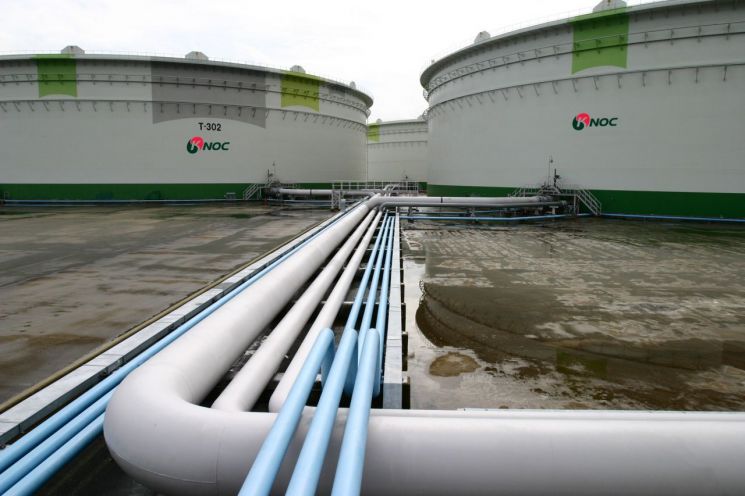
[Asia Economy Reporter Moon Chaeseok] The government announced that it will secure 640,000 barrels of strategic oil reserves this year, approximately 2.4 times more than last year, which the refining industry welcomes. However, some critics argue that the timing is regrettable. Although it is not as delayed as the repeated pattern over the past decade of buying when prices are high and selling when prices are low, there are voices suggesting that increasing the reserve volume earlier?before oil-producing countries agreed on production cuts?could have better supported companies' cash flow.
According to the Ministry of Trade, Industry and Energy on the 10th, the Korea National Oil Corporation plans to purchase a total of 640,000 barrels of strategic oil reserves this year, including 490,000 barrels of crude oil and 150,000 barrels of diesel. The budget of 31.4 billion KRW, funded by the ministry, will be used. Following the 4th Strategic Oil Stockpiling Plan, the corporation initially aimed to purchase 360,000 barrels this year to secure a total of 107 million barrels by 2025. However, due to recent lower oil prices, the purchase volume was increased to 640,000 barrels, 1.8 times the original plan, to buy early. Strategic oil reserves refer to quantities held despite costs such as storage facility construction and interest payments on purchase costs, to regulate domestic supply when war breaks out or relations with oil-producing countries deteriorate, preventing oil imports.
The industry expressed relief that the government agreed to take a certain volume but stopped short of "enthusiastic welcome." Due to the COVID-19 pandemic, demand plummeted to the extent that even dumping oil overseas found few buyers, so the government's acceptance helped extinguish an urgent fire. However, they said it is not enough to fundamentally solve the problem of securing cash flow and liquidity.
Currently, the refining industry's four major companies (SK Energy, GS Caltex, Hyundai Oilbank, and S-Oil) are expected to report first-quarter operating losses exceeding 3 trillion KRW, far above the securities market consensus estimate of 2 trillion KRW. There are concerns that if their main customers, airlines, which are also expected to see a sharp decline in performance, fail to pay accounts receivable, pressure from the capital market regarding loan repayments will intensify. It is anticipated that strategic oil purchases alone will not be sufficient to cover this.
An industry insider said, "It is fortunate and we are grateful that the government provided a lifeline, but the most difficult issue right now is cash flow." He added, "With payments from our main customers, the airlines, completely stopped, first-quarter results are expected to be seriously poor, and if COVID-19 prolongs beyond the second quarter, there may be no solution, which is worrying."
There is little disagreement that the government's decision to purchase additional strategic oil reserves when prices are low is better than in the past decade. However, experts say it will take at least six months to properly evaluate how much this policy has helped the refining industry and national interests. If the COVID-19 situation calms and the economy improves, the decision to buy reserves at low prices will be seen as successful. But if the downturn continues and the recession persists, criticism may arise that taxes were wasted unnecessarily, as gasoline consumption and other demands decline during economic slowdowns.
Professor Lee Deokhwan, Emeritus Professor of Chemistry and Science Communication at Sogang University, said, "The government's purchase of strategic oil reserves should be judged from the perspective of emergency support for refiners and national interest. Refiners welcome the government's purchase of 640,000 barrels because they have nowhere to store the overflowing supply." He added, "From a national interest perspective, if the COVID-19 crisis subsides and the economy recovers, the government will be praised for buying reserves when oil prices were low. However, if the recession continues for a long time, the reserves could become a burden, and the government may face criticism for purchasing them with public funds."
Previously, the government and the Korea National Oil Corporation were criticized for ▲misjudging oil prices and incurring losses of about 1.3 trillion KRW over the past decade (Korea National Oil Corporation, National Assembly audits in 2007, 2009, 2011, 2013, and 2015), ▲hesitating to purchase sufficient reserves during low oil price periods (government, 2008 and 2015), ▲spending 40 billion KRW on employee welfare despite losses from oil price misjudgments and being caught by the Board of Audit and Inspection (Korea National Oil Corporation, 2008), and ▲being caught manipulating crude oil exploration discovery probabilities to cover mistakes (Korea National Oil Corporation, 2009).
© The Asia Business Daily(www.asiae.co.kr). All rights reserved.

















