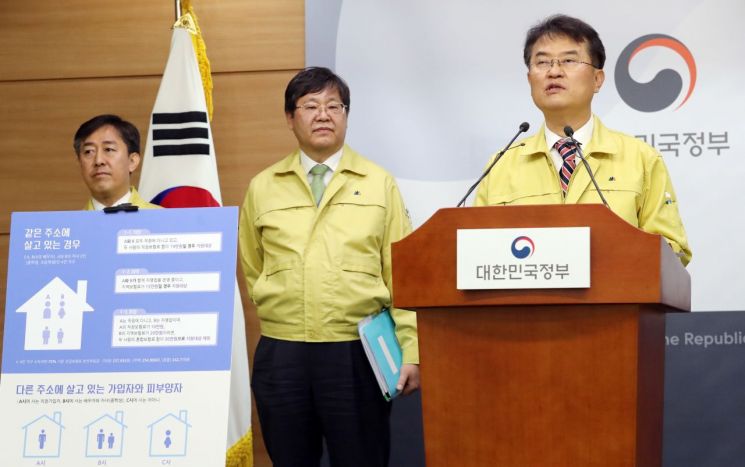
 Yoon Jong-in, Vice Minister of the Ministry of the Interior and Safety, is announcing the results of the joint task force (TF) of related ministries regarding the criteria for emergency disaster relief fund payments due to the COVID-19 situation on the morning of the 3rd at the Government Sejong Complex in Sejong City.
 [Photo by Yonhap News]
[Sejong=Asia Economy Reporter Joo Sang-don] Although the government announced on the 3rd that it would select the recipients of the emergency disaster relief fund as the "bottom 70% income group" based on health insurance premium payments and stated a policy to exclude "high-asset individuals," it has yet to announce the criteria even after a week. Meanwhile, calls to provide the disaster relief fund to "all citizens nationwide" have grown stronger, but the Ministry of Economy and Finance reaffirmed that there is "no change in the selective payment policy."
On the 10th, a member of the "Emergency Disaster Relief Fund Pan-Government Task Force (TF)" said, "The Ministry of Health and Welfare is working on setting criteria to exclude high-asset individuals from receiving the disaster relief fund," adding, "At this point, it is still not possible to specify the criteria or the announcement date."
Earlier on the 3rd, the TF announced that it would select recipients of the disaster relief fund based on the "health insurance premium payments as of March this year." Specifically, it presented a "Emergency Disaster Relief Fund Selection Criteria Table," similar to the "Social Service Project Income Assessment Standard Table," which calculates health insurance premium payments corresponding to each income level. According to this, for workplace subscribers, a household of four members must have a monthly health insurance premium payment of 237,652 KRW or less. For other household sizes, the amounts are: 195,200 KRW for three-person households, 150,025 KRW for two-person households, and 88,344 KRW for single-person households. For regional subscribers, the amounts differ: 254,909 KRW for four-person households, 203,127 KRW for three-person households, 147,928 KRW for two-person households, and 63,778 KRW for single-person households. The emergency disaster relief fund is paid on a household basis, with households defined according to the resident registration records as of the 29th of last month.
If recipients are selected solely based on health insurance premium payments, high-asset individuals could also receive the disaster relief fund. To prevent this, the TF plans to establish exclusion criteria through additional review of related public data. Options under consideration include excluding those subject to comprehensive real estate tax (with official housing prices of 900 million KRW or more, or multiple homeowners with 600 million KRW or more) or those possessing real estate or financial assets worth 500 to 600 million KRW or more, similar to the emergency welfare support system.
After announcing the criteria to identify the bottom 70% income group, the criteria for high-asset individuals have yet to be finalized even after a week, leading to renewed calls, mainly from the ruling party, for "universal payment" rather than "selective payment." On the 6th, Lee Hae-chan, leader of the Democratic Party of Korea, stated, "It is important to properly demonstrate that the state protects all citizens regardless of region or income," and announced plans to change the emergency disaster relief fund recipients to all citizens nationwide. Additionally, Prime Minister Chung Sye-kyun said, "While I believe selective welfare is necessary, given the urgency, universal payment can be made on the condition that high-income earners will later have mechanisms to return the funds," adding, "From the perspective of speed and administrative convenience, 100% universal payment is easier."
In response, the Ministry of Economy and Finance maintains its position that "there is no change in the selective disaster relief fund payment policy." On the 8th, Deputy Prime Minister and Minister of Economy and Finance Hong Nam-ki said, "We are currently working on the supplementary budget, including expenditure restructuring, based on the previously announced criteria," and "We will submit the supplementary budget bill for the emergency disaster relief fund to the National Assembly next week."
Although Deputy Prime Minister Hong drew a line against calls to provide the disaster relief fund to all citizens nationwide again, debates over selective payment and criteria for high-asset individuals are expected to continue for the time being.
There are also criticisms that the government has brought about this controversy itself. A professor of economics at a university said, "The government announced the decision to provide the disaster relief fund and the criteria for recipients at different times, and there is still no standard for what amount of assets qualifies as high-asset individuals," adding, "While it is understandable that it is realistically difficult to finalize and announce all criteria at once, it is true that this has ultimately intensified the controversy."
© The Asia Business Daily(www.asiae.co.kr). All rights reserved.
![User Who Sold Erroneously Deposited Bitcoins to Repay Debt and Fund Entertainment... What Did the Supreme Court Decide in 2021? [Legal Issue Check]](https://cwcontent.asiae.co.kr/asiaresize/183/2026020910431234020_1770601391.png)















