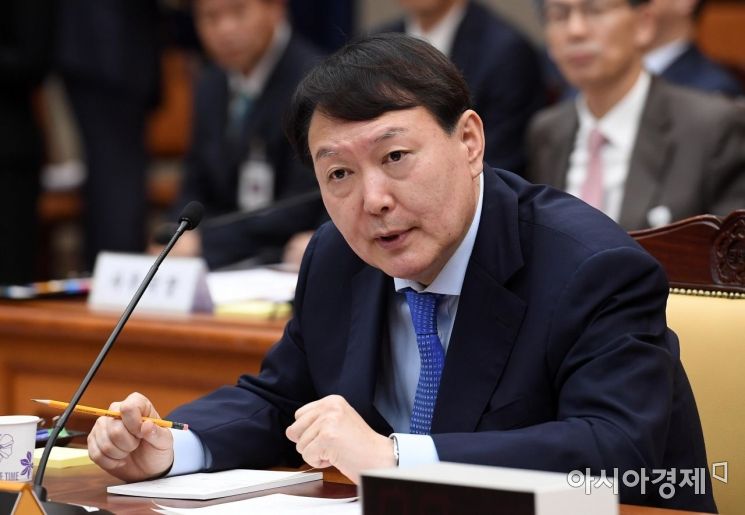
 Prosecutor General Yoon Seok-yeol is responding to questions from lawmakers at the National Assembly's Legislation and Judiciary Committee audit held on the 17th at the Supreme Prosecutors' Office in Seocho-gu, Seoul. Photo by Kim Hyun-min kimhyun81@
[Asia Economy Reporter Kim Hyung-min] Prosecutor General Yoon Seok-yeol has been scaling down meetings with senior prosecutors for 85 days as of today.
According to the prosecution on the 10th, since January 15, Yoon has minimized executive meetings and has been receiving reports from each department. The daily executive meetings held after his inauguration have also been reduced to only Fridays.
While one reason for maintaining this reporting system is to prevent the spread of the novel coronavirus (COVID-19), the legal community also analyzes that, fundamentally, it may be rooted in a distrust of the newly appointed senior officials at the Supreme Prosecutors' Office following the Ministry of Justice's personnel reshuffle in January.
A recent incident between Han Dong-su, head of the Supreme Prosecutors' Office Inspection Department, and Prosecutor General Yoon regarding the investigation into alleged collusion between a sitting chief prosecutor and a Channel A reporter adds weight to this 'distrust theory.'
Within and outside the prosecution, many believe that Yoon likely thought that a fair investigation would not be properly conducted due to Han's background.
Han is a member of the progressive judges' group Uri Beop Yeonguhoe and was close to Lee Yong-gu, the Ministry of Justice's Legal Affairs Director, who was an aide to former Minister of Justice Chu Mi-ae, with whom Yoon had conflicts. Additionally, Han was appointed before former Minister of Justice Cho Kuk resigned.
Because of this background, Yoon may have felt uneasy entrusting Han with the investigation.
Considering various circumstances, it is true that there is a possibility Han would conduct an investigation aligned with the Ministry of Justice's preferences. Even if Han leads the investigation impartially, it seems difficult to avoid questions about the neutrality of the process and results.
Yoon appears to have taken this into account by assigning the fact-finding investigation to the Supreme Prosecutors' Office Human Rights Department. This is interpreted not as a complete exclusion of the inspection but as entrusting it to a department that can conduct a more impartial review.
Yoon also considered that the content of the chief prosecutor using a reporter to pressure the suspect under investigation is a human rights-related matter, and the Human Rights Department has the authority to investigate external parties.
Meanwhile, Yoon is scheduled to return to work next week. It is reported that he took sick leave due to hospital treatment.
Recently, Yoon has faced significant attacks from the prosecution and political circles over allegations of collusion between the prosecution and media, as well as suspicions related to his mother-in-law, Choi. Amid rising crisis and resignation talks, attention is focused on his future actions.
There is also interest in whether he will expedite investigations into major cases postponed until after the general election. In particular, the investigation into the alleged insider trading involving the bio company SillaJen, which has political connections, is drawing attention. On this day, the Financial Investigation Division 1 of the Seoul Southern District Prosecutors' Office announced that it had requested arrest warrants for two related persons, including former CEO Lee Yong-han of SillaJen.
This case is also linked to the allegations of collusion between the prosecution and media. MBC reported that a Channel A reporter, using a friendship with a sitting chief prosecutor, coercively investigated Lee Cheol, the representative of Value Investment Korea (VK), the major shareholder of SillaJen, demanding him to report misconduct by Yoo Si-min, chairman of the Roh Moo-hyun Foundation, sparking controversy.
© The Asia Business Daily(www.asiae.co.kr). All rights reserved.

















