Government: "Does it Have to Be the American Way?"
Plan to Buy Corporate Bonds with Taxes Also Requires Parliamentary Approval
Faster Loans from Securities Firms Secured by Corporate Bonds
Possible Announcement Before Monetary Policy Committee Member Replacement
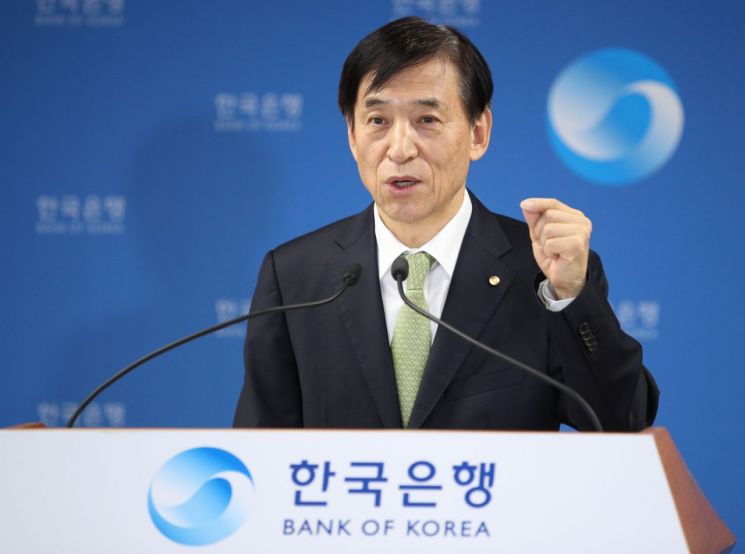
[Asia Economy Reporters Eunbyeol Kim and Sehee Jang] Lee Ju-yeol, Governor of the Bank of Korea, has left the decision on purchasing corporate bonds and commercial papers (CP) through a Special Purpose Vehicle (SPV) to the government. Given the possibility of renewed financial market instability depending on the development of the novel coronavirus disease (COVID-19), he clearly stated that sufficient preparation is necessary. Until now, the Bank of Korea had indicated through reference materials that purchasing corporate bonds and CPs would be possible if done in the same manner as the U.S. Federal Reserve (i.e., with government fiscal support guarantees), but this is the first time Governor Lee has directly expressed his position.
◆Bank of Korea passes the ball to the government…Government asks "Must it be the U.S. method?"= At a press conference following the Monetary Policy Committee meeting on the 9th, Governor Lee said, "Purchasing corporate bonds through an SPV under government guarantee is considered to be quite effective," adding, "There are limits and constraints to special loans to non-financial institutions alone, so it is more effective to cooperate with the government and respond to market stabilization through government credit enhancement."
An SPV is a structure where the government invests capital, and the central bank provides loans to the SPV. If the SPV investment incurs losses, the loss amount is deducted from the government’s capital. In the worst case, if losses exceed the government capital, the central bank could also be affected, but typically the central bank is not impacted.
The government has yet to finalize its stance on this. A government official said, "We somewhat agree with the market demand for corporate bond purchases," but added, "It is questionable whether an institution like in the U.S. needs to be established." Since establishing an SPV requires legal procedures, some view that it might be better for the Bank of Korea to directly purchase corporate bonds and for the government to provide payment guarantees. According to Article 68 of the Bank of Korea Act, the Bank of Korea can trade or lend securities in the open market if the principal and interest repayment is guaranteed by the government.
However, both the Bank of Korea and the government remain uncertain whether the domestic bond market is unstable enough to require 'direct purchases by the central bank.' Regardless of the method, government guarantees are necessary, but it is difficult to judge whether taxpayers’ money should be urgently used to purchase corporate bonds. This issue may be discussed in the National Assembly after the general election, so more time is needed.
◆Bank of Korea accelerates "corporate bond collateral loans to securities firms"...Announcement expected soon= Therefore, the Bank of Korea and the Ministry of Economy and Finance are accelerating efforts to provide loans to securities firms using corporate bonds as collateral. The idea is for the Bank of Korea to take corporate bonds held by securities firms as collateral and provide loans to those firms. This approach indirectly absorbs corporate bonds from the market, so securities firm loans will be implemented first, with the possibility of increasing the scale or considering direct corporate bond purchases depending on the situation.
On the 8th, the day before the Monetary Policy Committee meeting, the Bank of Korea requested the Ministry of Economy and Finance to review the scale and form of loans to securities firms. Even after the Monetary Policy Committee meeting, working-level officials discussed detailed matters regarding securities firm loans. Since the terms of four out of seven Monetary Policy Committee members expire on the 20th, it is likely that the securities firm loan plan will be finalized before then. According to Article 80 of the Bank of Korea Act, collateral loans to non-bank financial institutions require the Monetary Policy Committee’s resolution. Monetary Policy Committee members are full-time, so an extraordinary committee meeting can be convened at any time to pass resolutions. It is actually easier to hold such extraordinary meetings for these matters than for monetary policy decisions. A government official said, "The specific timing and scale of the announcement are still under discussion."
Securities firms expect that loans from the Bank of Korea will help secure liquidity. Kwang-yeol Han, a researcher at NH Investment & Securities, said, "It will reduce the burden on securities firms in raising funds through CP issuance."
© The Asia Business Daily(www.asiae.co.kr). All rights reserved.

















