'Arrogant Landlord' Incheon Airport, Will It Accept Duty-Free Tenant Demands?
Lotte and Shilla Duty-Free Give Up Terminal 1 New Duty-Free Business Rights
Incheon Airport's Rent Reduction, Offered Like a Favor, Is Essentially a Short-Sighted Measure
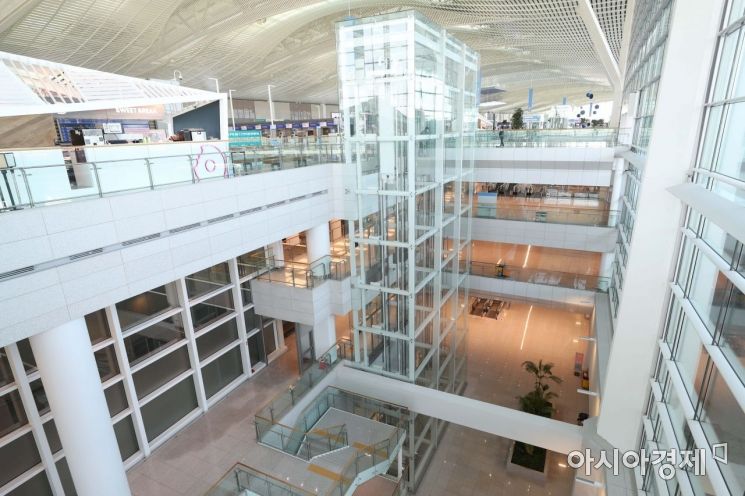 Terminal 2 of Incheon International Airport is quiet on the 8th. On this day, Prime Minister Chung Sye-kyun announced at the Central Disaster and Safety Countermeasures Headquarters (CDSCHQ) meeting held at the Government Sejong Complex regarding the response to the novel coronavirus infection (COVID-19), "We will temporarily suspend visa exemptions and visa-free entry for countries that have banned the entry of our citizens, and expand restrictions on the entry of foreigners for non-essential purposes." / Photo by Moon Ho-nam munonam@
[Asia Economy Reporter Lim Hye-seon] The "proud landlord" Incheon International Airport is drawing industry attention as to whether it will accept the duty-free shops' demand to "change the rent calculation method." Lotte and Shilla Duty Free, the world's second and third largest duty-free operators, have taken the drastic step of giving up the new duty-free business rights at Incheon Airport Terminal 1. This time, the duty-free shops have shown a determination of "never backing down," signaling a willingness to fight to the end.
According to the duty-free industry on the 11th, Incheon Airport has entered a period of deliberation over the new duty-free shop bidding at Terminal 1, which has returned to square one after Lotte and Shilla Duty Free gave up their business rights. Incheon Airport must reselect operators for four zones?perfume & cosmetics (DF2), liquor & tobacco (DF3), liquor & tobacco (DF4), and fashion & others (DF6)?excluding the fashion & others (DF7) business right taken by Hyundai Department Store Duty Free. They are considering whether to offer the opportunity to the next-ranked bidders or to hold a complete re-bid for all zones that were relinquished. The duty-free industry believes that re-bidding will be difficult under Incheon Airport's current rent calculation method.
Duty-free shops have repeatedly requested changing the rent calculation method from a minimum guaranteed amount to a sales-based operating rate. This is because paying rent based on the bid amount (minimum guaranteed amount) can become a burden when business performance deteriorates. However, Incheon Airport has consistently rejected these requests. The rent for duty-free shops at Incheon Airport is adjusted in line with passenger fluctuation rates. The first-year rent is paid as the minimum guaranteed amount, and from the second year of operation, the rent is adjusted by 50% of the previous year's passenger fluctuation rate. The maximum adjustment limit is ±9% of the previous year's rent. If the amount calculated by multiplying the sales of each product category by the operating rate exceeds the minimum guaranteed amount, the difference must also be paid.
The background to the duty-free shops' outburst includes the rent reduction benefits that Incheon Airport generously offered. Incheon Airport notified the duty-free shops that rent would be reduced by 20% from March to August. This is because duty-free shops have also been hit hard as passenger numbers dropped by more than 90% due to the COVID-19 pandemic. The number of departing passengers at Incheon Airport fell from an average of 100,000 per day last year to about 1,000 in April this year. Accordingly, Incheon Airport Duty Free's sales in April decreased by 98% compared to last year. Currently, duty-free operators are running monthly deficits exceeding 100 billion won, making operations virtually impossible. Although the 20% rent reduction is grossly insufficient for business sustainability, they accepted it anxiously, fearing even that might disappear.
The problem lies in Incheon Airport's caveat. Incheon Airport attached a condition that the duty-free shops must forgo the rent reduction benefits for the first six months of the contract year. Due to the decrease in international passengers this year, duty-free shops could have received up to a 9% rent reduction next year. However, Incheon Airport eliminated this as well. According to the commercial facility rent reduction deferment application submitted to Incheon Airport, duty-free shops whose minimum guaranteed amount changes from August next year must pay the previous year's rent for the initial six months (August 2021 to January 2022). This means if they paid 30 billion won in rent during the same period last year, the same amount applies next year. In effect, the rent reduction deferment application was a waiver of next year's rent discount.
An industry insider said, "With Incheon Airport duty-free sales virtually at zero, what is needed is a special win-win measure rather than superficial or deceptive measures," adding, "Now is the time to protect the world's number one duty-free industry." They also argued, "Like Korea Airports Corporation, Incheon Airport should calculate rent based on sales." Korea Airports Corporation, which operates regional international airports, exempts basic rent and calculates sales-linked rent reflecting monthly sales fluctuations during the operation period. If sales are zero, rent is zero.
The industry agrees that excessive rent could lead to the closure of airport duty-free shops, inevitably resulting in job losses for workers. A representative case is the Hanwha Duty Free at Jeju Airport, which closed in 2017. About 170 Hanwha Galleria employees working at the airport were forced out. The industry has already experienced large-scale layoffs due to the return of the Shinsegae Gimhae Airport Duty Free license in 2015 and the loss of licenses by SK and Lotte Duty Free. The impact of employment insecurity is even greater at Incheon Airport duty-free shops.
From Incheon Airport's perspective, lowering rent is not easy. Last year, 65% of Incheon Airport Corporation's total revenue came from rental income, of which 91% was paid by large corporations. With Incheon Airport Corporation accelerating the conversion of non-regular workers to regular employees, fixed cost burdens are high, making it practically difficult to forgo rent. Nevertheless, there are criticisms that ignoring duty-free shops on the brink of survival contradicts principles. An industry official pointed out, "It is not right for Incheon Airport to shift risks onto duty-free shops," adding, "Incheon Airport is the only one in the world charging fixed rent."
© The Asia Business Daily(www.asiae.co.kr). All rights reserved.

















