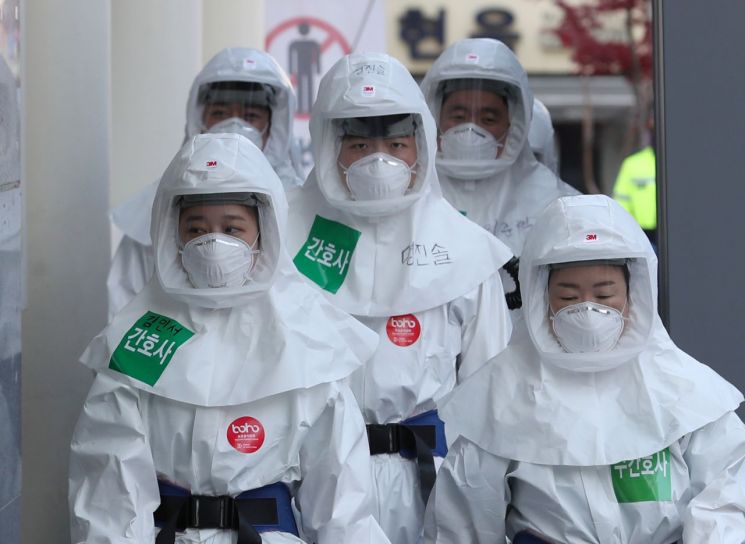
[Asia Economy Reporter Cho Hyun-ui] Regarding the controversy over the delayed payment of work allowances for medical staff who treated COVID-19 patients in Daegu, the Daegu city government explained that "the delay was due to changes in the Ministry of Health and Welfare's guidelines," but the government rebutted, saying this "is contrary to the facts."
On the 9th, Yeo Joon-sung, policy advisor to the Minister of Health and Welfare, posted on Facebook that "there are parts of Daegu city's explanation about the 'non-payment of medical staff allowances' that are inconsistent with the facts." Earlier, Daegu city explained that although they initially planned to pay allowances every two weeks, the Ministry of Health and Welfare's guidelines changed the payment to a monthly basis, and during this process, issues with deductions such as the four major insurances and taxes caused delays in payment.
Advisor Yeo pointed out that Daegu city's explanation is "not true." He said, "The Central Disaster and Safety Countermeasures Headquarters' guidelines do not specify the timing of payments," and added, "If Daegu city has such guidelines, please disclose them."
Advisor Yeo emphasized, "Whether local governments pay weekly, biweekly, or monthly is up to the local government," but stressed, "Usually, when a labor contract is made, it is natural to pay after the contract ends." He added, "The Central Disaster and Safety Countermeasures Headquarters' guidelines state that military personnel, public health doctors, and those dispatched to public institutions are paid every two weeks, and private recruits must work for at least one month, with allowances paid according to the number of days worked."
He disclosed the payment details of personnel dispatched by the central government to Daegu and stated, "The government has already provided the funds so that Daegu city can make payments as soon as possible." According to the details, the city has already received about 20 billion KRW in budget from the central government for medical staff allowances.
Regarding personnel dispatched to screening clinics, 4 billion KRW was paid on the 3rd of last month, and personnel dispatched to residential treatment centers received their wages included in the 18.8 billion KRW center operating expenses paid on the 18th of last month. On the 20th of last month, 8.2 billion KRW was provided for two months' wages for 450 medical staff dispatched to medical institutions, totaling 31 billion KRW in related budget support.
Meanwhile, starting from the afternoon of the 9th, Daegu city has been sequentially paying allowances beginning with medical staff who worked at four residential treatment centers that ended operations last month. According to Daegu city, a total of about 2,100 medical volunteers came to Daegu, of whom only about 900 working at screening clinics and public health centers received allowances, while the remaining approximately 1,200 did not.
© The Asia Business Daily(www.asiae.co.kr). All rights reserved.

















