100 Days Since the Outbreak of COVID-19
Global cumulative confirmed cases exceed 1.51 million... Faster than Novel Flu and Hong Kong Flu
New domestic cases drop below 40... Italy and Spain also show decline
China, France, and the UK see increases
 Terminal 2 of Incheon International Airport is quiet on the 8th. On this day, Prime Minister Chung Sye-kyun announced at the Central Disaster and Safety Countermeasure Headquarters (CDSCHQ) meeting held at the Government Sejong Complex regarding the response to the novel coronavirus infection (COVID-19), "We will temporarily suspend visa exemptions and visa-free entry for countries that have banned the entry of our citizens, and expand restrictions on the entry of foreigners for non-essential purposes." / Photo by Moon Ho-nam munonam@
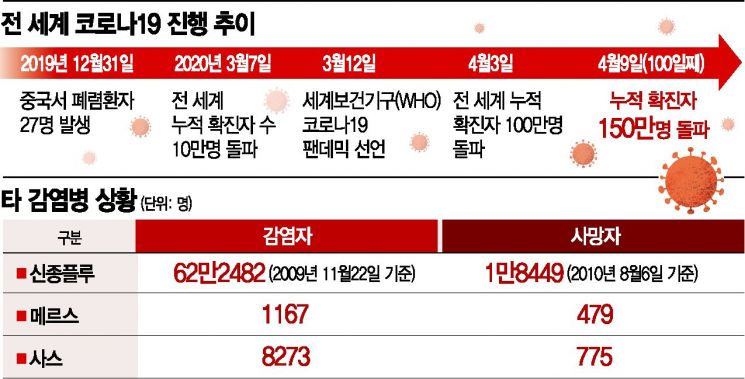
[Asia Economy Reporters Choi Dae-yeol and Kim Heung-soon] On the 9th, it marked 100 days since the outbreak of the novel coronavirus infection (COVID-19). This is based on December 31 of last year, when 27 pneumonia patients of unknown cause were reported in Wuhan, Hubei Province, China. On this day, the global cumulative confirmed COVID-19 cases surpassed 1.5 million. This is an increase of 500,000 cases in just six days after surpassing 1 million on the 3rd. The death toll also reached about 88,000, showing a faster spread compared to other infectious diseases such as the Hong Kong Flu (1968) and the Novel Influenza A/H1N1 2009 (2009), which the World Health Organization (WHO) previously declared as pandemics, similar to COVID-19.
New confirmed cases increase by 80,000 daily
100,000 cases after two months, over 500,000 in less than three weeks thereafter
According to data compiled by Johns Hopkins University in the United States, as of 10 a.m. on this day, the cumulative confirmed COVID-19 cases in 181 countries worldwide reached 1,513,358. The international statistics site 'Worldometer' reported a cumulative case count of 1,513,304.
The global cumulative confirmed cases exceeded 100,000 on the 7th of last month, 67 days after the first patient was reported, and rapidly increased after WHO declared a pandemic for the third time in history five days later. After surpassing 500,000 on the 27th of last month, approximately 80,000 new cases were added daily, increasing by another 1 million in 13 days.
The United States has the highest number of confirmed cases at 430,376. Spain (148,220), Italy (139,422), France (113,965), and Germany (113,296) also have cumulative cases exceeding 100,000. The global death toll is 88,415, with 17,669 deaths in Italy, 14,792 in Spain, 14,739 in the United States, and 10,869 in France due to COVID-19.
In South Korea, as of midnight on this day, 39 new cases were added compared to the previous day, bringing the cumulative confirmed cases to 10,423. The death toll increased by 4 from the previous day to 204. Domestically, the number of new cases has been around 50 for the past three days since the 6th, and dropped below 40 on this day, indicating a slight calming of the COVID-19 spread.
According to data analyzed by Johns Hopkins University on the daily change in new confirmed cases over four days from the 3rd, the United States also saw new cases drop below 30,000 after initially being at 33,300. Italy, Spain, Iran, the Netherlands, and Germany also showed a decreasing trend in new cases. However, some European countries such as France and the UK are seeing increases in new cases, and China, the origin of COVID-19, is also showing a resurgence due to an increase in imported cases.
 On the 8th, vehicles attempting to leave the city passed through the highway terminal tollgate in Wuhan, Hubei Province, China, where the lockdown due to the novel coronavirus disease (COVID-19) was lifted.
 COVID-19 surpasses Novel Flu
High transmission due to many mild and asymptomatic cases
The Novel Flu, which led to WHO's pandemic declaration in 2009, was also considered to have spread faster than other infectious diseases in the past, but compared to the current COVID-19, it was relatively slower. In the case of Novel Flu, it was identified in late April of that year when cases of influenza virus infection different from the usual ones were reported in the United States and Mexico.
About 100 days after the first patient was reported, by late July, the number of cases was around 162,380. More than half of the global cases occurred in the Americas, including the United States, Canada, and Mexico, while about 26,000 cases each were reported in the Western Pacific and Europe, including South Korea. The number of cases was no longer separately counted from late November 2009, but according to academic sources, it is estimated that about 1.63 million people worldwide were infected until the epidemic was declared over in August of the following year.
The influenza (Hong Kong Flu) that started in Hong Kong in 1968 infected more than 500,000 people in Hong Kong alone and spread worldwide, causing over 1 million deaths. Although the exact number of infected people was not counted, considering the fatality rate was less than 1%, it is estimated that over 100 million people were infected. Experts believe that the rapid spread of infectious diseases is due to increased human interaction and travel compared to the past, combined with the clinical characteristics of COVID-19, which can be transmitted even when symptoms are mild or absent. This means that even if infected, people realize it late and easily cause secondary and tertiary infections.
Professor Ki Moran of the National Cancer Center explained, "The reproduction number, which shows the transmissibility of infectious diseases, is estimated to be about 4 in Hubei, China, and about 3.5 in Daegu, South Korea, where the Shincheonji Church incident occurred. Considering that the reproduction number for influenza is usually around 2, this is a considerably high level."
© The Asia Business Daily(www.asiae.co.kr). All rights reserved.



















