"Bad Mood Due to Recession" Poster Torn
"Election Campaign Noisy" Fists Swing
Increase in Anger-Driven Election Crimes
'Impulsive Acts, Blaming Politics' Also Strictly Punished
Police Refer 37 out of 939 Election Offenders
False Information Distribution Most Common Type
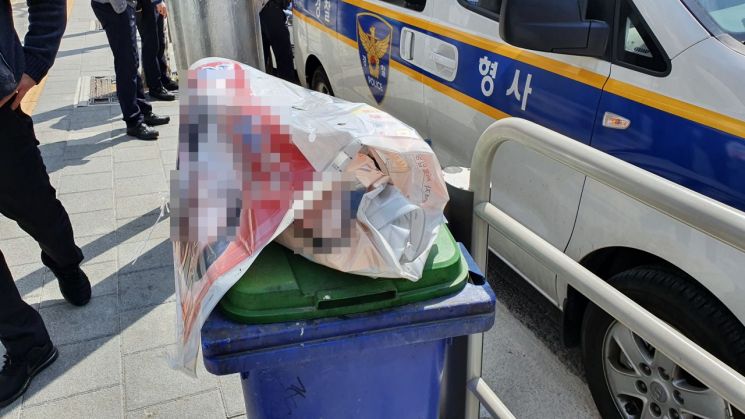 On the afternoon of the 6th, a damaged election poster was discarded on a food waste bin on a street in Gwanak-gu, Seoul. The Gwanak Police Station in Seoul announced that they have booked and are investigating Mr. A, a man in his 60s who is unemployed, on charges of violating the Public Official Election Act (obstruction of posters, etc.) for intentionally damaging election posters.
 [Image source=Yonhap News]
[Asia Economy Reporter Jeong Dong-hoon] How are the spread of the novel coronavirus infection (COVID-19), the economic recession, and the upcoming election affecting public sentiment? Whether it will be a judgment against the ruling party or a show of support will be revealed by the election results, but election crimes occurring in the field of public life may reflect a fragment of the increasingly tense public mood.
According to the National Police Agency, as of the morning of the 9th, 939 election-related offenders were caught by the police, of whom 37 were sent for prosecution. By the five major types of election crimes, the numbers are as follows: ▲False election (fake news, spreading false information, etc.) 255 ▲Bribery election (providing money or entertainment) 96 ▲Election violence (assault on candidates or election officials, damage to posters and wall notices, etc.) 59 ▲Public officials involved in elections 13 ▲Illegal organization mobilization (mobilizing private organizations outside election campaigns) 2.
The economic downturn caused by COVID-19 and dissatisfaction with the lack of political roles are leading to election crimes such as damage to wall notices. Around 9 p.m. on the 2nd, Mr. A (in his 40s) was caught damaging a wall notice with a knife on a sidewalk in Goejeong-dong, Saha-gu, Busan. He said, "I did it because I was upset about the recession." There were also incidents involving direct violence. Around 5 p.m. the previous day, Mr. B (in his 40s) was booked without detention for punching an election campaign worker of a candidate at the entrance of Gupo Market in Buk-gu. Mr. B reportedly got angry because "the election campaign was noisy." Earlier this month, near Hongdaeipgu Station on the Seoul subway, an unidentified man threw stones at a party member helping a candidate's election campaign. The police, after receiving the report, are tracking the man who threw the stones based on CCTV footage near the scene.
Professor Song Jae-ryong of the Department of Sociology at Kyung Hee University said, "In this election held amid accumulated social dissatisfaction due to the COVID-19 situation, 'anger crimes' may particularly increase," adding, "It is a psychology that looks for excuses in politics and COVID-19 to justify one's actions after committing a crime."
Even if anger is blamed on politics, punishment will not be lightened. The judicial authorities maintain a strict stance on violations of the Public Official Election Act. Election-related crimes such as damaging wall notices are punishable by imprisonment of up to two years or a fine of up to 4 million won. Assaulting or threatening election campaign workers can result in imprisonment of up to 10 years or a fine ranging from 5 million to 30 million won. In fact, during the June 13, 2018 local elections, an 80-year-old man who jumped onto a campaign vehicle and verbally abused was sentenced to four months in prison even on appeal.
With the nationwide increase in CCTV installation rates, the arrest rate of violent election offenders (including those who damage wall notices) has also increased proportionally. During the 19th presidential election, violent election offenders numbered 273 (31.1% of the total), a significant increase compared to 107 (14.5%) in the 18th election, which is analyzed to be related to the spread of CCTV.
© The Asia Business Daily(www.asiae.co.kr). All rights reserved.

















