Trump "Phased Lifting Once Decline Begins... Expect Economic Activity Resumption"
Xi Jinping "Concerns Over Imported Cases and Re-emergence Pressure"... Emphasizes Quarantine Amid Rising Asymptomatic Infections
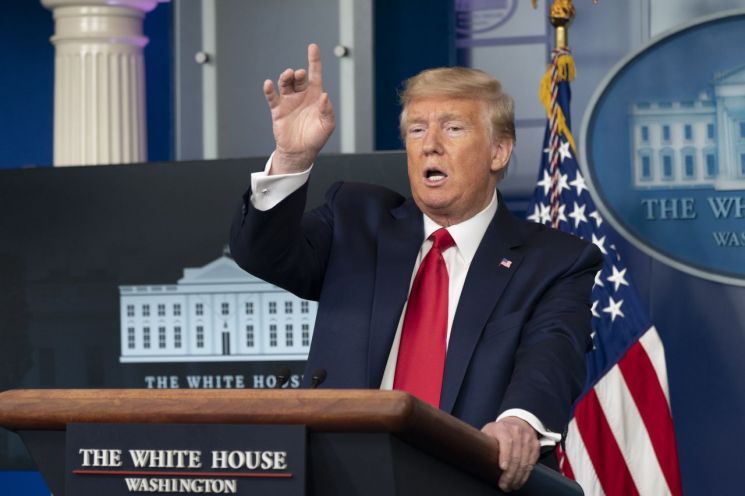 On the 8th (local time), U.S. President Donald Trump is giving a speech at the Coronavirus Task Force briefing. President Trump stated that he expects the coronavirus to slow down faster than anticipated. [Image source=EPA Yonhap News]
[Asia Economy reporters Cho Young-shin and Lee Hyun-woo] U.S. health authorities have hinted at easing social distancing measures, expecting the peak of the epidemic to be near. In contrast, China, another G2 country, appears to be tightening its epidemic prevention controls. The international medical community warns that the number of confirmed COVID-19 cases reported by countries statistically does not include asymptomatic or mild cases, which would make the actual number much higher, and emphasizes the need to maintain social distancing measures, lending weight to China's approach.
According to foreign media including CNN on the 8th (local time), U.S. President Donald Trump said at the COVID-19 task force briefing that day, "We expect the slowdown in the spread of COVID-19 to occur faster than expected," and "As the outbreak declines, we can gradually lift lockdown measures and resume economic activities." Debbie Birx, White House COVID-19 response coordinator, also said in an interview with Fox News that "We are reviewing whether social distancing guidelines can be eased from the end of this month."
Especially, the fact that Dr. Anthony Fauci, director of the U.S. National Institute of Allergy and Infectious Diseases (NIAID), who had previously clashed with President Trump, mentioned a turning point gives strength to the U.S. policy of easing social distancing. Dr. Fauci said at the briefing that "COVID-19 will begin to show a turnaround after this week," and "While previous models estimated deaths between 100,000 and 200,000, the actual number is expected to be much lower."
The number of confirmed COVID-19 cases in the U.S. reached 424,945 as of that day. However, as the daily increase in confirmed cases decreases, health authorities are cautiously optimistic that the COVID-19 situation will soon reach its peak. Johns Hopkins University, which operates a COVID-19 statistics site, calculated the arithmetic average of new cases over the past five days and reported that the increase in cases has been declining since April 3.
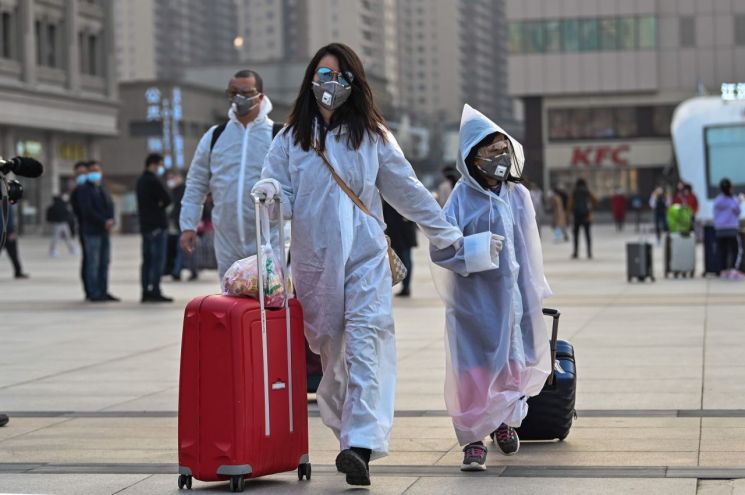 As train operations resumed with the lifting of the lockdown in Wuhan, Hubei Province, China on the 8th, residents of Wuhan headed to the train station. [Image source=Yonhap News]
Unlike the U.S., China is emphasizing epidemic prevention even after lifting the lockdown in Wuhan, Hubei Province. According to the People's Daily, Chinese President Xi Jinping said at the Communist Party Politburo Standing Committee meeting that day, "Although progress has been made in COVID-19 prevention efforts and production resumption, there is still pressure from overseas imports and resurgence," and emphasized, "Epidemic prevention work must never be relaxed."
Particularly, there is heightened vigilance over concerns of a secondary spread due to an increase in asymptomatic infections. According to the Hong Kong South China Morning Post (SCMP), among the COVID-19 confirmed cases in China from March 31 to April 7, 68% were asymptomatic infections. The Chinese State Council issued new guidelines for managing asymptomatic confirmed cases. The guidelines require reporting within two hours upon detection of a confirmed case, local management officials must complete testing within 24 hours, and establish communication systems. The National Health Commission of China has also been separately counting and publicly disclosing asymptomatic confirmed cases since April 1.
SCMP introduced research results from the University of G?ttingen in Germany, which analyzed COVID-19 mortality estimates, confirmed case numbers from 40 countries worldwide, and UN population data, reporting that the average detection rate of asymptomatic COVID-19 infections in these 40 countries is only 6%.
© The Asia Business Daily(www.asiae.co.kr). All rights reserved.


















