[Asia Economy Reporter Chunhee Lee] Within this year, the speed limit on general roads in major cities nationwide will be lowered to 50 km/h. Vehicles will also be required to come to a complete stop when crossing pedestrian crossings and making right turns.
The government discussed and finalized these measures in the '2020 Traffic Accident Fatality Reduction Plan' at the National Policy Issue Inspection and Coordination Meeting chaired by the Prime Minister on the 9th.
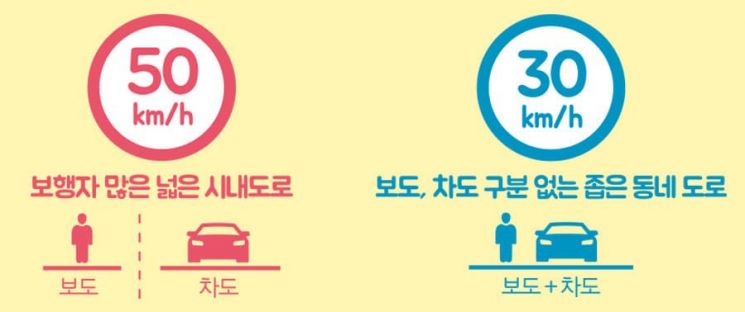
The Ministry of Land, Infrastructure and Transport, which prepared the plan, decided to implement the urban speed limit reduction policy 'Safe Speed 5030' earlier than the originally scheduled April next year. Safe Speed 5030 is a policy that lowers the speed limit on general urban roads from 60 km/h to 50 km/h and reduces the speed limit on residential side streets without sidewalks to 30 km/h. The government plans to implement this system in special and metropolitan cities during the third quarter and in major cities nationwide within the year.
In Yeongdo-gu, Busan, where Safe Speed 5030 was piloted, pedestrian fatal accidents decreased by 37.5% compared to before the implementation. Through this plan, the government aims to reduce traffic accident fatalities to the 2,000 range by 2022. This means reducing the number of fatalities, which was 3,349 last year, by more than 14%.
The duty of care for drivers at pedestrian crossings, where pedestrian accidents frequently occur, will also be strengthened. Drivers must come to a complete stop not only when pedestrians are 'crossing' at signal-free pedestrian crossings but also when they are 'about to cross.' Additionally, it will be legally mandatory to stop briefly and then proceed slowly when making a right turn.
Furthermore, the government has allocated a budget of approximately 1.4 billion KRW this year to directly support incentives such as transportation cards, which were previously funded by local governments, for elderly drivers who voluntarily surrender their driver's licenses. For taxi drivers aged 65 and older, qualification maintenance inspections will be conducted every three years (annually for those aged 70 and above). The issuance of limited licenses, which are granted only to elderly drivers whose driving abilities have been confirmed, is also under consideration.
© The Asia Business Daily(www.asiae.co.kr). All rights reserved.

















